Mystery History - Answer KeyBuilt by Gravity. Delivered by Determination.July 2026
|
These two photographs capture a remarkable chapter in construction of one of the most consequential infrastructure projects in Los Angeles history.
|
 |
|
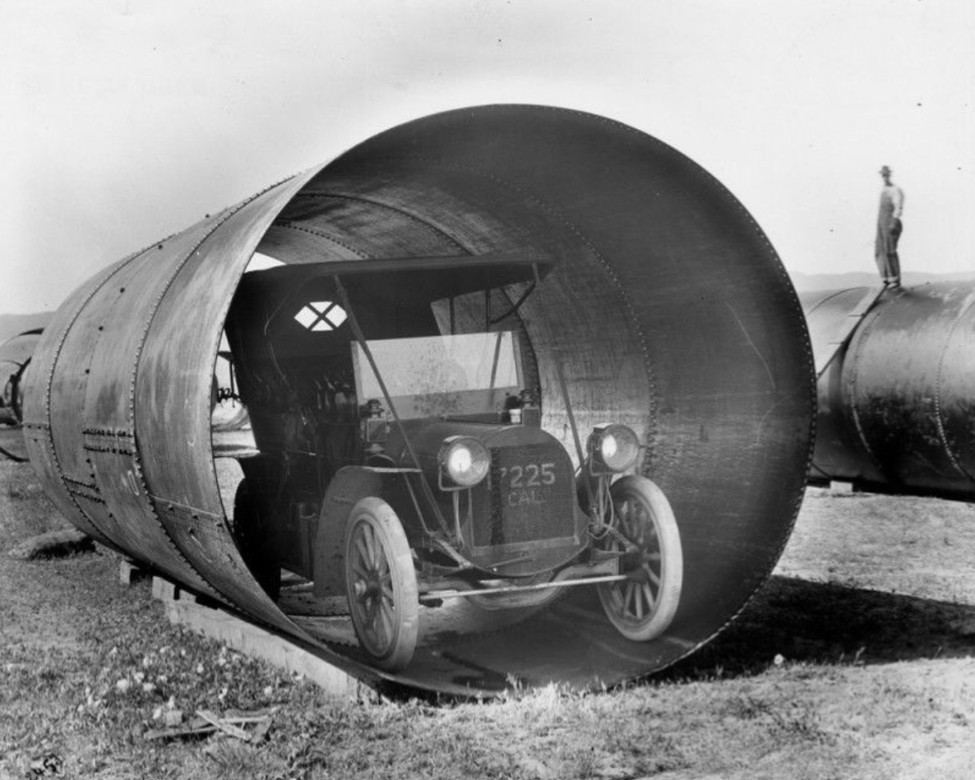
| Image 1 – Automobile inside steel siphon pipe |
 |
|
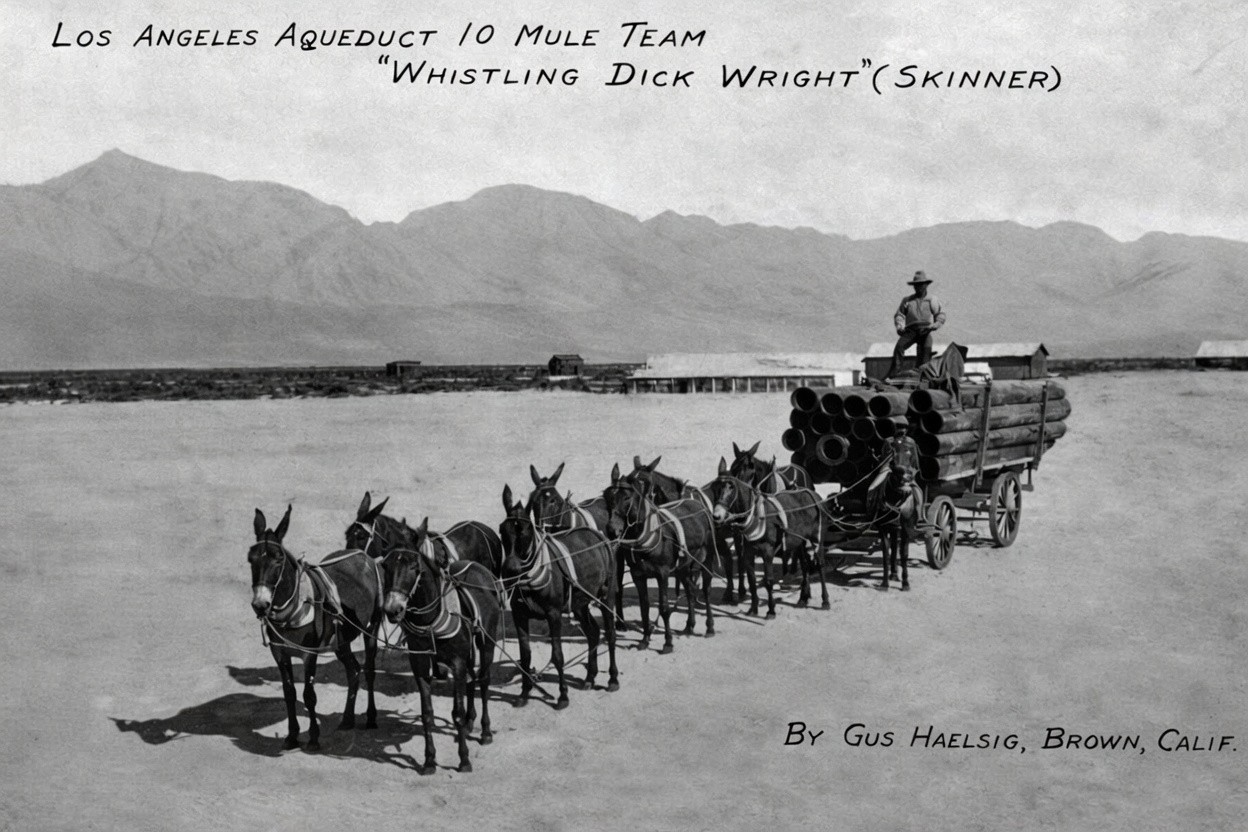
| Image 2 – Whistling Dick Wright and mule team |
Water & Power Associates · July 2026
Mystery History — Answer Key
Built by Gravity. Delivered by Determination.
Thank you for participating in this quarter's Mystery History challenge. Here are the questions and answers.
Question 1
The automobile in the first photograph was likely included to:
C — Correct
Show the enormous scale of the steel siphon pipe
Historical note
The automobile was placed inside the pipe to demonstrate its extraordinary size. Some siphon pipes measured up to 10 feet in diameter and photographs like this helped the public appreciate the scale of aqueduct construction.
Question 2
The giant steel pipe sections were required primarily to:
B — Correct
Carry water across deep valleys under pressure
Historical note
The aqueduct's 23 steel siphons allowed water to descend into canyons and rise again using hydraulic pressure alone. No pumps were required along the 233-mile route.
Question 3
Why did construction crews rely on unusually large mule teams for portions of aqueduct construction?
B — Correct
Rail transport ended short of the siphon crossing and no suitable road existed
Historical note
Although tractors were tested elsewhere, the Jawbone crossing required mule teams because pipe sections weighing up to 30 tons had to be hauled where rail lines and roads could not reach.
Question 4
Dick Wright, known as “Whistling Dick,” became notable because he:
B — Correct
Managed one of the aqueduct's most difficult hauling operations
Historical note
Wright supervised a 52-mule team hauling pipe sections across the Mojave Desert to the Jawbone Siphon, one of the most demanding operations on the entire project.
Question 5
Approximately how old was Wright while performing this work?
D — Correct
74
Historical note
Wright was approximately 74 years old during this work. Some historical postcards identify him as 76, likely reflecting a slightly later point during his service.
Question 6
What larger challenge do these photographs illustrate?
B — Correct
Moving massive materials across remote terrain before modern heavy equipment
Historical note
Together these images show both the scale of the materials and the extraordinary effort required to transport them across remote desert terrain.
Question 7
More than a century later, what best describes the role of the Los Angeles Aqueduct in Los Angeles' water system?
B — Correct
It remains a foundational, locally controlled source that typically supplies 30 to 40 percent of Los Angeles' water as part of a diversified portfolio
Historical note
Today the original Los Angeles Aqueduct and the Second Los Angeles Aqueduct continue to provide roughly 30 to 40 percent of Los Angeles' water through gravity conveyance at minimal energy cost.
Bonus Question
Which aspect of the project do you believe represented the greatest engineering challenge and why?
Suggested discussion points
- The Elizabeth Tunnel — five miles through solid granite and completed ahead of schedule.
- The Jawbone Siphon — extreme pressure and thousands of tons of steel.
- The gravity-fed alignment — delivering water 233 miles with no pumps.
- Supporting infrastructure — camps, roads, rail spurs, hydroelectric facilities, and construction support systems.
There was no single correct answer.