The Story of the Los Angeles Aqueduct
 |
|
| (1912)* - View of a man fishing along the Owens river in 1912. |
Historical Notes The Owens River is a river in southeastern California approximately 183 miles long. It drains into and through the Owens Valley, an arid basin between the eastern slope of the Sierra Nevada and the western faces of the Inyo and White Mountains. The river terminates at Owens Lake, but its flow is greatly diminished by diversion into the Los Angeles Aqueduct since 1913.*^ |
 |
|
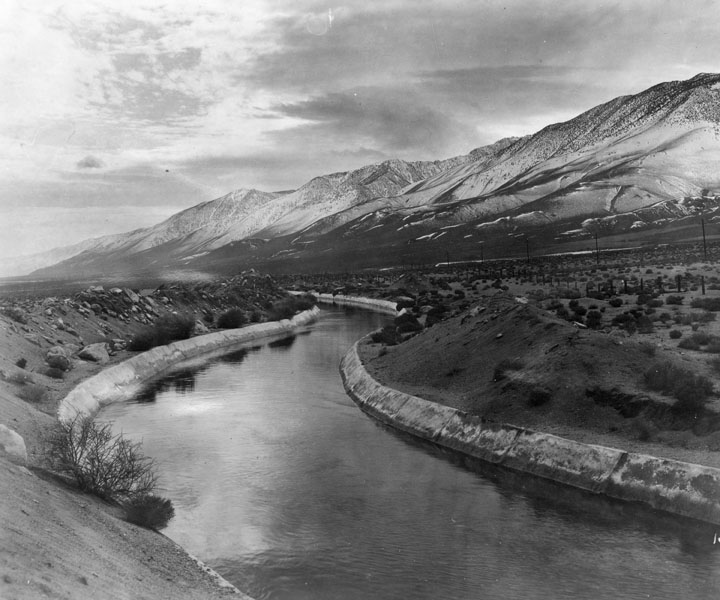
| (1928)* - Panoramic view of the Los Angeles Aqueduct in the Owens Valley near Alabama Hills on November 24, 1928. |
 |
|
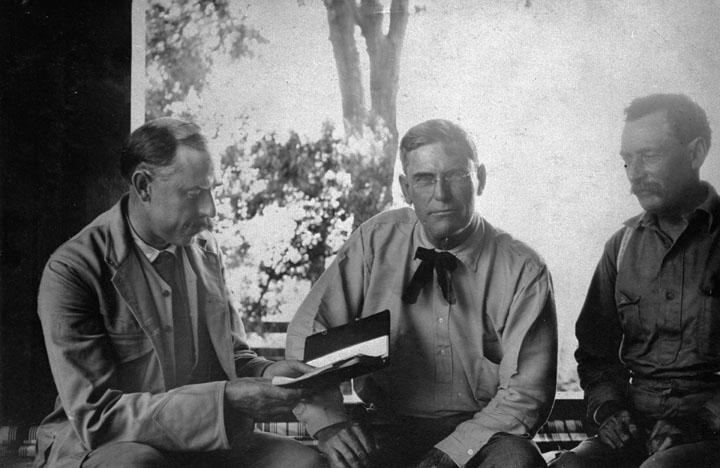
| (1906)* - The three fathers of the LA Aqueduct - left to right: Joseph B. Lippincott, Fred Eaton and William Mulholland. Click HERE to read more on the connection between Fred Eaton and William Mulholland. |
Historical Notes In 1904, Fred Eaton and J. B. Lippincott traveled to Yosemite Valley on a family camping trip. They crossed the Sierra at Tioga Pass and headed south to Bishop for supplies, and eventually back to Los Angeles through the Owens Valley. During that trip Eaton began making plans that would bring water to a growing city and launch a long conflict. Upon his return to Los Angeles, Eaton began to act quickly. Aware that Mulholland was searching for a new source of supply for Los Angeles, Eaton persuaded Mulholland to return to the valley with him. During that trip he convinced Mulholland that the Owens River could provide Los Angeles with a reliable source of water. Eaton visited the Owens Valley again in 1905 and began to purchase land for the City of Los Angeles. He gave the impression that he was working for the US Reclamation Service on a public irrigation project, angering local residents when they discovered he was buying land and water rights for Los Angeles^ |
Click HERE to read more on the The Three Fathers of the Los Angeles Aqueduct. |
 |
|
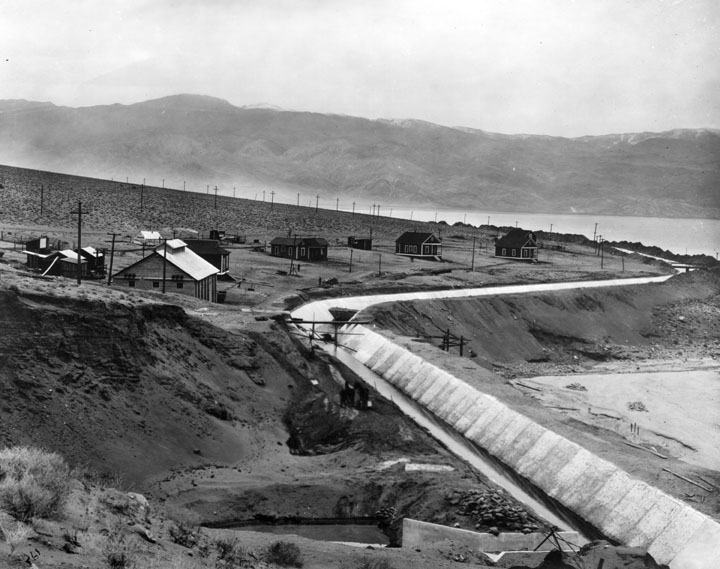
| (ca. 1911)* - Owens Valley during the planning and construction period of the Los Angeles Aqueduct. In this view, the aqueduct skirts around Owens Lake, a "dead sea," with no outlet to the ocean. |
Historical Notes After securing the land and water rights, the Board of Water Commissioners needed to obtain the money from Los Angeles residents, and legal rights from the Federal Government, to construct the aqueduct. A bond measure to pay for the construction passed in Los Angeles by a 10 to 1 margin. After much debate in the House of Representatives, President Theodore Roosevelt decided that Los Angeles should have the rights to the Owens River water.^ |
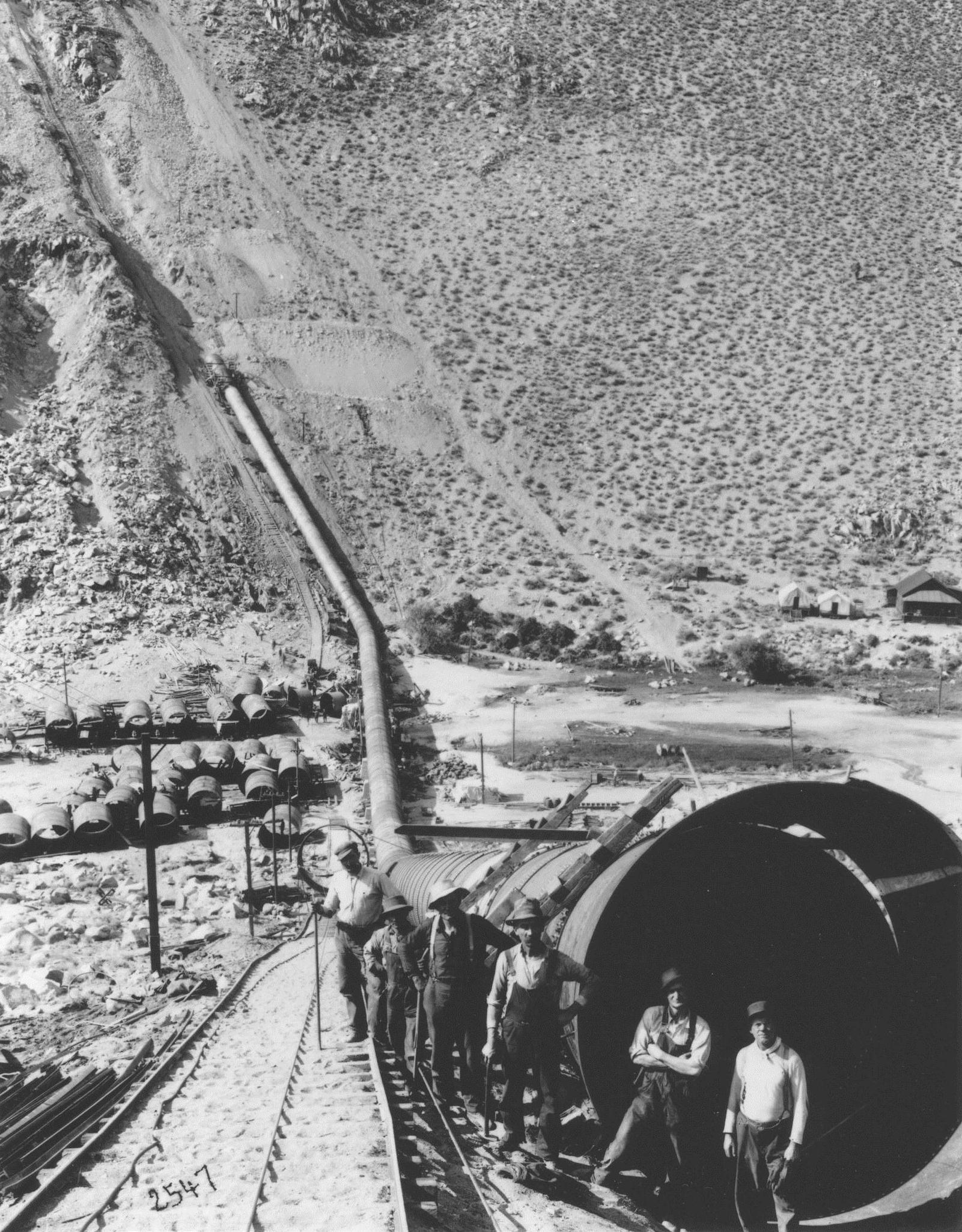 |
| (ca. 1912)* - A view of workmen posing in front of a new section of the aqueduct pipeline. |
Historical Notes Construction on the Los Angeles Aqueduct began in 1908. Workers from all over the world came to work at high-paying jobs that would last until 1913.^ |
 |
|
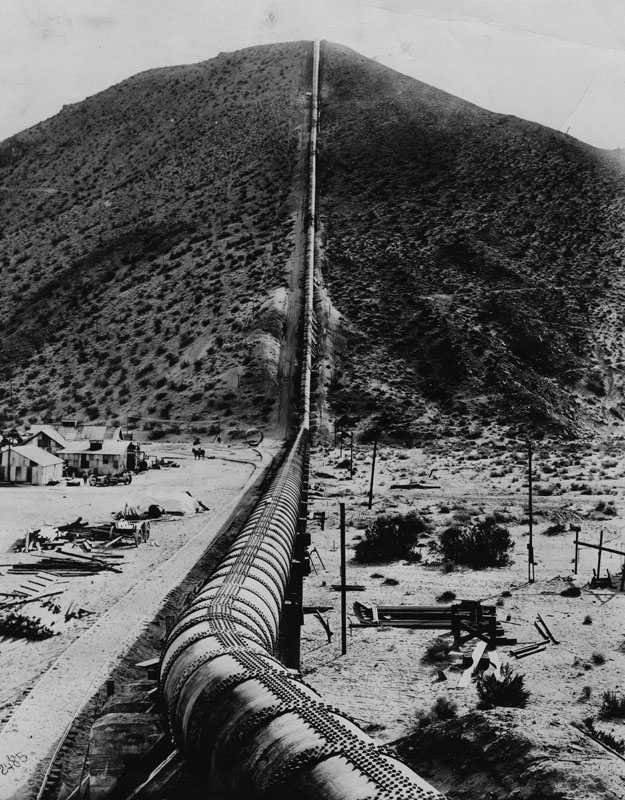
| (ca. 1912)* - Caption reads: The famous Jawbone siphon of the Los Angeles Owens River aqueduct, built by William Mulholland, which crosses two mountain ranges and the Mojave Desert to bring the city its water supply from the snow-capped High Sierras--a 250-mile journey. |
Click HERE to see more on the Construction of the LA Aqueduct. |
 |
|
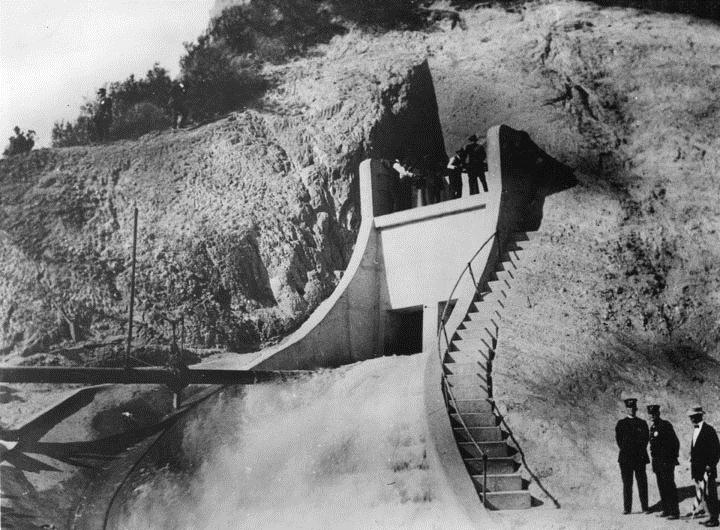
| (November 5, 1913)* - Official Opening of the water gates of the Los Angeles Aqueduct. |
Click HERE to see more on the Opening of the LA Aqueduct. |
 |
|
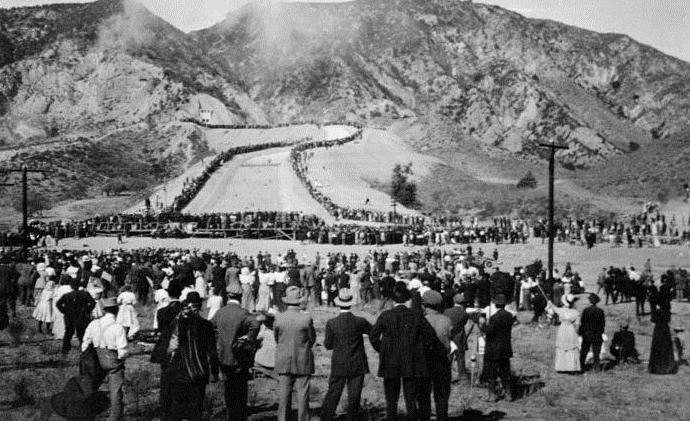
| (November 5, 1913)* - Crowds watch as the water gates are opened and the Los Angeles Aqueduct water starts to flow down into the San Fernando Valley. William Mulholland, builder of the aqueduct and H. A. Van Norman, Chief Engineer and General Manager, Water Bureau. |
Historical Notes Once Los Angeles had a reliable water supply it began to grow dramatically. Some argue that the city would not be what it is today without the LA Aqueduct. Owens Valley residents began to fight the City's water export. Confrontations escalated to several dynamitings of the Aqueduct. To secure its water rights, the City began to purchase extensive tracts of land in the Owens Valley.^ Much has been written about the water conflict between Owens Valley and the City of Los Angeles and also of the environmental impacts resulting from the LA Aqueduct's construction. The Water and Power Associates recommend several books as listed below to gain a better understanding of all the complex issues surrounding the Los Angeles Aqueduct. |
Also,
Click HERE to read an insightful interview with Robert V. Phillips, Chief Engineer and General Manager of LADWP 1972-1975. Both Mr. Phillips and his father knew and worked with Mulholland and Van Norman. |
Recommended reading about William Mulholland and the history of water in Los Angeles:
By Catherine Mulholland
The Water Seekers
By Remi Nadeau
Vision or Villainy
By Abraham Hoffman
Cadillac Desert: The American West and Its Disappearing Water
By Marc Reisner
References and Credits
* DWP - LA Public Library Image Archive
^ DWP - The Story of the Los Angeles Aqueduct
*^Wikipedia: California Water Wars; Owens River
< Back