Baseball in Early Los Angeles
Few places in Los Angeles carry a story as layered as Chavez Ravine. What became Dodger Stadium in 1962 was not simply a construction project, but the result of more than a decade of change — community displacement, political conflict, and one of the most ambitious engineering efforts the city had ever undertaken. The photographs that follow trace that transformation, from the neighborhoods that once covered these hills to the creation of one of baseball's most enduring landmarks.The land had already been transformed once before a single stadium shovel turned. In the early 1950s, the city of Los Angeles acquired most of Chavez Ravine through eminent domain, displacing more than 300 families from the neighborhoods of Palo Verde, La Loma, and Bishop to make way for a federally funded public housing project. When a change in the political climate killed those plans, the cleared land sat largely empty for years. It was not until June 1958, when Los Angeles voters approved a referendum bringing the Brooklyn Dodgers west, that a new purpose emerged for the ravine. The last remaining residents were removed in May 1959. Groundbreaking came four months later.What followed was an engineering achievement on a scale the city had rarely seen. Nineteen earthmovers relocated eight million cubic yards of earth across 300 acres, flattening ridges and filling ravines to create the bowl-shaped foundation that architect Emil Praeger and builder Vinnell Constructors would fill with 21,000 precast concrete units, some weighing as much as 32 tons. From groundbreaking in September 1959 to Opening Day in April 1962, the stadium rose in less than three years — privately financed, built without public construction funds, and opened before 52,564 fans who drove in on terraced lots designed so that fans could walk directly from their cars to their seats. |
THE COMMUNITY THAT CAME BEFORE |
Before the stadium, there were neighborhoods. For generations, Mexican American families had built homes, schools, and churches on the hills of Chavez Ravine. Their story does not begin with baseball. Within a few years, nearly all of it would be gone. |
 |
|
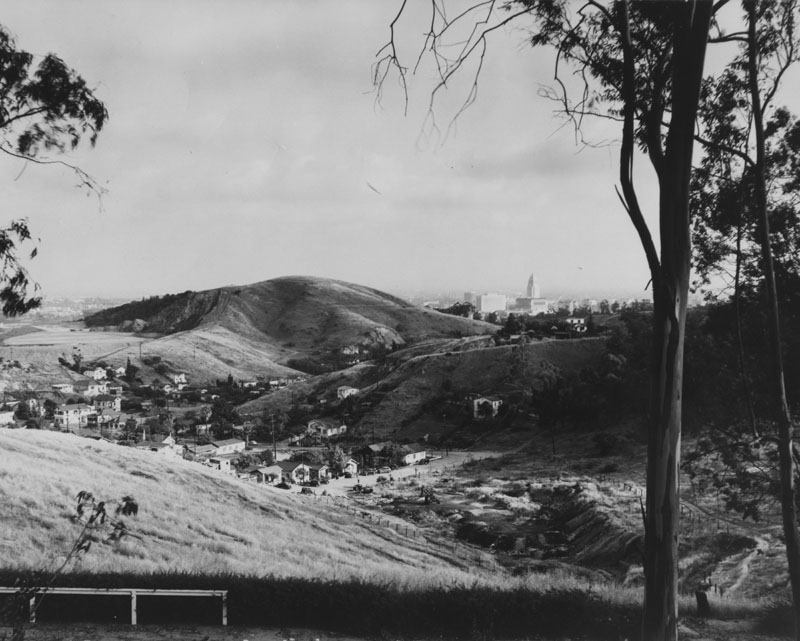
| (ca. 1952)* - Panoramic view of Chavez Ravine and its residential community, with downtown Los Angeles in the distance. The three neighborhoods spread across these hills — Palo Verde, La Loma, and Bishop — were home to more than 300 Mexican American families who had built a close-knit, self-sustaining community within sight of the city that surrounded them. |
Historical Notes Chavez Ravine had been home to Mexican American families since the early 1900s, and by the 1950s the neighborhoods of Palo Verde, La Loma, and Bishop had developed into a self-sufficient community with their own churches, schools, and small businesses. Many residents had come to the ravine specifically because racial housing discrimination in other parts of Los Angeles had closed those neighborhoods to them. Owning land in Chavez Ravine represented something rare and hard-won: a place that was genuinely theirs. In 1950, the Los Angeles Housing Authority began acquiring land in Chavez Ravine under the Federal Housing Act of 1949, which had authorized the construction of 10,000 new low-income housing units across the city. Residents were told they would receive fair compensation and would have priority access to the new housing once it was built. In many cases, the prices offered were well below market value, and those who held out were threatened with still lower offers or seizure by eminent domain. By 1953, most of the land had been acquired and the neighborhood structures demolished, though a small number of families refused to leave. |
 |
|
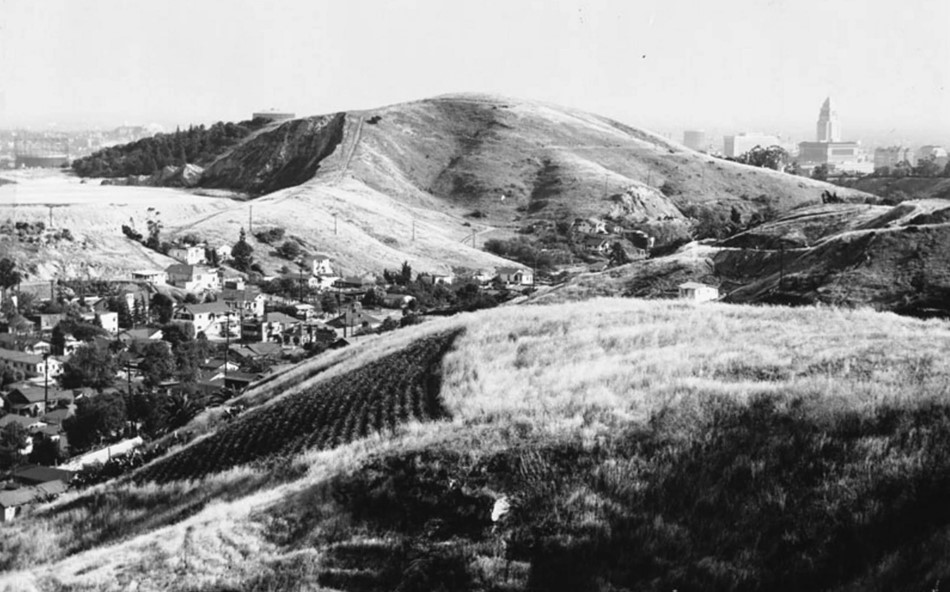
| (ca. 1952)* - A second panoramic view of Chavez Ravine, looking across the hills that would later be reshaped for Dodger Stadium. The rugged terrain of these 300 acres gave Palo Verde, La Loma, and Bishop their character as small, semi-rural communities within a growing city — and would later present an enormous engineering challenge to the stadium's builders. |
Historical Notes The planned housing project for Chavez Ravine, known as Elysian Park Heights, was designed by Austrian-born architect Richard Neutra. His plans called for 24 thirteen-story towers and 163 low-rise townhouses, along with rebuilt schools and playgrounds — among the most ambitious public housing proposals in Los Angeles history. It never advanced beyond plans and cleared land. The political climate shifted sharply when anti-communist sentiment made public housing a target of suspicion, and Mayor Norris Poulson was elected in 1953 on a platform that included stopping the project entirely. The city returned the now nearly empty land to local control with one condition: it must be used for a public purpose. For years the ravine sat idle, its homes and churches gone, while the city searched for a new direction. The answer would eventually arrive from Brooklyn — but not before several more years of legal battles over whether a private baseball stadium satisfied the terms of that agreement. |
 |
|
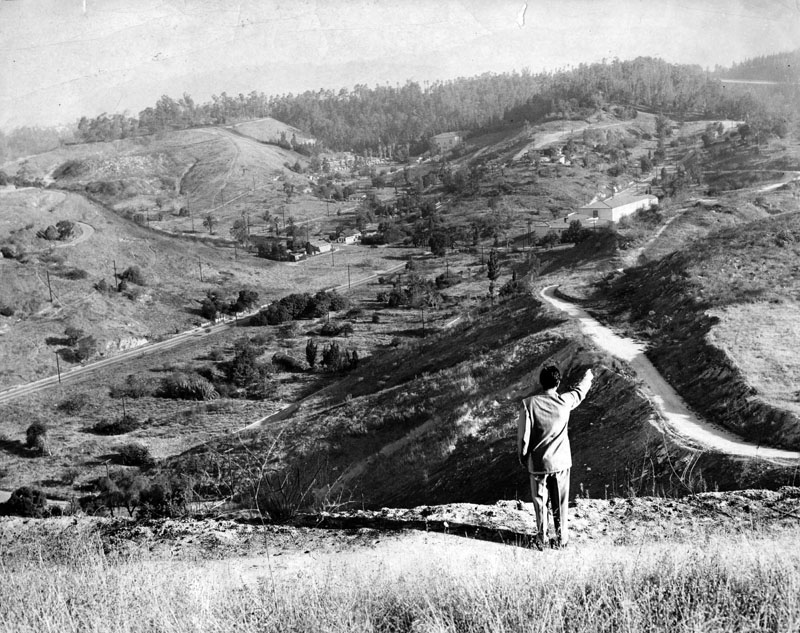
| (1957)* - A man points out the future location of home plate on the Chavez Ravine site, shortly after Walter O'Malley announced on October 7, 1957, that the Dodgers would move to Los Angeles and build a new stadium here. The Los Angeles Police Academy is visible in the background. The hills surrounding this spot would need to be dramatically reshaped before any stadium could rise. |
Historical Notes Walter O'Malley had spent much of the early 1950s trying to replace Brooklyn's aging Ebbets Field, which seated only about 32,000 fans and had parking for fewer than 700 cars. He had hoped to build a new domed stadium in Brooklyn, but years of negotiations with New York City officials came to nothing. Los Angeles offered something Brooklyn could not: a large parcel of already-cleared land, a booming population, and no existing major league competition. O'Malley announced the move in October 1957, the same week the New York Giants announced their move to San Francisco — ensuring that both teams would bring big-league baseball to California together. The deal gave the Dodgers 300 acres of Chavez Ravine in exchange for the deed to the minor league Wrigley Field in Los Angeles, plus a commitment to build a privately financed stadium and improve the surrounding parkland. Voters approved the arrangement in June 1958, and lawsuits followed almost immediately. The courts would not clear the last legal obstacle until late 1959 — just months after the final Chavez Ravine families had been removed. |
THE DODGERS COME WEST |
In 1958, the Brooklyn Dodgers became the Los Angeles Dodgers, and baseball arrived on the West Coast for the first time. While their permanent home was still being planned and fought over, the team made a temporary home in the largest stadium in the country. For Los Angeles, it was the beginning of something new. For Brooklyn, it was the end of something irreplaceable. |
 |
|
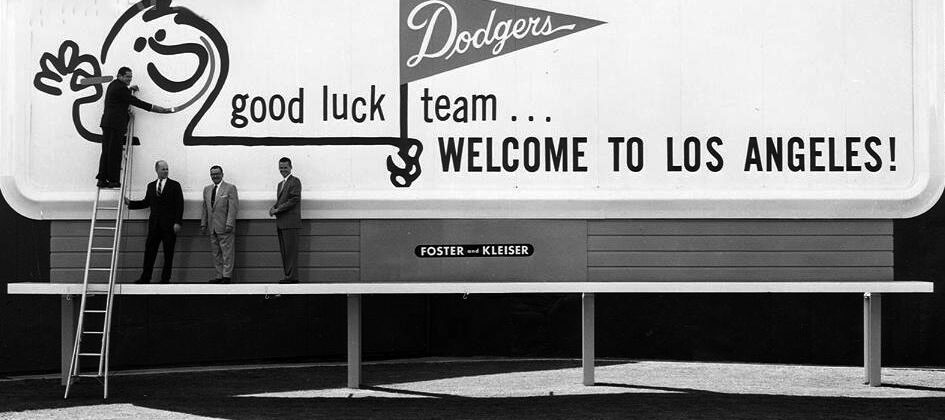
| (1958)* - A new signboard welcomes the Dodgers to Los Angeles, marking the beginning of an era for a city that had no major league baseball team the year before. The Dodgers played their first game in Los Angeles on April 18, 1958, drawing 78,672 fans to the Los Angeles Memorial Coliseum — a crowd that broke the single-game attendance record for professional baseball. |
Historical Notes The Dodgers' arrival in Los Angeles in 1958 was one of the defining events in the city's modern history. Baseball had been present in Southern California for decades in the form of the Pacific Coast League, but the Pacific Coast League's Los Angeles Angels and Hollywood Stars were a different world from the National League champions who had just won the 1955 World Series in Brooklyn. The city embraced the team with enthusiasm that surprised even the Dodgers' front office. In their first season at the Coliseum, the Dodgers drew more than 1.8 million fans. The move was celebrated in Los Angeles and mourned in Brooklyn. Ebbets Field, the Dodgers' home since 1913, was demolished in 1960. In New York, the team's departure — along with the simultaneous departure of the Giants — left the National League without a New York franchise for four years, until the expansion New York Mets began play in 1962. The move permanently shifted the geography of Major League Baseball, establishing that the sport could thrive in car-dependent Western cities that had grown up around the automobile rather than the subway. |
 |
|
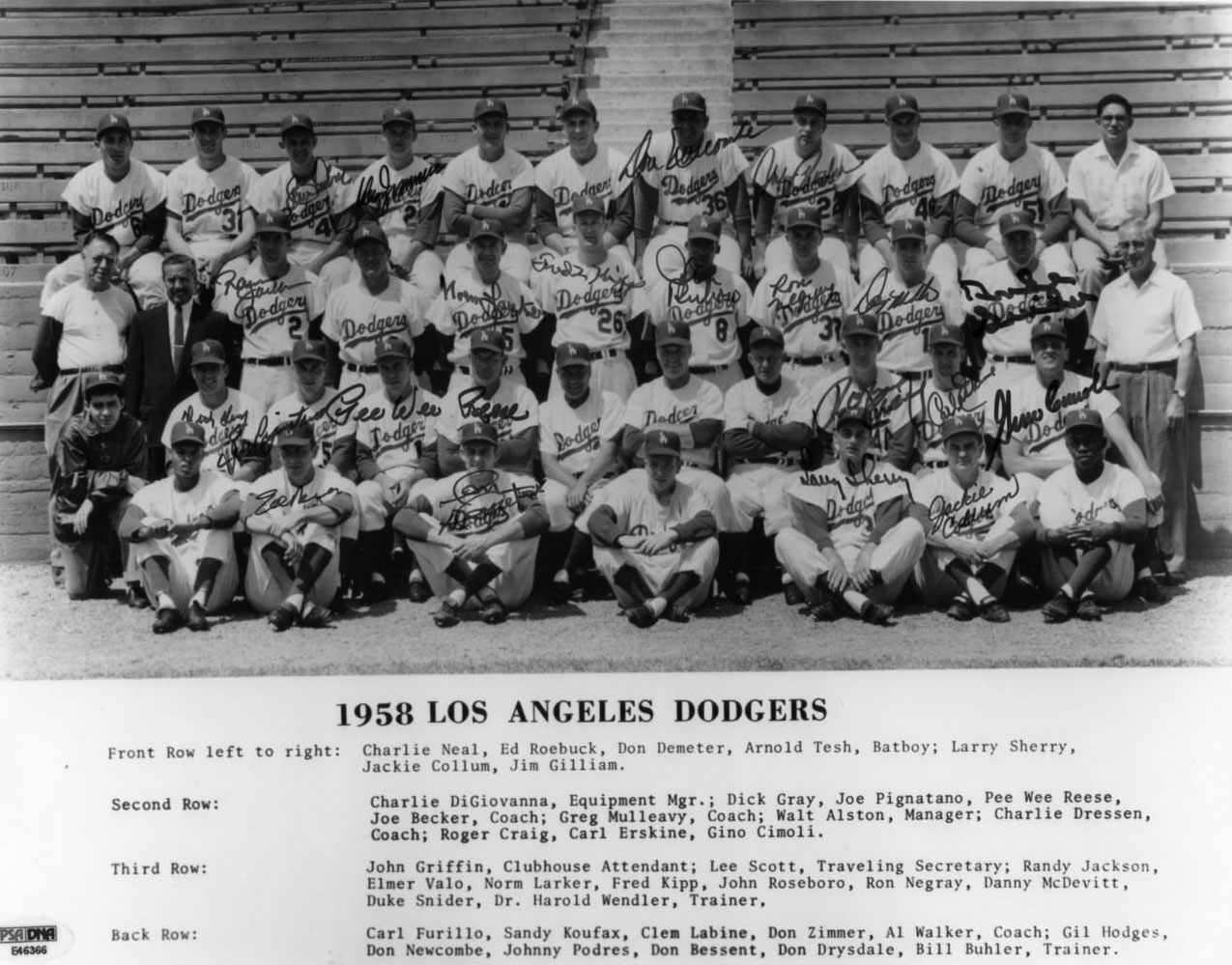
| (1958)* - Team photo of the Los Angeles Dodgers in their first season on the West Coast. Players who had spent their careers in Brooklyn now called Los Angeles home. The team played at the Los Angeles Memorial Coliseum from 1958 through 1961 while construction of their permanent ballpark in Chavez Ravine proceeded through legal delays and engineering challenges. |
Historical Notes The 1958 Dodgers brought with them a roster that included some of the most recognizable names in the game. Gil Hodges, Duke Snider, Don Drysdale, and Carl Furillo had all been part of the Dodger teams that won the 1955 World Series. The team also carried with it the legacy of Jackie Robinson, who had broken Major League Baseball's color barrier as a Dodger in 1947, though Robinson had retired before the move. His presence in the franchise's history gave the team a particular significance as it arrived in Los Angeles, which had its own complex history of racial segregation in housing and public life. Playing at the Coliseum presented both opportunities and peculiarities. The stadium had been built for football and track and field, and its dimensions forced the Dodgers to use a 42-foot screen in left field to compensate for a foul line that was only 251 feet from home plate. Despite the unusual configuration, the temporary arrangement worked well enough. The Dodgers won the World Series in 1959, drawing more than 2.25 million fans during the regular season — a National League record at the time — while construction on their permanent home was just beginning to break ground in Chavez Ravine. |
GROUNDBREAKING AND GRADING |
On September 17, 1959, the first shovels went into the ground at Chavez Ravine. What followed was one of the largest earthmoving operations in Los Angeles history — a transformation so complete that the landscape itself became unrecognizable. In less than 31 months, a baseball palace rose where neighborhoods had stood. |
 |
|
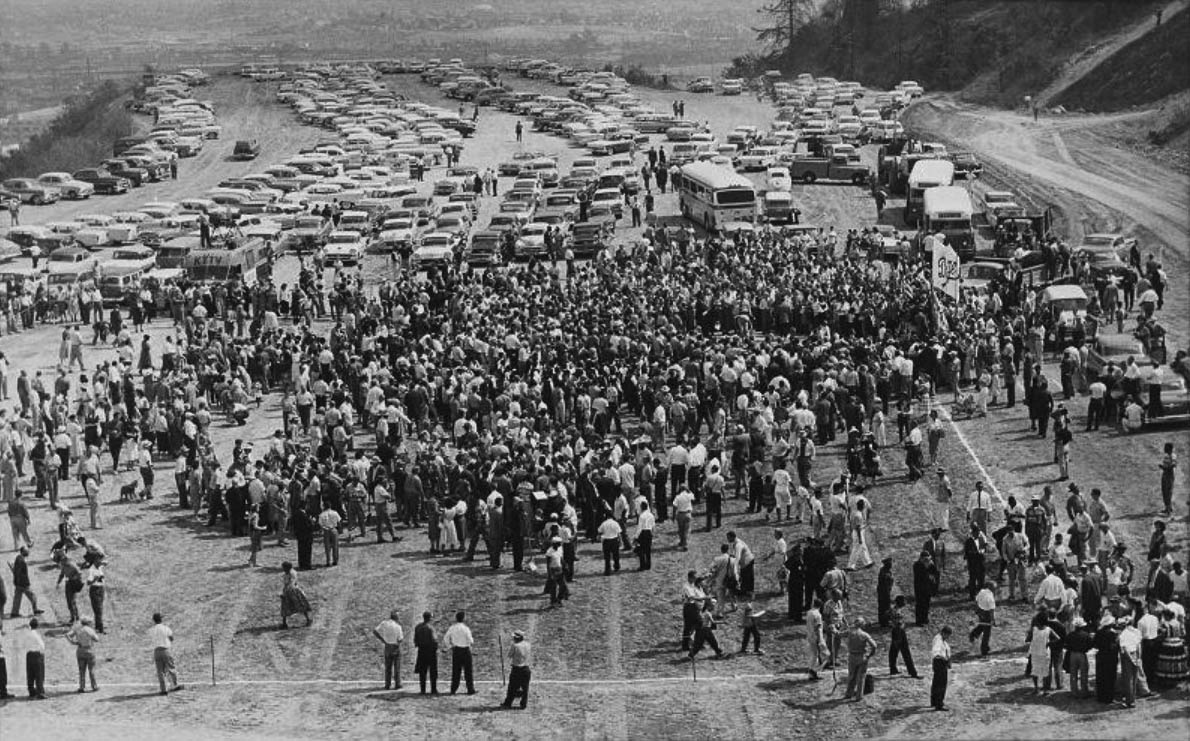
| (1959)* – A crowd estimated at more than 5,000 gathers for the groundbreaking ceremony at Chavez Ravine on September 17, 1959. White lines mark the approximate location of the playing field, with home plate at lower right. Dodger players took their positions on the diamond but were quickly surrounded by fans seeking autographs. Among the dignitaries breaking ground were Walter O'Malley, Mayor Norris Poulson, and engineer Emil Praeger, whose designs would guide construction over the next 31 months. |
Historical Notes The groundbreaking on September 17, 1959, came four months after the last Chavez Ravine families had been forcibly removed from the land and just weeks after the United States Supreme Court declined to hear the final legal challenge to the Dodgers' acquisition of the property. The ceremony marked the moment when years of political battles, court cases, and community displacement finally gave way to construction. For Dodger fans, it was the beginning of something long anticipated. For the displaced residents of Palo Verde, La Loma, and Bishop, it was something else entirely. Emil Praeger, the architect and engineer who designed Dodger Stadium, had a long history with the O'Malley family. He had previously designed Holman Stadium at the Dodgers' spring training facility in Vero Beach, Florida, and had been consulting on the Los Angeles project since the late 1950s. A Navy captain with experience in bridges, foundations, and large-scale public works, Praeger brought both technical precision and a willingness to innovate. He insisted that the largest precast concrete elements, some weighing 32 tons, be cast on site rather than transported by truck — a decision that led to the construction of a six-acre casting yard on the Chavez Ravine property itself. |
 |
|
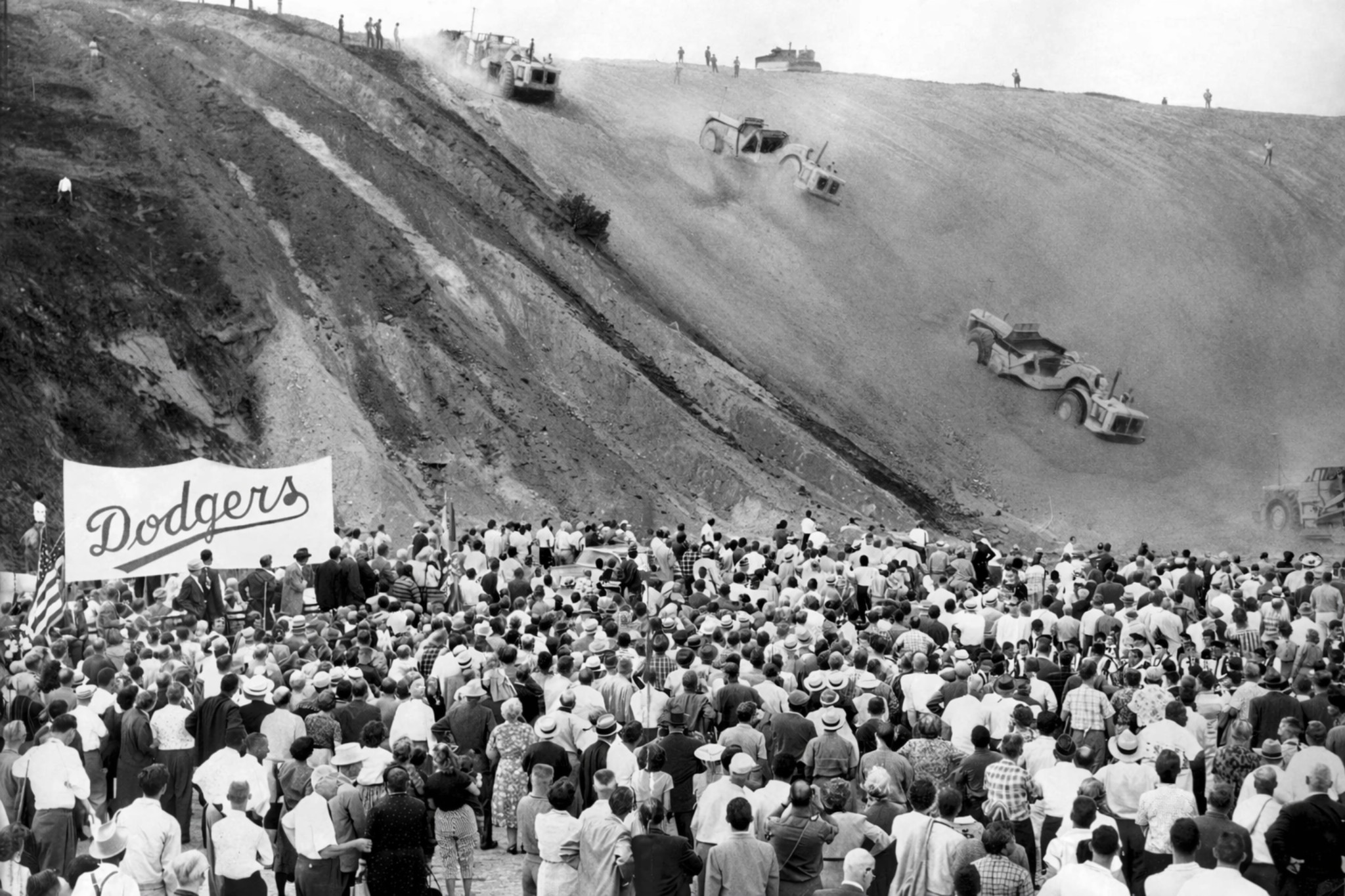
| (1959)* - Hundreds of onlookers watch earthmovers thunder down the hills of Chavez Ravine at the September 17, 1959, groundbreaking ceremony for Dodger Stadium. A Dodgers banner marks the occasion as nineteen giant earthmovers begin the first cuts into terrain that would yield eight million cubic yards of earth before the grading was complete. The scale of the operation is visible in the tiny human figures silhouetted along the ridge above — dwarfed by the machines already at work below them. |
| Historical Notes
The earthmoving operation at Chavez Ravine was one of the largest in Los Angeles history outside of freeway construction. Nineteen earthmovers worked continuously across a 300-acre site, removing the tops of ridges and filling in ravines to create a level foundation for the parking lots and the bowl-shaped amphitheater that would hold the grandstand. At the highest point, a 726-foot promontory known variously as Mount Lookout, Silverwood Hill, and O'Malley Hill was cut down and its material redistributed across the site. The removed earth and rock were used to fill Sulfur and Cemetery Ravines, giving the parking lots their current flat, terraced character. One unusual consequence of the grading was the fate of the former Palo Verde Elementary School, which had served the Chavez Ravine community before the neighborhood's demolition. Rather than removing the building, construction crews simply buried it beneath the parking lot northwest of third base, where it remains today. The school stood as the community's most visible symbol of its own organization and self-sufficiency. Its burial under asphalt, unannounced and unacknowledged, became one of the details most frequently recalled by former residents in later years as they tried to make sense of what had happened to the neighborhood they grew up in. |
CONSTRUCTION UNDER WAY |
Once the earth was moved and the courts had cleared the last legal obstacles, the stadium itself began to take shape. What rose from the reshaped hillside was unlike any ballpark that had come before it — a privately built, cantilevered concrete structure that gave every fan an unobstructed view of the field. |
 |
|
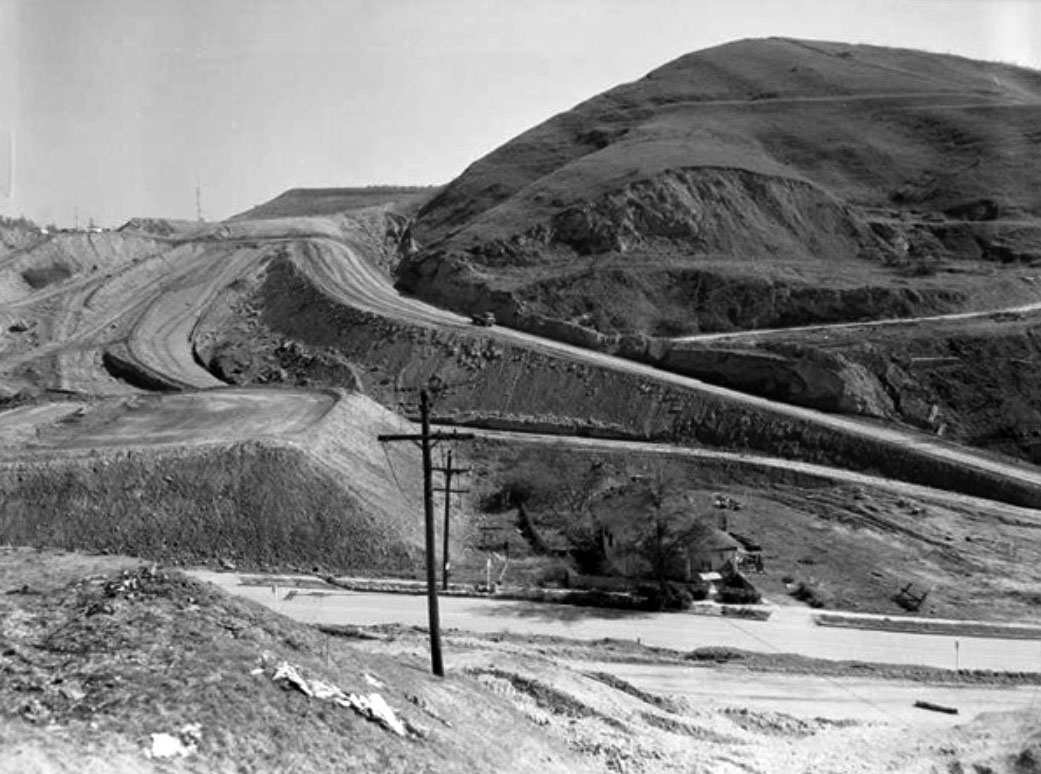
| (1960 )* - A lone house stands among the graded hillsides and earthmoving equipment at the Dodger Stadium construction site in 1960. This image, from the Los Angeles Times, captures the final trace of Chavez Ravine's residential past against the industrial scale of what was replacing it. Legal disputes stalled actual stadium construction for much of 1960, even as grading work continued around the site. |
| Historical Notes
Construction of the stadium structure was delayed through much of 1960 by legal challenges that forced the Dodgers to continue earthwork while the right to build remained unsettled. A faction of the Los Angeles City Council attempted to rezone the Chavez Ravine property after the 1959 groundbreaking, and additional lawsuits raised questions about the terms of the city's agreement with O'Malley. The California Supreme Court ruled in the Dodgers' favor twice. Walter O'Malley finally signed the full construction contract with Vinnell Constructors on August 25, 1960. A handful of property holders also remained near the stadium site and required individual negotiations before the property was fully cleared. Each delay pushed the opening date, and at various points it seemed possible the stadium would not be ready until 1963. O'Malley set his jaw and publicly vowed that Dodger Stadium would open in April 1962 — no matter what. |
 |
|
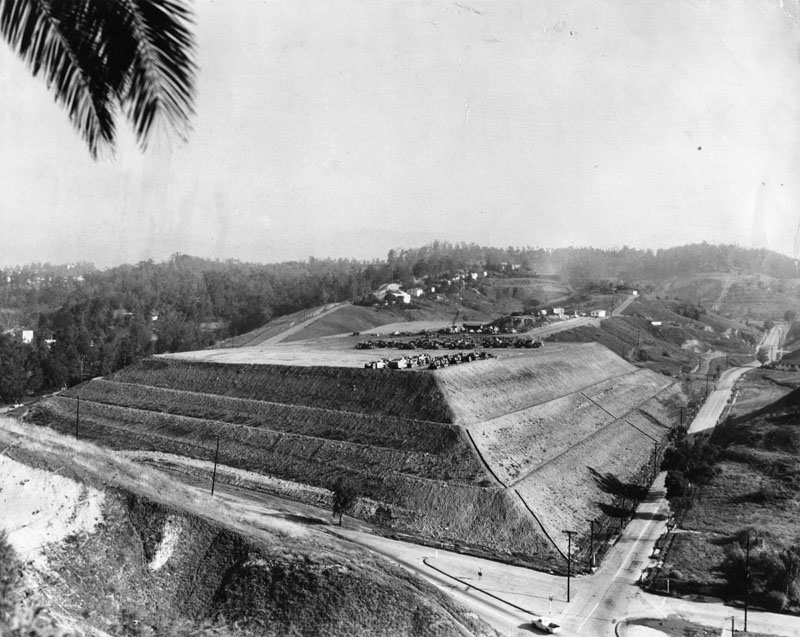
| (1960)* - Early construction of Dodger Stadium, which would be built entirely with private funds at a final cost of $23 million. It was the first privately financed Major League Baseball stadium since the original Yankee Stadium opened in 1923 — and it would remain the last until Oracle Park in San Francisco opened in 2000. The Herald-Examiner described the finished product as a monument of concrete and terraced asphalt surrounding carefully tended greenery. |
| Historical Notes
Walter O'Malley's insistence on private financing for Dodger Stadium was both a business decision and a statement. He had accepted city-owned land as part of his deal with Los Angeles, but he was determined that no public construction funds would pay for the building itself. In an era when taxpayer-funded stadiums were becoming the norm, O'Malley's approach was unusual enough to attract national attention. It also meant that every construction decision — every material choice, every engineering compromise, every delay caused by weather or legal action — had a direct financial consequence for the Dodger organization rather than for the public. The $23 million final cost included both construction and the land purchase, as well as required improvements to the surrounding parkland that were part of the city's agreement with the team. Construction involved 21,000 precast concrete elements, a six-acre on-site casting yard, and a German-built crane that was at the time the largest in North America. Contractor Vinnell Constructors, based in Alhambra, had originally hoped only to handle the earthmoving contract; they ultimately became responsible for the entire project under the direct supervision of company vice president Jack Yount. |
 |
|
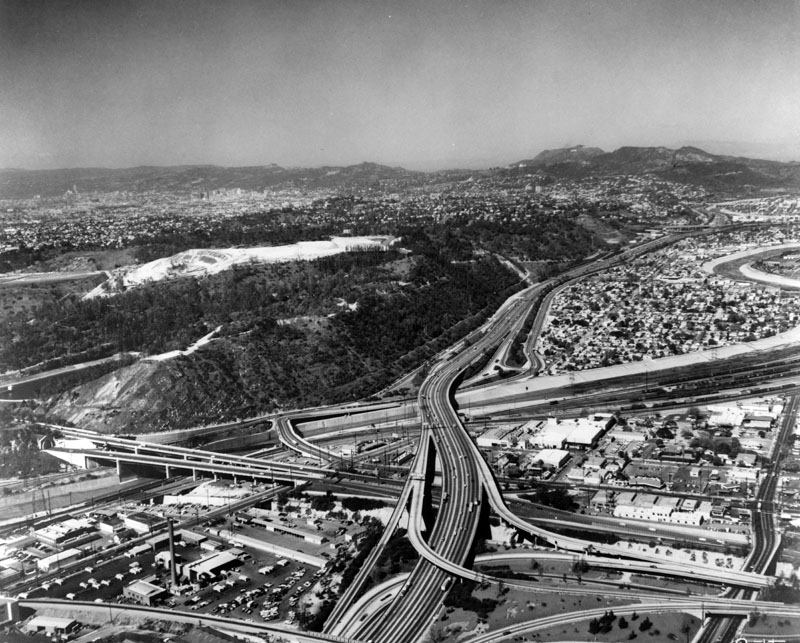
| (ca. 1960)* - Aerial view of Chavez Ravine and Dodger Stadium in the early stages of construction, with the surrounding residential neighborhoods and the freeway corridors of Los Angeles spreading in every direction. The stadium site sits in sharp contrast to the settled landscape around it — a raw, cleared bowl in the middle of a city already built and busy. The ease of freeway access from multiple directions was central to O'Malley's vision of a car-centered ballpark. |
| Historical Notes
The aerial perspective reveals how deliberately the Dodger Stadium site was integrated into Los Angeles's freeway network. Walter O'Malley had chosen Chavez Ravine partly because of its proximity to the 101, 110, and 5 freeways, which allowed fans to arrive from virtually any part of the metropolitan area by automobile. The terraced parking lots, designed by Praeger to sit at the same elevation as the stadium's various seating levels, were as important to O'Malley's vision as the grandstand itself. He wanted fans to park close to their seats, walk a short distance, and leave quickly after the game — a system built entirely around the car. The freeway corridors visible in this photograph were themselves relatively new at the time. The postwar freeway building boom in Los Angeles had proceeded rapidly through the 1950s, and several of the expressways shown had opened within the previous decade. The stadium's placement in Chavez Ravine, overlooking the interchange of multiple routes near downtown, made it one of the most accessible large-scale venues in the region. O'Malley had studied traffic patterns carefully before committing to the site, and the parking lot configuration — 21 terraced lots across five different levels accommodating 16,000 cars — reflected that study. |
 |
|
| (1960)* - The primary grading of the Chavez Ravine site nears completion, as photographed by the Los Angeles Times on April 12, 1960. The caption that ran with the original photograph read: "With preliminary grading finished, Dodgers hope to get going on new park sometime in June." Ongoing legal challenges would delay that start, but the contours of the eventual stadium bowl are already beginning to emerge from the shaped hillsides. |
| Historical Notes
The phrase "preliminary grading finished" in the original Times caption understates what had already been accomplished on the site. Moving eight million cubic yards of earth across 300 acres was itself a project of enormous scale, equivalent in volume to a building covering a city block and standing more than 260 stories high — an analogy that Dodger vice president Fresco Thompson later offered to help people comprehend the numbers. The completion of that phase left behind a dramatically reshaped landscape: the dominant ridgelines of the original Chavez Ravine were gone, replaced by graded slopes and leveled plateaus ready to receive the stadium's foundation work. The June start that the Times caption hoped for was delayed by the continuing legal battles over zoning and the terms of the stadium contract. The full construction contract was not signed until August 1960, meaning that the actual structural work on the grandstand did not begin until that fall. The delay pushed the projected opening from 1961 to 1962, costing the Dodgers a season in their new home. O'Malley accepted the setback but made clear that 1962 was an absolute deadline. He later recalled that nothing short of the stadium literally falling down would have prevented him from opening on April 10, 1962. |
 |
|
| (1960)* - Looking south across the massive grading operation at Chavez Ravine during the early construction of Dodger Stadium, with downtown Los Angeles visible through the haze in the distance. City Hall rises prominently at left. Millions of cubic yards of earth were moved to reshape the rugged hills and ravines into the stadium bowl, terraced parking areas, and access roads. Photo source: LIFE Magazine. |
Historical Notes This color photograph shows just how extensively the original topography of Chavez Ravine was altered before the stadium structure began to rise. Rather than simply excavating a bowl for the playing field, crews reshaped hundreds of acres, cutting into hillsides and using the excavated material to fill adjoining ravines. The broad graded slopes visible here would eventually become part of the carefully terraced landscape surrounding Dodger Stadium. The view toward downtown also illustrates one of the site's great attractions to Walter O'Malley. Chavez Ravine stood only a short distance from the Civic Center yet provided enough land for the stadium and thousands of parking spaces. Its elevated setting offered sweeping views across Los Angeles, while nearby freeways connected the new ballpark with the rapidly expanding metropolitan region. Photo source: LIFE Magazine. Possibly photographed by Ralph Crane. |
 |
|
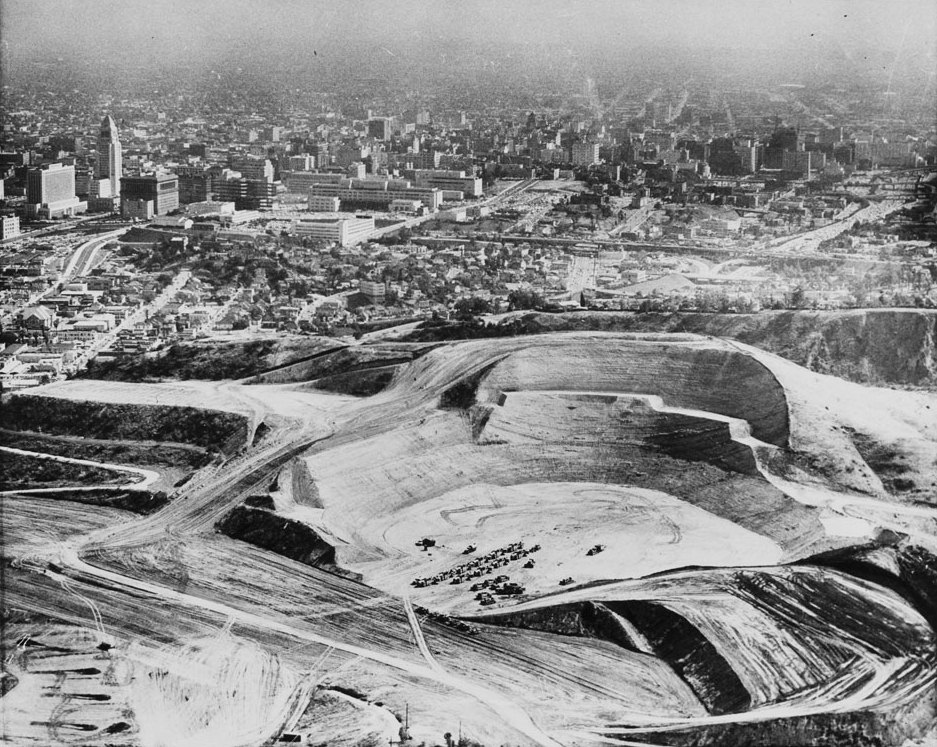
| (1960)* - Idle trucks, bulldozers, and earthmovers sit motionless at the Chavez Ravine construction site on May 25, 1960. An Examiner clipping attached to the reverse of this photograph reads: "No action — legal snarls again stalled construction of Dodger's new baseball park in Chavez Ravine, where idle trucks, bulldozers and earth-movers are pictured late Tuesday." The machines that had moved millions of cubic yards of earth sat waiting while the courts worked through another round of challenges to the project. |
Historical Notes The delays came from multiple directions at once. Critics argued the original referendum had been improperly conducted. Others challenged the city's authority to transfer publicly acquired land to a private franchise. The California Supreme Court had already ruled twice for the Dodgers, but each ruling seemed to prompt a new challenge. The idle machines at Chavez Ravine became a recurring image in Los Angeles newspapers that spring and summer — a visible symbol of civic ambition waiting on the courts. O'Malley responded with a patience that occasionally broke into open frustration. He had committed to building a major stadium without public money and had expected the city to hold up its end. At one point he warned publicly that continued delays might make the Dodgers' position in Los Angeles untenable. The final resolution came in the fall of 1960, and by August of that year the full construction contract was signed. The machines went back to work. |
 |
|
| (2015)* - Google Earth view looking south across Dodger Stadium toward downtown Los Angeles. More than five decades after the massive grading operation seen in the preceding photograph, the stadium sits within the reshaped hills of Chavez Ravine, surrounded by the terraced parking areas and access roads created as part of the original development |
Historical Notes Opened on April 10, 1962, Dodger Stadium was designed to fit within the extensively reshaped terrain of Chavez Ravine. The stadium bowl, surrounding parking terraces, and access roads visible here were the result of one of the largest grading operations undertaken in Los Angeles at the time. Approximately eight million cubic yards of earth were moved across the 300-acre site before structural construction of the ballpark could proceed. The 2015 view also shows how Walter O'Malley's automobile-oriented plan continued to define the site more than half a century later. The stadium is encircled by the broad terraced parking lots that were designed at different elevations corresponding to the various seating levels, allowing spectators to approach their seats with relatively little climbing. The original configuration provided 21 terraced lots on five levels with space for approximately 16,000 cars. |
Then and Now
 |
|
| (1960 vs. 2015)* - Then and Now – Looking south across Chavez Ravine toward downtown Los Angeles, before and after the construction of Dodger Stadium. The 1960 view shows the enormous grading operation that reshaped the hills and ravines into the stadium bowl, terraced parking areas, and access roads. More than five decades later, Dodger Stadium occupies the excavated bowl, while the transformed downtown skyline rises beyond. Photo comparison by Jack Feldman. |
Historical Notes The comparison reveals the extent to which the original landscape of Chavez Ravine was reshaped for Dodger Stadium. In the 1960 photograph, the stadium itself has yet to rise, but its future setting is already recognizable. Hillsides have been cut away, ravines filled, and broad terraces created for the stadium and surrounding parking areas. By the time the primary grading was completed, approximately eight million cubic yards of earth had been moved across the site. The downtown skyline provides a second Then & Now comparison. City Hall, one of the most prominent buildings on the horizon in 1960, remains readily identifiable in 2015 but is dwarfed by the high-rise towers constructed during the intervening decades. Together, the two views document not only the transformation of Chavez Ravine into Dodger Stadium, but also the changing scale of downtown Los Angeles beyond it. |
RISING FROM THE HILLSIDE |
With the legal battles settled and the earthwork done, the stadium itself began to take physical form in 1961. Concrete frames rose from the shaped hillside, a massive German crane moved the heaviest pieces into place, and what had been a raw graded bowl became, month by month, recognizable as a ballpark. |
 |
|
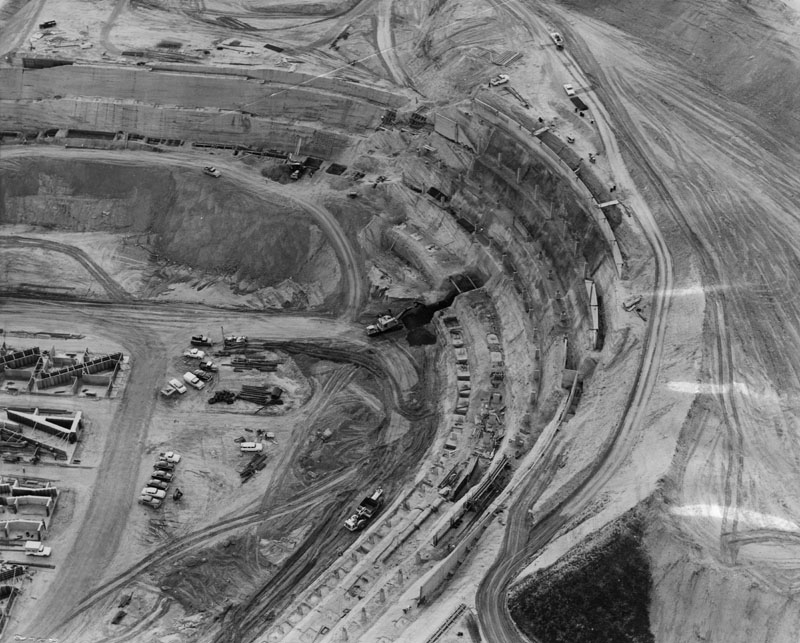
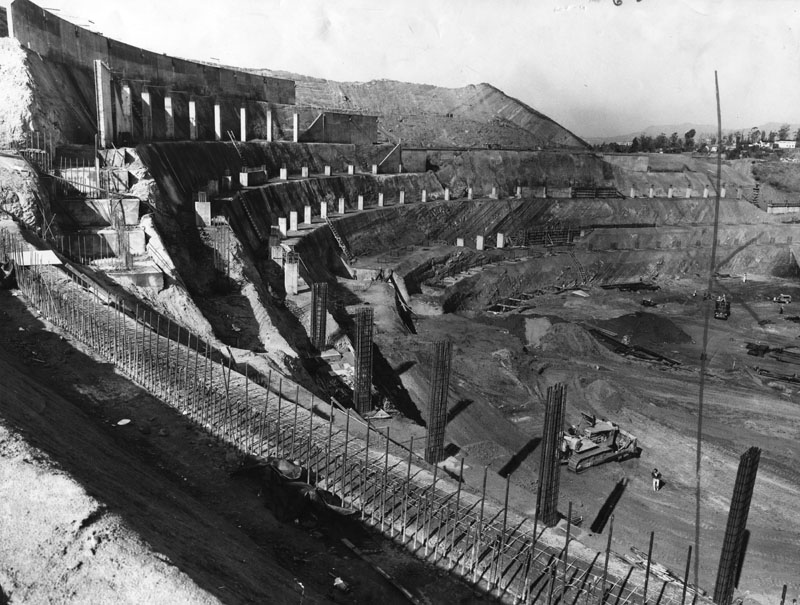
| (1961)* - The shaped dirt tiers of the Chavez Ravine site begin to suggest the outline of the stadium that would fill them. A caption dated February 16, 1961, reads: "Dirt tiers will soon support stands for 56,200-seat Dodger Bowl for 1962." The terraced structure visible here would receive 21,000 precast concrete units assembled on site, some of them weighing as much as 32 tons. |
| Historical Notes
The decision to build the grandstand using precast concrete rather than steel set Dodger Stadium apart from most of the ballparks of its era and gave it a distinctive solidity. Walter O'Malley specifically wanted concrete — he believed it would age better and require less maintenance than steel, and he had seen enough examples of deteriorating urban stadiums in the Northeast to be convinced that durability mattered more than speed of construction. The precast approach required more planning and a larger on-site operation, but it ultimately produced the structure that has survived, with relatively modest upgrades, for more than six decades. The February 1961 caption refers to the stadium as the "Dodger Bowl," a name that was sometimes used during the planning phase before the final designation as Dodger Stadium was settled. O'Malley had initially favored "Dodger Stadium" to distinguish it from the many ballparks named after their locations or their owners, and that name eventually prevailed. The seating capacity noted in the caption, 56,200, remained close to the stadium's official opening-day figure of 56,000. Over the following decades, renovations and reconfiguration would adjust that number, and Dodger Stadium today seats approximately 56,000 fans. |
 |
|
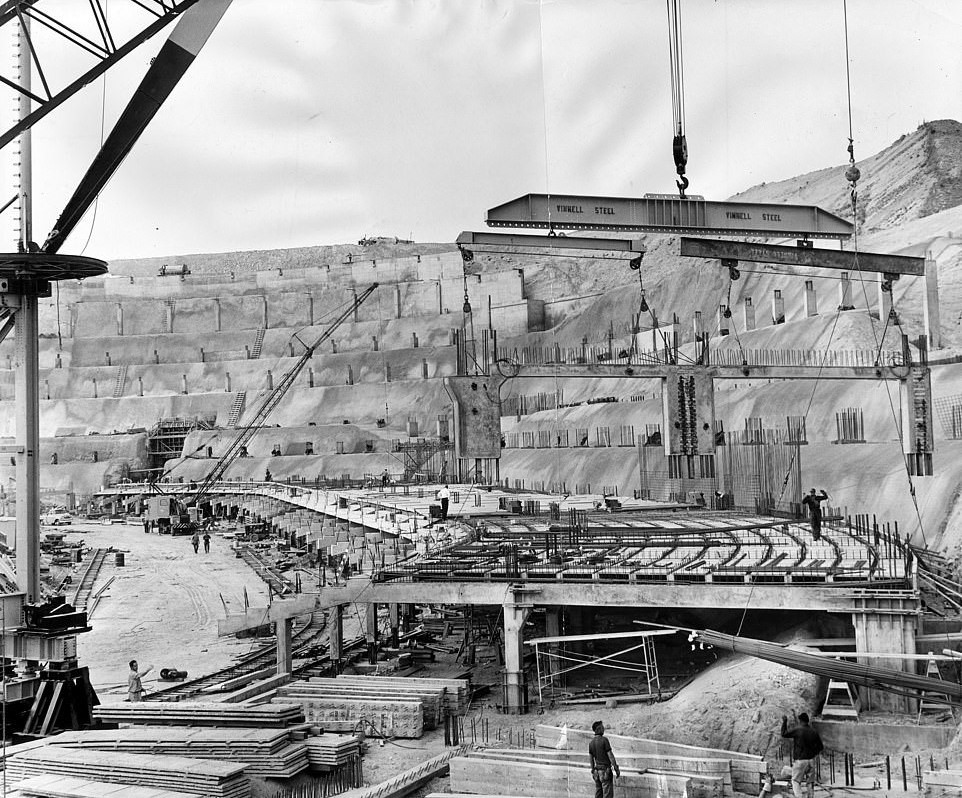
| (1961)* - Steel and concrete begin to fill the shaped hillside of Chavez Ravine as stadium construction accelerates ahead of the original schedule. Building the 124-foot grandstand required 40,000 cubic yards of concrete, including 78 precast frames, and 13 million pounds of reinforcing steel — numbers that give some sense of the structural ambition behind what had appeared, only months earlier, to be nothing but graded dirt and machinery. |
Historical Notes The pace of construction in 1961, once legal obstacles were cleared and the full contract was in place, impressed even those who had been skeptical that the stadium could be completed on time. At the project's peak, 342 workers were on site simultaneously, handling everything from concrete casting to steel placement to finish work on the parking structures. The project required a level of coordination that was unusual for the era, and Jack Yount, the Vinnell Constructors vice president who supervised the work, later recalled that the variety of tasks proceeding at once made it one of the most complex projects his company had ever undertaken. The construction of the grandstand itself was only part of the challenge. The surrounding parking lots, designed on 21 terraced levels at five different elevations, required their own substantial concrete work, as did the access roads connecting the freeway system to the stadium entrances. The entire project — stadium, parking, roads, and landscaping — accounted for the full $23 million cost. That figure included the $4.47 million in city and county improvements to surrounding parkland that were part of the original agreement, making the purely private construction cost somewhat lower, though still the largest private investment in a baseball facility since the 1920s. |
 |
|
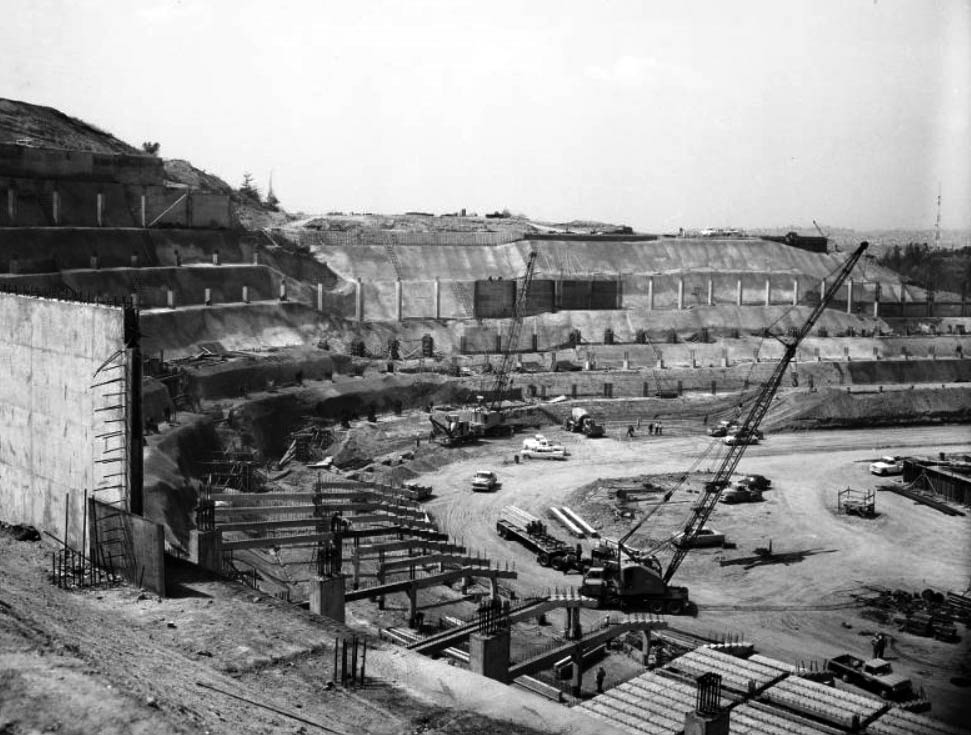
| (1961)* - Dodger Stadium takes shape on the reshaped hillside of Chavez Ravine. The grandstand's cantilevered design, visible in the emerging tiers, was a departure from older stadium construction — each level projecting outward without interior support columns, ensuring that no fan's view of the field would be blocked by a post or pillar. The design reflected O'Malley's insistence that every seat in the house be a good seat. |
| Historical Notes
The cantilevered grandstand was one of the features that most distinguished Dodger Stadium from its contemporaries. Traditional stadium construction of the era often placed vertical support columns between seating sections, creating obstructed views for some ticketholders. O'Malley had studied stadiums across the country and in Japan, and he was determined that Dodger Stadium would not repeat that problem. The cantilevered design eliminated the columns but required more complex structural engineering and heavier concrete work in the horizontal elements — a tradeoff that O'Malley accepted without hesitation. The stadium's integration into the hillside also gave it a characteristic that no flat-site ballpark could replicate. Because the grandstand was built into the contours of the reshaped terrain rather than sitting on a flat foundation, fans entering at each level of the stadium stepped off the parking lots and directly into their seating section at roughly grade level. The upper deck was as accessible as the field level, requiring no long climbs up interior stairways. O'Malley had planned this from the beginning, and the terraced parking lot system was designed specifically to make it work. |
 |
|
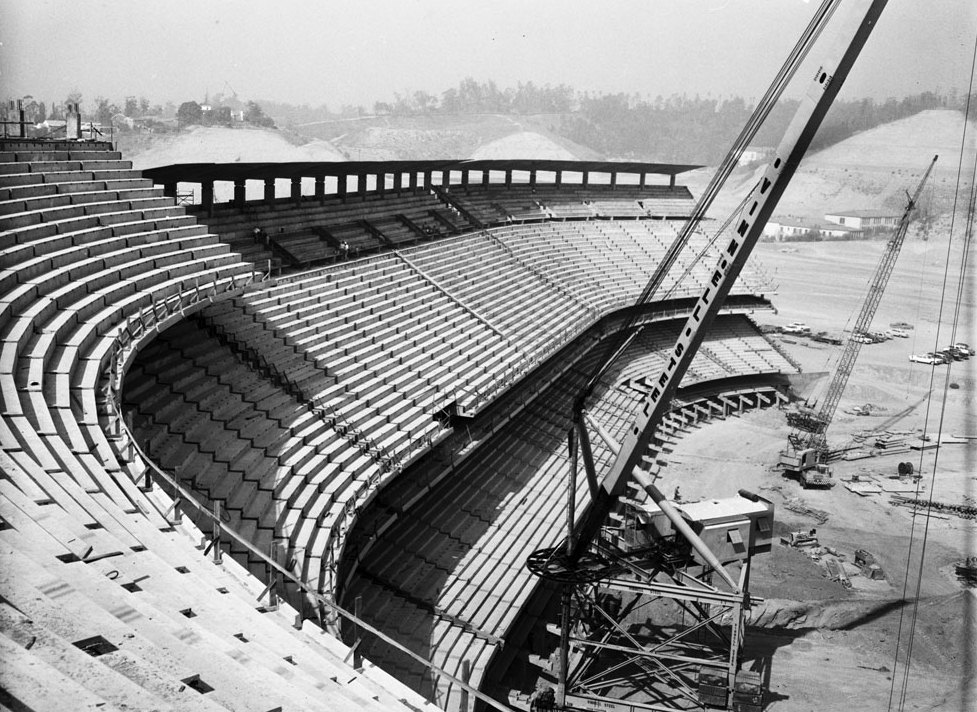
| (1961)* – Dodger Stadium under construction on April 7, 1961, as precast concrete sections begin to define the grandstand's lower tiers. Because the largest precast elements were too heavy to transport by truck, a special casting yard was built on the site itself. The contractor imported a crane from Germany — then the largest in North America — to lift the heaviest pieces, some weighing 32 tons, into position. |
Historical Notes The German crane, which cost approximately $150,000, was one of the more unusual pieces of equipment in Los Angeles construction history at the time. Its purchase underscored the scale of what was being attempted: the 32-ton precast frames that made up the stadium's primary structural members simply had no American crane capable of handling them on a construction site. The crane's arrival in Chavez Ravine attracted considerable attention, and it appears in several construction-era photographs as one of the most distinctive features of the job site. The six-acre on-site casting yard that produced the precast elements was itself a substantial operation, essentially a temporary factory built on the stadium grounds to serve the construction project. Workers cast the concrete forms in sections, cured them, and then lifted them into place with the German crane. This approach gave the construction team precise control over the quality of each element and eliminated the risks involved in transporting oversized loads on Los Angeles streets. When construction was complete, the casting yard was removed and the area incorporated into the parking lot system. |
 |
|
| (1961)* - A panoramic view of Dodger Stadium taking shape in Chavez Ravine, with the large German-built crane prominent in the foreground. The crane, the largest in North America when it arrived on the job, was essential to placing the 32-ton precast concrete frames that form the grandstand's structural backbone. By this stage of construction, the overall scale and form of the stadium are clearly visible. |
Historical Notes Panoramic photographs taken during this phase of construction reveal how dramatically the landscape of Chavez Ravine had been transformed. The ridgelines and ravines that had defined the terrain of the old neighborhoods were gone, replaced by the clean geometric curves of a structure designed to hold 56,000 people. The surrounding city — visible in the background of many construction photographs — provides a sense of scale that reinforces just how large an undertaking this was in relation to its neighbors. The pace of work visible in photographs from the spring and summer of 1961 reflected the pressure on the construction team to meet the April 1962 opening. O'Malley had made the deadline public, and the city of Los Angeles had invested considerable civic energy in the idea of the Dodgers playing in their permanent home by 1962. Spring rains in early 1962 would ultimately create a final crisis, forcing the turf to be dyed green with the help of a Hollywood producer's suggestion, and delaying the completion of finish work until the very last days before opening. But in the summer of 1961, construction was proceeding well enough that observers were describing the project as ahead of schedule. |
 |
|
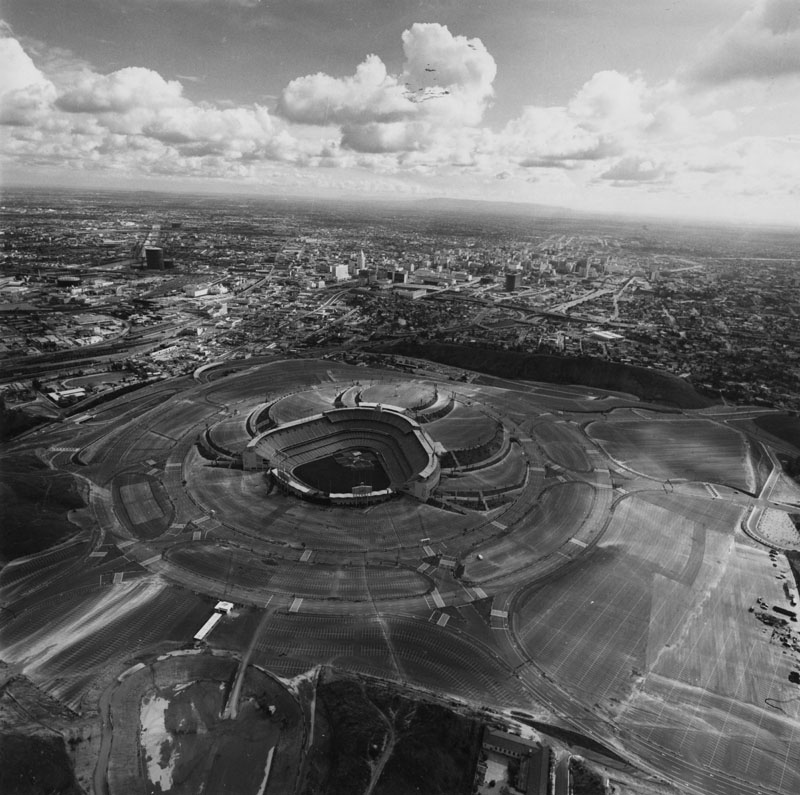
| (ca. 1961)* - Aerial view of downtown Los Angeles with Dodger Stadium in the final stages of construction in the foreground. The stadium's relationship to the city center is apparent from this vantage — close enough to see the high-rises of downtown, far enough to feel like its own destination. At the project's peak, 342 construction workers were on site simultaneously, working toward an April 1962 opening that O'Malley had publicly vowed to meet regardless of weather or circumstance. |
Historical Notes The relationship between Dodger Stadium and downtown Los Angeles has always been both close and distinct. The stadium sits less than two miles from City Hall, visible from the playing field on a clear day, yet its hilltop location and enclosed parking system give it the character of a self-contained world. O'Malley had wanted the stadium to feel like a destination rather than simply a facility, and the combination of the hillside setting, the terraced parking, and the sweeping views of the San Gabriel Mountains in the distance gave it an atmosphere unlike any other ballpark in the country. The aerial photograph also shows how quickly the surrounding neighborhoods had developed by the early 1960s. The freeways that O'Malley had counted on to bring fans from across the region are visible threading between residential and commercial areas that had grown up rapidly in the postwar decade. Dodger Stadium was being built into a city already shaped by the automobile, and its design reflected that reality at every level. When it opened, it would be the most car-friendly major sports venue in the country — a model that other cities and other teams would spend the following decades trying to replicate. |
 |
|
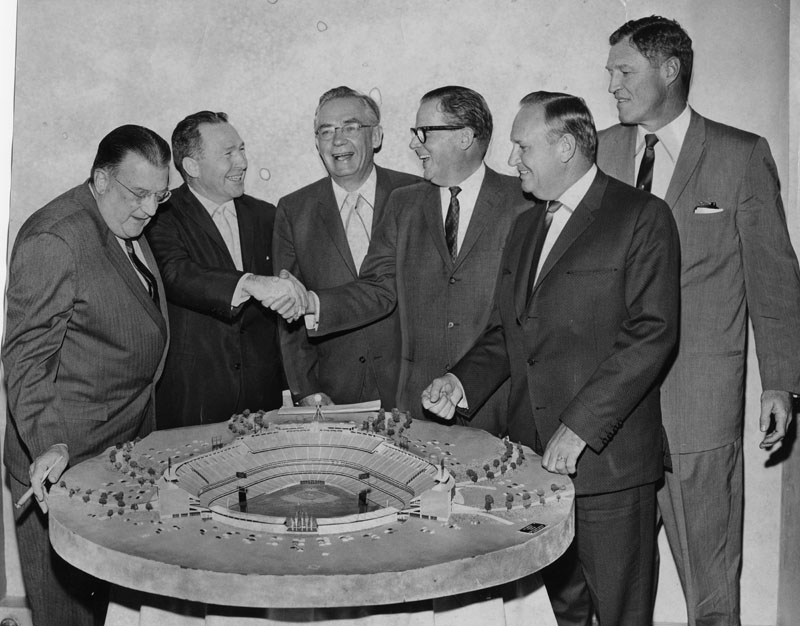
| (1961)* - Civic leaders gather around a model of Dodger Stadium on December 12, 1961, four months before the scheduled opening. The original caption reads: "Plans were revealed yesterday for a gigantic civic celebration in conjunction with the opening of the new Dodger Stadium next April. Shown admiring the model of the baseball showplace are: Walter O'Malley, Dodger president; Mayor Sam Yorty; H.C. McClellan, chairman of the dedication committee; ex-mayor Norris Poulson; Gene Autry, Angel owner; and Bob Reynolds, Angel president." Gene Autry's presence reflects a detail often overlooked: for their first four seasons in Dodger Stadium, the Los Angeles Angels shared the new ballpark with their National League neighbors. |
| Historical Notes
The gathering of civic and baseball leadership around the stadium model in December 1961 represented a moment of genuine anticipation for the city. Los Angeles had been waiting for this building since 1958, through legal battles and construction delays and four seasons at the Coliseum. The model shown in the photograph had been built by the Warner Bros. studio art department as a gift from film producer Mervyn LeRoy to Walter O'Malley, and it accurately represented the pastel-colored seating palette that the stadium would display when it opened. O'Malley had studied color psychology and specifically chose the soft turquoise, sky blue, yellow, and light orange of the original seats. Gene Autry's presence in the photograph is a reminder that Dodger Stadium's opening in 1962 also marked the arrival of a second Los Angeles team, the expansion Angels, who played at the stadium from 1962 through 1965. O'Malley had actively supported Autry's effort to bring an American League franchise to Southern California, even though it created direct competition for broadcast coverage and fan attention. The two teams shared the ballpark under a rental agreement that required the Angels to remove certain Dodger insignia on days when they played at home. The arrangement ended when the Angels moved to Anaheim in 1966 and opened what eventually became Angel Stadium. |
THE FINISH LINE |
Spring storms, last-minute construction heroics, and a Hollywood solution for a rain-soaked outfield all played their part in getting Dodger Stadium ready for Opening Day. On April 10, 1962, more than 52,000 fans arrived to see what Walter O'Malley had built. |
 |
|
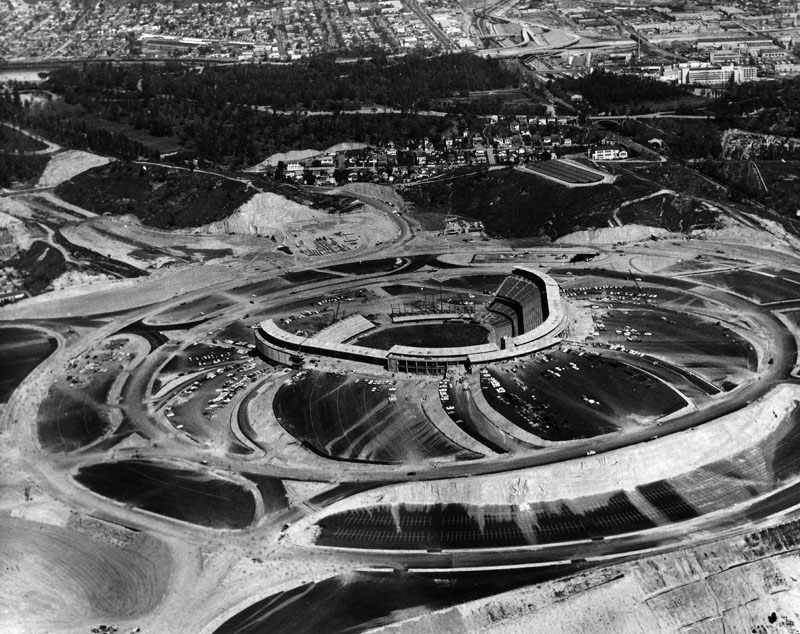
| (1962)* - Dodger Stadium nears completion as workers finish the tiered parking lots designed to surround the grandstand at multiple elevations. The lots were engineered by Emil Praeger to give fans direct access to their seating level without climbing interior stairways — a fundamental feature of O'Malley's vision for a car-friendly ballpark. The 21 lots on five different levels would accommodate 16,000 vehicles when the stadium opened. |
| Historical Notes
The parking lot design was as carefully considered as the grandstand itself. Praeger's system placed each terraced lot at roughly the same elevation as the corresponding seating level, so that a fan parked in Lot 3 could walk directly into the Loge level, while a fan in Lot 6 would enter at the Top Deck. The result was an unusually comfortable arrival experience for the era: no long walks from distant lots, no steep interior stairways, and a relatively quick exit after the game through multiple road connections to the surrounding freeway system. O'Malley had studied traffic flow at stadiums across the country and had designed the entire circulation system to minimize congestion. The parking lots also represented a significant physical legacy of the earthmoving operation that had reshaped Chavez Ravine. The flat, terraced surfaces that made the lots possible were the direct result of moving eight million cubic yards of earth from the ridge tops and depositing it in the low areas of the site. The former Palo Verde Elementary School, the last structural remnant of the old neighborhood, was among the features buried beneath the parking asphalt as the final leveling work was completed. Its location, northwest of the third-base line, was unknown to most fans for decades. |
 |
|
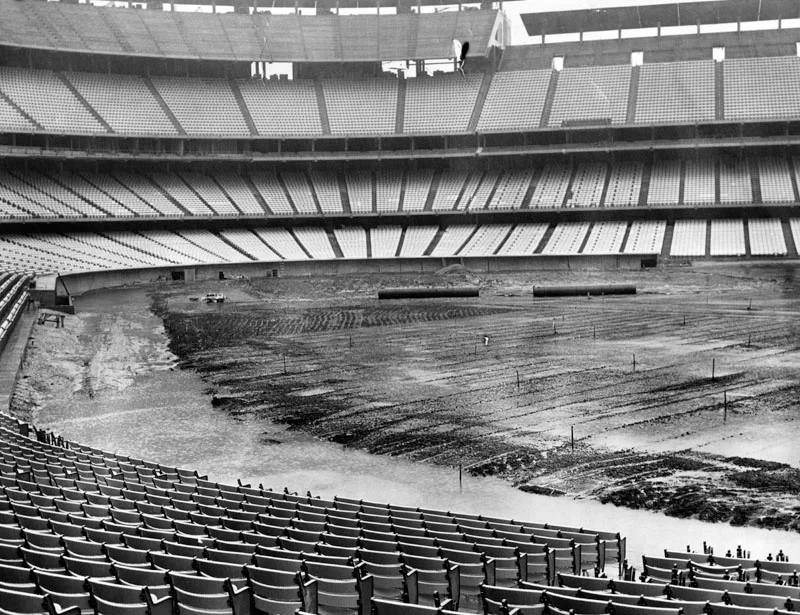
| (1962)* - Spring storms have turned the Dodger Stadium playing field into a muddy construction site on February 23, 1962 — less than seven weeks before Opening Day. The storms created a genuine crisis for Walter O'Malley, who had vowed publicly to open on April 10 no matter what. Heavy equipment including a jet engine dryer was brought onto the field in an attempt to prepare the ground for sodding, and O'Malley incurred approximately $500,000 in additional costs because of the weather delays. |
| Historical Notes
The 1962 winter rains tested O'Malley's resolve in the most direct way possible. He had spent years fighting legal battles to build the stadium, had committed to opening in April, and now found the field itself turned to mud weeks before the scheduled first game. A jet engine drying machine was brought in and its blasts carried across the construction site for hundreds of feet. Construction halted temporarily and then resumed at a frantic pace. O'Malley looked at options including temporarily using Wrigley Field and even wrote to the American Seating Company, the only subcontractor not affiliated with Vinnell, about installing the stadium seats on schedule. The solution for the outfield grass came from an unlikely source. O'Malley's friend Mervyn LeRoy, the Hollywood producer who had earlier commissioned the stadium model as a gift, suggested that the Dodgers do what the movie studios did — dye the grass the color it was supposed to be. The Dodgers applied green dye to the struggling turf, and it worked well enough to be essentially invisible from the stands on Opening Day. The only evidence of the improvisation was a handful of green-stained trouser legs on Dodger players who dove or slid in the early days of the season. |
Dodger Stadium Opening
 |
|
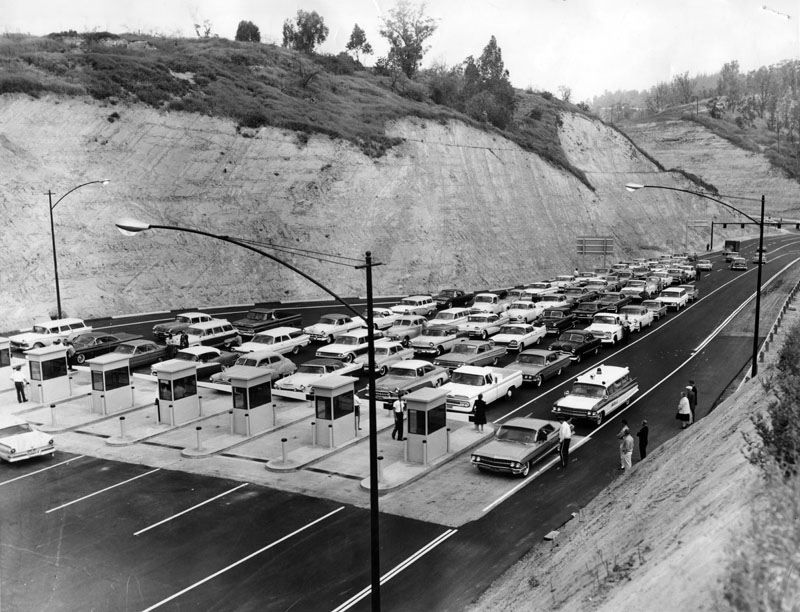
| (1962)* - Opening Day at Dodger Stadium, April 10, 1962. Cars line up at the Solano Avenue entrance as 52,564 fans make their way to the first game played at the new ballpark. The original caption read: "No, this isn't an on-ramp to a toll road. Nor is it a traffic jam. It's an auto lineup of anxious baseball fans waiting at Solano Street entrance to new Dodger Stadium today. Note ambulance waiting in extreme right lane of photo. Solano entrance is one of five access roads busy early today routing 56,000 fans making beeline to Dodger opener in $18 million stadium." The Dodgers lost that first game to the Cincinnati Reds, 6 to 3. Sandy Koufax won the second game the next day, 6 to 2. |
| Historical Notes
Opening Day on April 10, 1962, drew 52,564 fans, somewhat short of the stadium's stated capacity of 56,000 but still an enormous crowd by any measure. A parade through the center of the city preceded the game, and the civic atmosphere reflected years of anticipation finally realized. The Dodgers' temporary home at the Coliseum had been functional and occasionally spectacular, but it had never felt like a proper baseball setting. Dodger Stadium, with its immaculate sight lines, its mountain views beyond the outfield, and its new-concrete smell, was something different — a facility designed from the ground up for the game. The loss to the Cincinnati Reds on Opening Day was quickly set aside. Sandy Koufax pitched a complete game the following afternoon, and over the course of the 1962 season, the Dodgers drew 2.7 million fans to their new home, setting what was then a National League attendance record. The stadium that Walter O'Malley had fought for across a decade of negotiations, legal battles, and construction crises was an immediate success. It would go on to host four World Series, several All-Star Games, and, over more than six decades of continuous operation, more than 150 million visitors — making it one of the most attended venues in the history of professional sports. |
 |
|
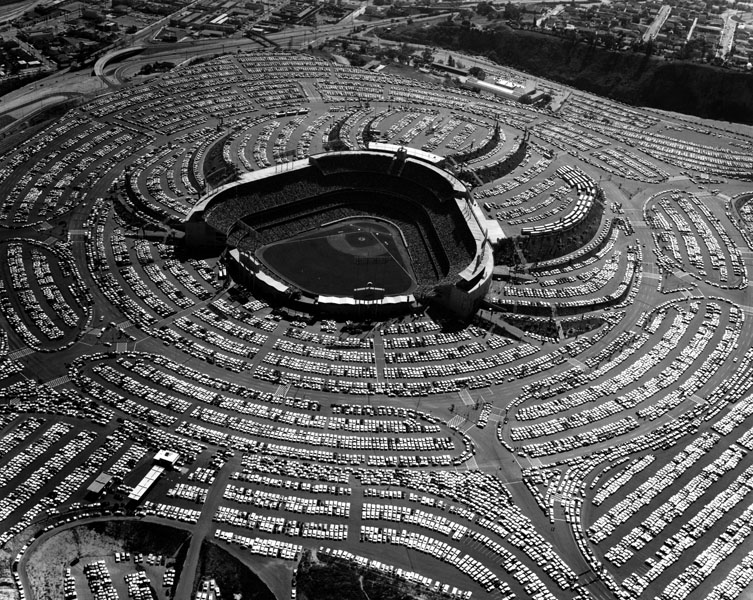
| (1960s)* - Aerial view of a capacity crowd at Dodger Stadium, with all 21 terraced lots filled to their 16,000-car capacity. The stadium sits in the bowl carved from Chavez Ravine, surrounded by the freeway corridors that O'Malley had counted on to make it accessible to the entire region. By the mid-1960s the Dodgers were drawing more fans than any team in the major leagues, validating every decision that had gone into selecting this site and building this ballpark. |
| Historical Notes
The aerial view of a full parking lot and packed grandstand captures exactly what Walter O'Malley had imagined when he first began planning a new stadium in the early 1950s. Ample parking, freeway access, and an unobstructed view from every seat had been his guiding principles, and the attendance figures of the early 1960s confirmed that the formula worked. The Dodgers set the National League attendance record in 1962, their first year in the stadium, and led the major leagues in attendance in most seasons that followed. Dodger Stadium stands today as both a triumph of design and a reminder of what came before. Beneath the parking lots and grandstands lies the history of a community, reshaped by forces far larger than itself — an enduring part of the story every time the gates open and the crowd arrives. It remains the third-oldest active ballpark in Major League Baseball, behind only Fenway Park and Wrigley Field, its cantilevered concrete grandstand set into the same reshaped hillside where Emil Praeger and Jack Yount finished their work in the spring of 1962. |
 |
|
| (1962)* - Opening Day: April 10, 1962. Fans lined up to see the new ballpark, then awaited the first pitch. The Dodgers lost, 6-3, to the Cincinnati Reds, the defending National League champs, before 52,564 fans. That year, the Dodgers drew 2.7 million fans, the most in baseball history to that point. |
| Historical Notes
The opening of Dodger Stadium brought something Los Angeles had never quite experienced — a major league ballpark built for the city it served. The Coliseum years had been a novelty; this was the real thing. Within a few seasons, Dodger Stadium would routinely lead all of baseball in attendance, a record it would hold for years. The 1962 team was a preview of what was coming. Sandy Koufax was finding his dominance, Don Drysdale was already established, and Maury Wills was rewriting the stolen base record book. The ballpark and the team were growing into each other at the same time. |
 |
|
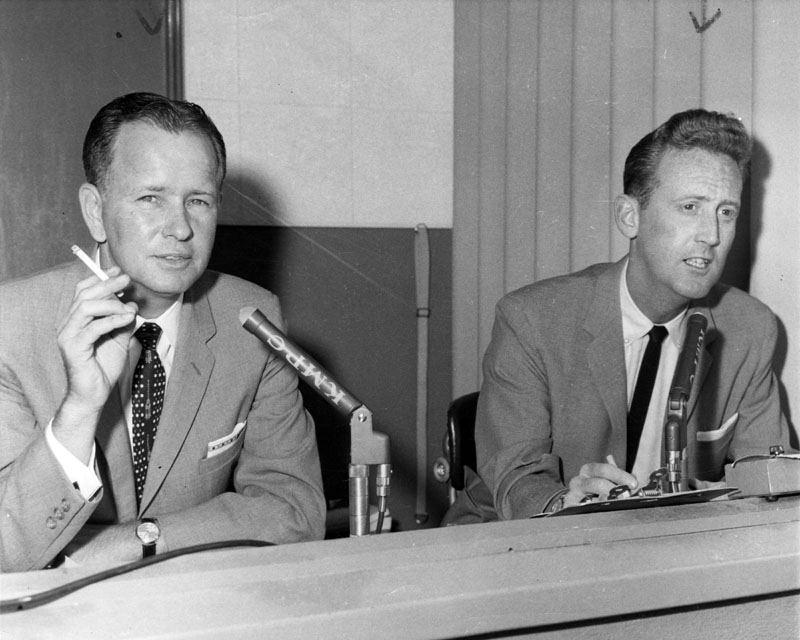
| (ca. 1959)* - Sportscasters Jerry Doggett (left) and Vin Scully doing their thing. |
Historical Notes Vin Scully joined the Brooklyn Dodgers broadcast team in 1950 at age 22, making him one of the youngest announcers in major league history at the time. He would remain the voice of the Dodgers for 67 seasons, retiring after 2016 — the longest tenure of any broadcaster with a single team in professional sports history. His conversational style, built for radio but equally suited to television, became inseparable from the sound of summer in Los Angeles. Jerry Doggett joined Scully in the booth in 1956 and remained his partner through 1987. Together they formed one of the most recognizable announcing partnerships in baseball. Doggett's steady, reliable style complemented Scully's storytelling, and for more than three decades their voices accompanied the Dodgers through championships, heartbreaks, and a generation of change in the city around them. |
 |
|
| (1962)* - During the Dodgers' first years in L.A., shortstop Maury Wills sparked the team's meager offense. Wills led the National League in stolen bases from 1960-1966, and shattered Ty Cobb's 47-year-old record of 97 stolen bases by swiping 104 in 1962. Despite the fact that L.A. lost its lead over the rival Giants in the 1962 pennant race, Wills won MVP. |
 |
|
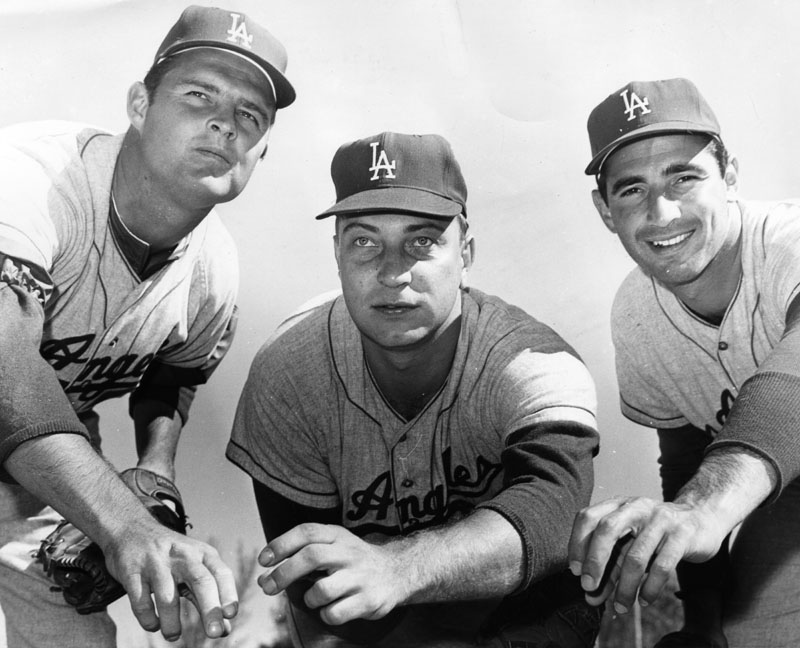
| (1963)* - Dodger pitchers, from left: right-hander, Don Drysdale; and left-handers, Johnny Podres and Sandy Koufax. Photo dated: March 13, 1963. |
Historical Notes They were the most dominating 1-2 pitching punch in Los Angeles history, combining during a five-year period from 1962-66 for 209 regular-season victories, 53 shutouts and four Cy Young Awards. And they only pitched for the Dodgers and manager Walter Alston, two of many parallels to the respective careers of Hall of Famers Sandy Koufax and Don Drysdale. Johnny Podres spent most of his career with the Brooklyn and Los Angeles Dodgers. He is perhaps best remembered for being named the Most Valuable Player of the 1955 World Series, pitching a shutout in Game 7 against the New York Yankees to help bring the Dodgers their only World Series title in Brooklyn before their move to Los Angeles after the 1957 season. |
 |
|
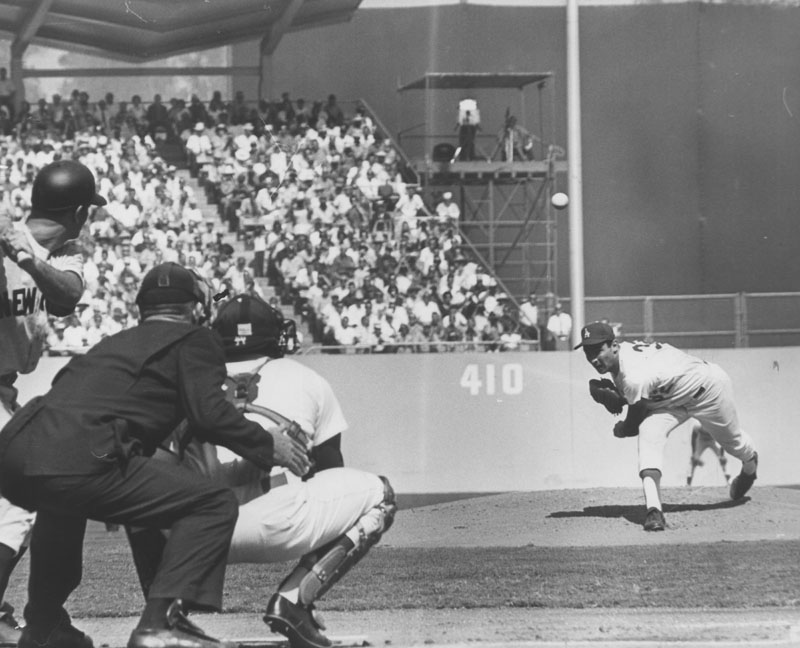
| (1963)* - Sandy Koufax pitching in Game 4 of the 1963 World Series against the Yankees. The date of that game was Oct. 6, 1963. Photo: Los Angeles Dodgers |
Historical Notes Like Drysdale, Sandy Koufax began his career in Brooklyn. Like Drysdale, he came into his own in L.A. And, like Drysdale, he retired because of an arm injury. Beginning in 1961, Koufax won 25 or more games three times and led L.A. to three World Series titles. One of the few elite Jewish athletes, he refused to pitch the opening game of the 1965 World Series because it fell on Yom Kippur. With the Series tied at 3-3, Koufax pitched the seventh and deciding game on two days rest--and beat the Minnesota Twins, 2-0. The "Left Hand of God," indeed. Koufax's career peaked with a run of six outstanding seasons from 1961 to 1966, before arthritis in his left elbow ended his career prematurely at age 30. He was named the National League's Most Valuable Player in 1963. He also won the 1963, 1965, and 1966 Cy Young Awards by unanimous votes, making him the first 3-time Cy Young winner in baseball history and the only one to win 3 times when the award was for all of baseball, not just one league. In each of his Cy Young seasons, Koufax won the pitcher's triple crown by leading the NL in wins, strikeouts, and earned run average. Koufax's totals would also have led the American League in those seasons. Koufax was the first major leaguer to pitch four no-hitters (including the eighth perfect game in baseball history). Despite his comparatively short career, Koufax's 2,396 career strikeouts ranked 7th in history as of his retirement, trailing only Warren Spahn (2,583) among left-handers. Koufax and Nolan Ryan are the only two pitchers inducted into the Hall of Fame who had more strikeouts than innings pitched. |
 |
|
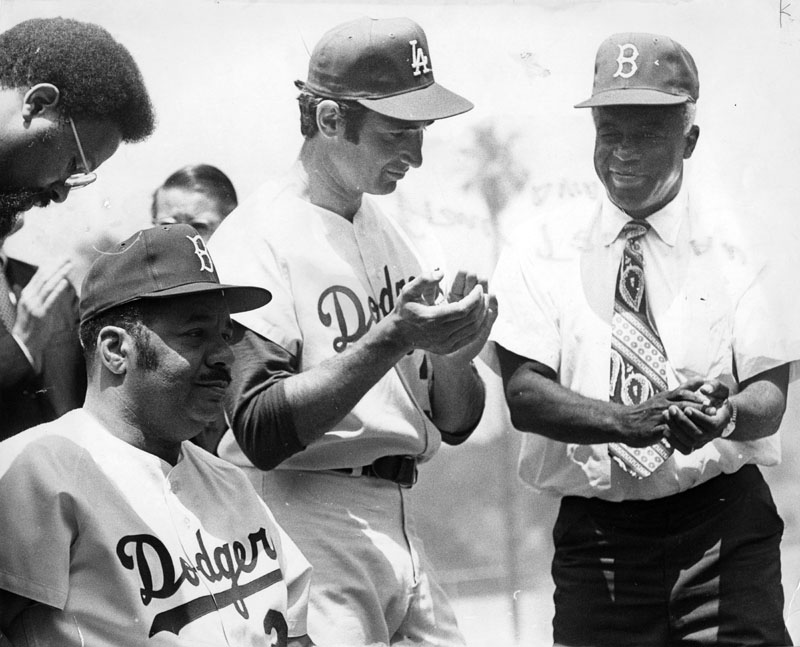
| (1972)* - Photograph caption reads: "Two stars from Brooklyn flank great one from Los Angeles, as Roy Campanella (left), Sandy Koufax (center) and Jackie Robinson get together." Photograph dated June 5, 1972. |
 |
|
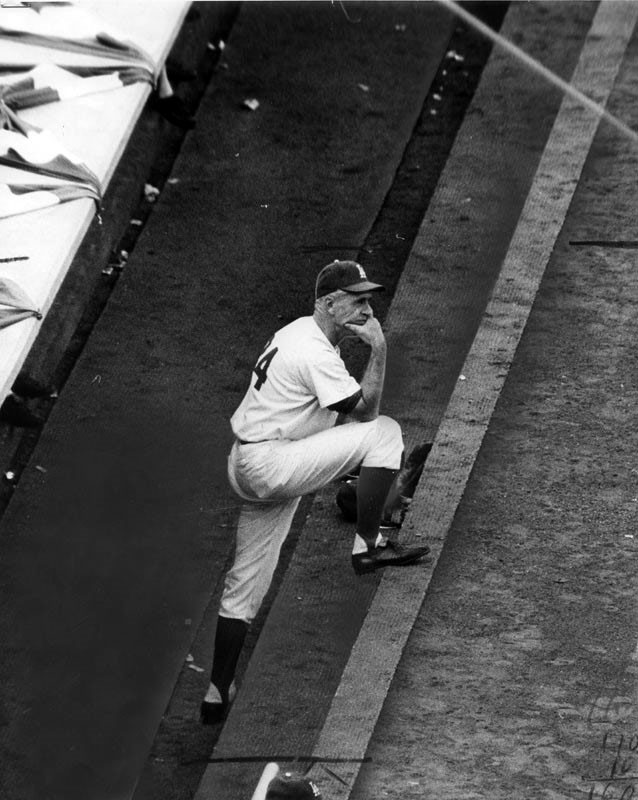
| (1966)* – View showing Walter Alston looking on from the dugout. |
Historical Notes When the Dodgers hired manager Walter Alston before the 1954 season, he signed a one-year contract. Some 23 year later, he continued to labor under those terms. Alston won four World Series and over 2,000 games before being replaced by Tommy Lasorda before the 1977 season. He died in 1984. |
 |
|
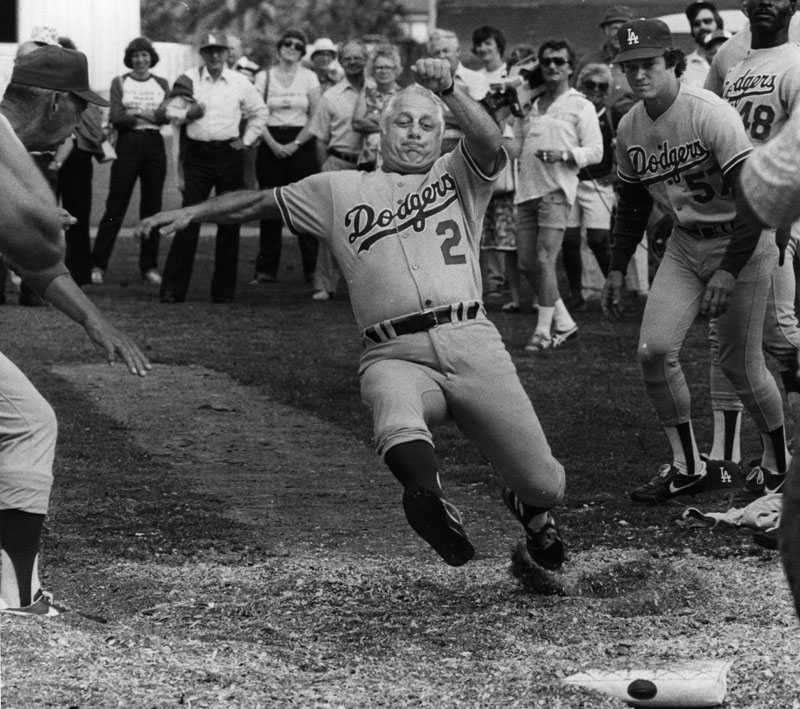
| (n.d.)* - Dodger players and onlookers in background, watch as Tommy Lasorda slides into base bag. |
Historical Notes Tommy Lasorda's first off-field assignment with the Dodgers was as a scout from 1961 to 1965. In 1966, he became the manager for the Pocatello Chiefs in the rookie leagues, then managed the Ogden Dodgers to three Pioneer League championships from 1966–68. He became the Dodgers AAA Pacific Coast League manager in 1969 with the Spokane Indians (1969–71) and remained in the position when the Dodgers switched their AAA farm club to the Albuquerque Dukes (1972). His 1972 Dukes team won the PCL Championship. Lasorda was also a manager for the Dominican Winter Baseball League team Tigres del Licey (Licey Tigers). He led the team to the 1973 Caribbean World Series Title in Venezuela with a series record of 5 wins and 1 loss. In 1973, Lasorda became the third-base coach on the staff of Hall of Fame manager Walter Alston, serving for almost four seasons. He was widely regarded as Alston's heir apparent, and turned down several major league managing jobs elsewhere to remain in the Dodger fold. |
 |
|
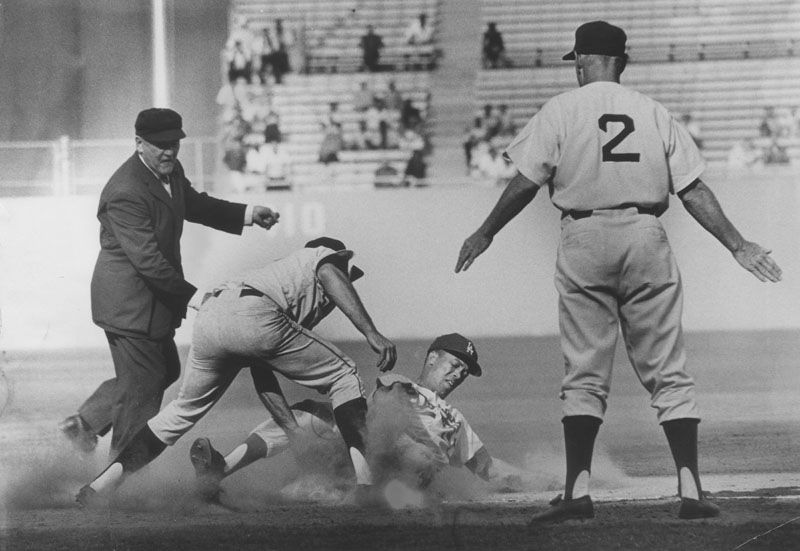
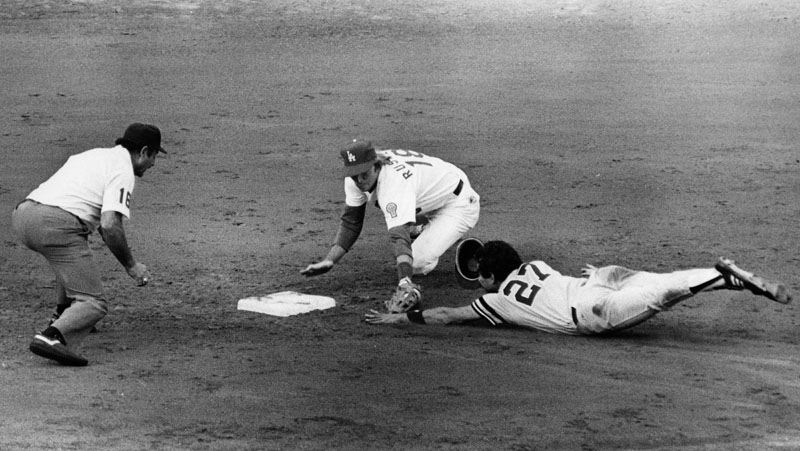
| (n.d.)* - Runner tries to stretch his hand towards base as Dodger Bill Russell makes the tag on his left hand. Umpire standing on left calls "out". |
Historical Notes Bill Russell played his entire 18-year, 2,181-game career with the Los Angeles Dodgers as the starting shortstop for four National League pennant winners and one World Series champion. He also served as the team's manager from 1996 to 1998. |
 |
|
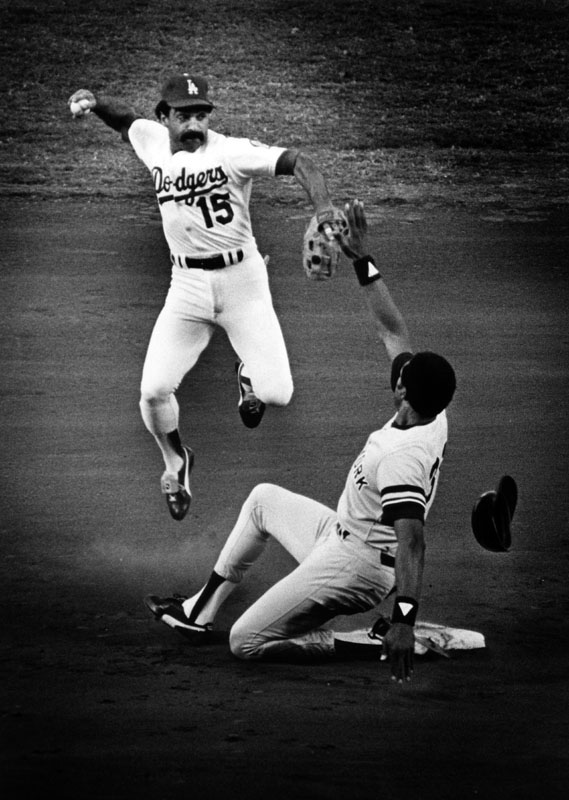
| (n.d.)* - Davey Lopes turns a double play in the first inning of the Dogers vs Yankees game. |
Historical Notes Lopes spent nine seasons with the Los Angeles Dodgers as their regular second baseman. Along with Steve Garvey (1B), Bill Russell (SS) and Ron Cey (3B), they formed the longest running infield in baseball history, which stayed together for eight and a half seasons. |
 |
|
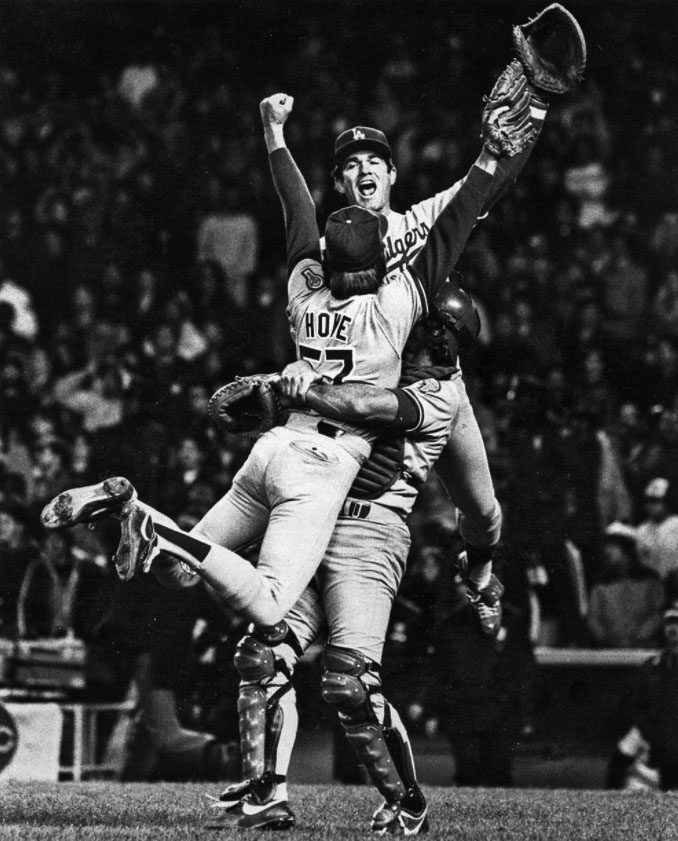
| (1981)* - Dodgers’ Steve Garvey, Steve Howe and Steve Yeager celebrate winning the World Series. Los Angeles beat the New York Yankees in six games. Los Angeles Times: Framwork |
Historical Notes A page one story in the Oct. 29, 1981, Los Angeles Times reported: Pedro Guerrero drove in five runs with a home run, triple and single and the Dodgers climaxed a remarkable series of playoff comebacks Wednesday night by routing the New York Yankees, 9-2, to win the 78th World Series at Yankee Stadium. It was the fourth straight victory for the Dodgers after they had dropped the first two games at Yankee Stadium. Previously they had come from an 0-2 deficit to beat the Houston Astros, 3-2 in the National League West divisional playoffs and had overcome Montreal, 3-2, after trailing 1-2, in the NL championship playoffs. The result was the exact reversal of the 1978 World Series, when the Yankees lost the first two games at Dodger Stadium, then won the next four. The victory gave Los Angeles its fourth world championship and its first since 1965 when they beat the Minnesota Twins. Previously, they won championships in 1959 over the Chicago White Sox and in 1963 over the Yankees. |
 |
|
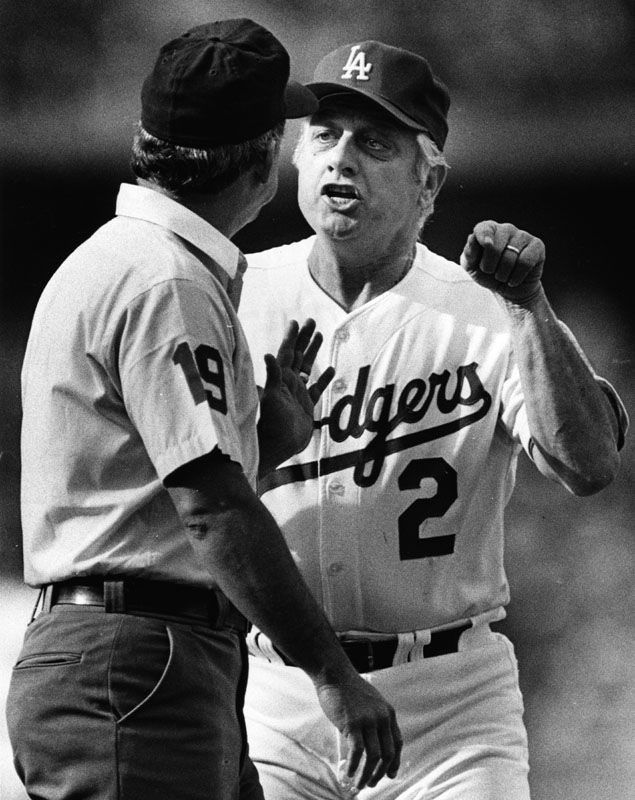
| (n.d.)* - Dodger manager Tommy Lasorda argues his point with base umpire. |
Historical Notes In 2009, Tommy Lasorda marked his sixth decade in one capacity or another with the Brooklyn/Los Angeles Dodgers organization, the longest non-continuous (he played one season with the Kansas City Athletics) tenure anyone has had with the team, edging Dodger broadcaster Vin Scully by a single season. He was inducted into the National Baseball Hall of Fame as a manager in 1997. |
 |
|
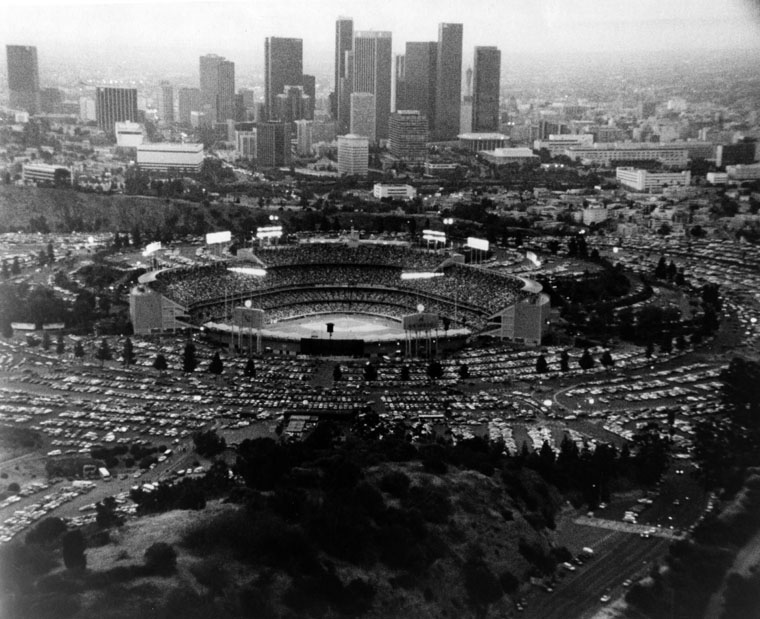
| (n.d.)* - Aerial view of a packed Dodger Stadium with the tall buildings of the city as a backdrop. Rows upon rows of cars are parked around the stadium and crowds of people fill the bleachers. |
Historical Notes Dodger Stadium is currently the third oldest ballpark in Major League Baseball (behind Fenway Park in Boston and Wrigley Field in Chicago) and is the largest ballpark by seating capacity. It has always held 56,000 fans, due to a conditional-use permit limiting its capacity. Every time the Dodgers add seats, they always remove an equal number of seats in the upper deck or in the pavilion to keep the capacity the same. |
 |
|
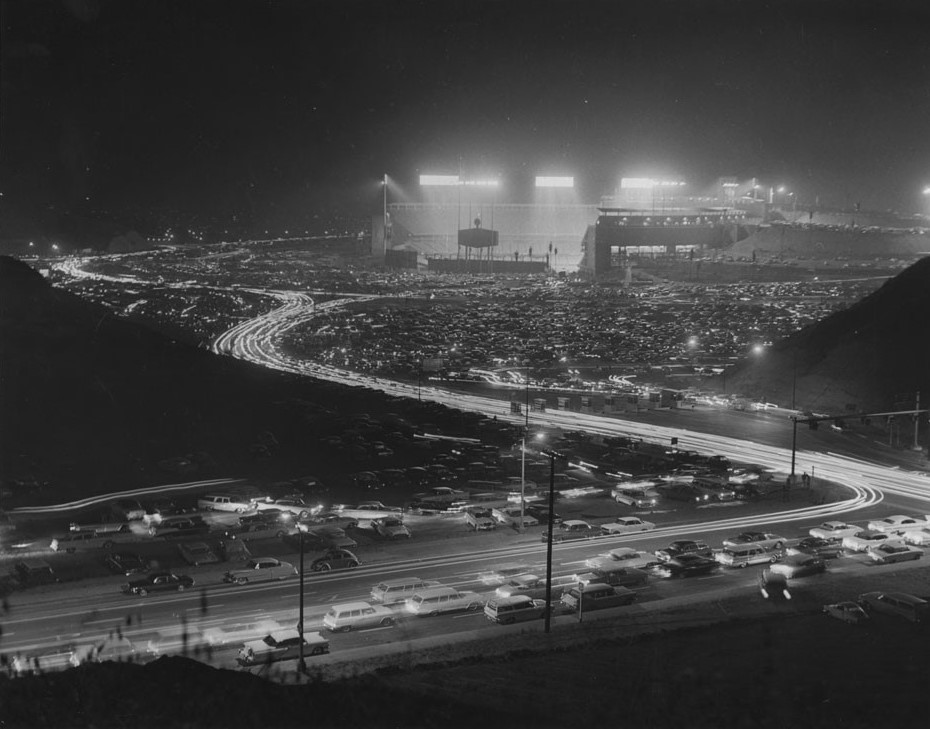
| (1962)* - Dodger Stadium at night on June 1, 1962, less than two months after the new ballpark opened. Although built as the home of the Dodgers, on this night the Los Angeles Angels were playing here against the Cleveland Indians. The Angels, who shared the stadium with the Dodgers from 1962 through 1965, referred to the ballpark as Chavez Ravine. Streams of headlights wind through the packed parking lots and access roads as fans arrive and depart beneath the brightly illuminated stadium. |
| Historical Notes
The photograph captures an interesting chapter in the stadium's early history. While Dodger Stadium was built for Walter O'Malley's Dodgers, the American League's Los Angeles Angels also made the new ballpark their home beginning in 1962. Rather than play in a stadium bearing the name of another major-league team, the Angels generally referred to their temporary home as Chavez Ravine. They remained there through the 1965 season before moving to the newly completed Anaheim Stadium in 1966. On June 1, 1962, the Dodgers were on the road in Philadelphia, while the Angels hosted the Cleveland Indians at Chavez Ravine. The nighttime photograph therefore appears to show the stadium during an Angels home date rather than a Dodgers game, an easy detail to overlook given how closely the ballpark would become identified with the Dodgers. The image also illustrates one of the defining features of the new stadium: its dependence on the automobile. Thousands of cars filled the terraced parking lots surrounding the ballpark, while streams of headlights traced the access roads through Chavez Ravine. The sight demonstrated Walter O'Malley's vision of a modern Los Angeles ballpark designed not only around baseball, but around the automobile and the rapidly expanding freeway system. |
 |
|
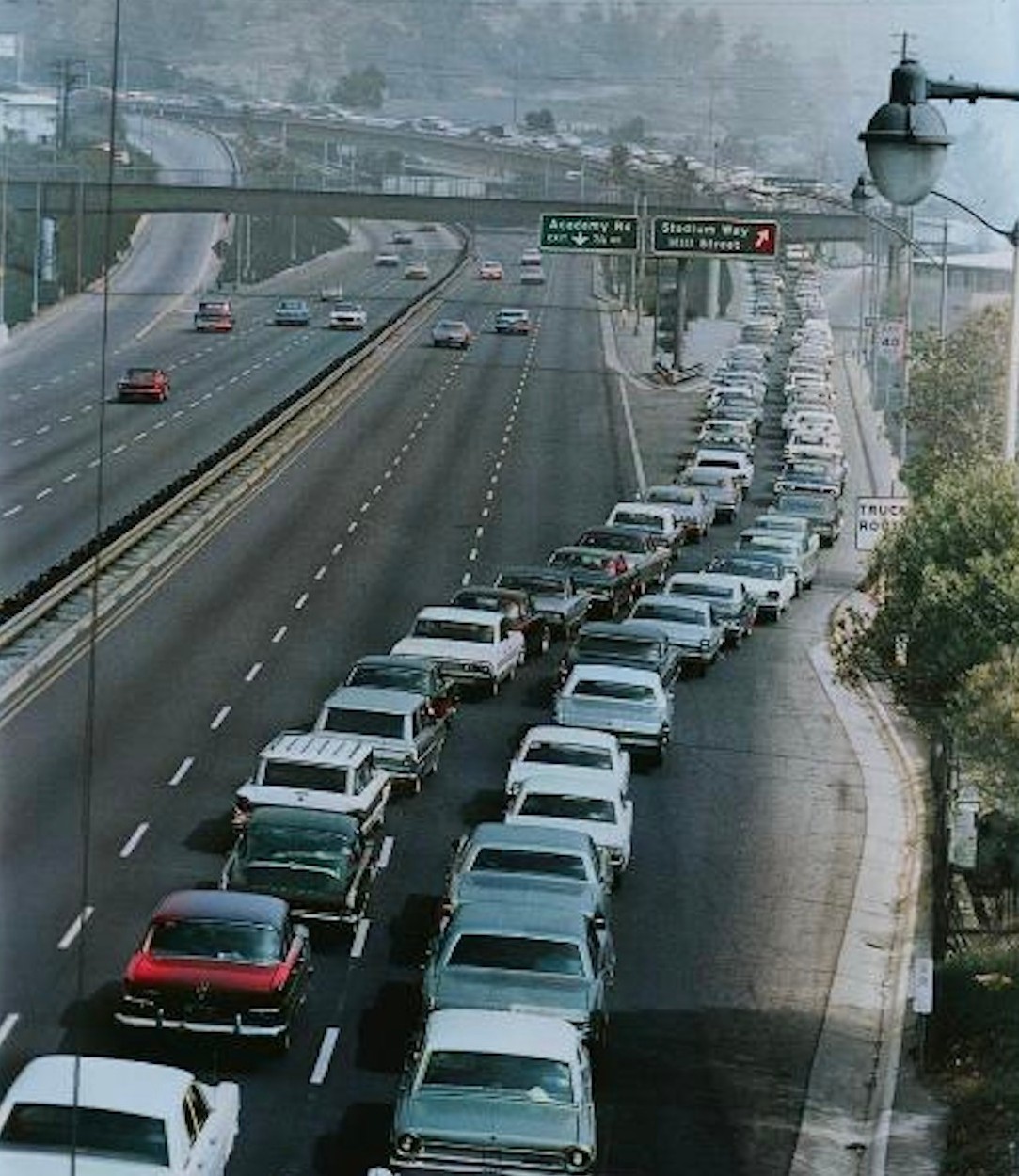
| (1960s)* - Traffic streams toward Dodger Stadium, where accommodating the automobile was an important part of the ballpark's design from the beginning. Photo courtesy of Jason Horton. |
| Historical Notes
Walter O'Malley understood that a successful ballpark in Los Angeles had to accommodate the automobile. Dodger Stadium was surrounded by roughly 16,000 parking spaces spread across terraced lots, with the lots arranged at different elevations around the stadium. The idea was to allow fans to park near the same level as their seats, reducing the amount of climbing once they reached the ballpark. Getting tens of thousands of fans into and out of Chavez Ravine remained a challenge, however, and game-day traffic quickly became part of the Dodger Stadium experience. Long lines of cars winding through the hills became almost as recognizable as the stadium itself, reflecting both the enormous popularity of the Dodgers and the car-centered Los Angeles of the 1960s. |
 |
|
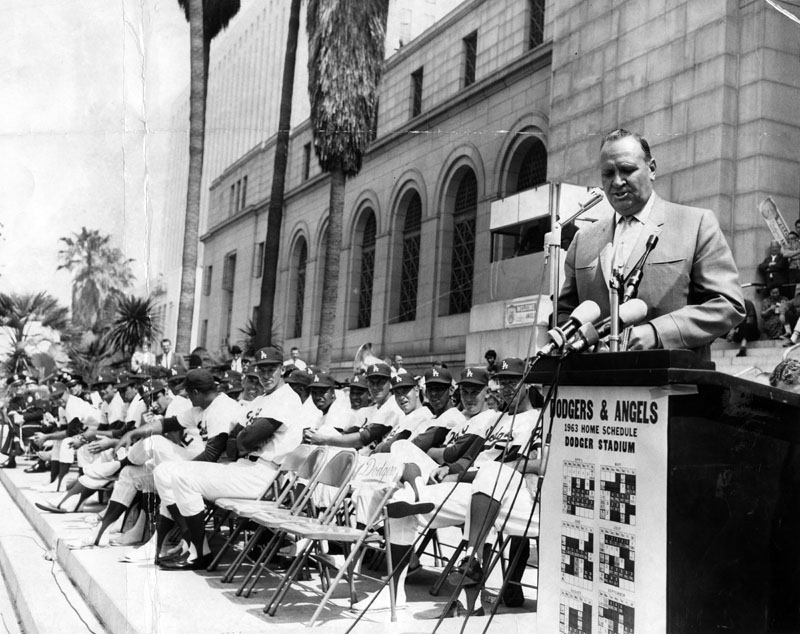
| (1963)* - Photograph caption dated April 6, 1963 reads, "Gene Autry, co-owner of the Angels, speaks a few words at City Hall ceremonies for the Angels and Dodgers." The Angels would share Dodger Stadium with the Dodgers for four seasons before moving to their new stadium in Anaheim in 1966. |
| Historical Notes
For four seasons, from 1962 through 1965, Dodger Stadium was home to both of Los Angeles's Major League Baseball teams. The American League's Los Angeles Angels, owned by a group headed by entertainer Gene Autry, had begun play in 1961 at Wrigley Field in South Los Angeles. When Dodger Stadium opened the following year, the Angels became tenants while plans moved forward for a permanent home of their own. To distinguish their temporary home from that of their National League rivals, the Angels generally referred to the ballpark as Chavez Ravine rather than Dodger Stadium. The arrangement created the unusual situation of two major-league teams from different leagues sharing the same Los Angeles ballpark. The Angels played their final season there in 1965 and moved to the newly completed Anaheim Stadium in 1966. |
* * * * * |
Angel Stadium of Anaheim
Originally known as Anaheim Stadium and later Edison International Field
The Los Angeles Angels, originally the California Angels, have a rich history that began in 1961. The team has undergone several name changes and has seen many ups and downs, including a World Series victory in 2002. Angel Stadium, their home since 1966, is a historic venue that has hosted numerous significant events and has undergone several renovations to maintain its status as a premier baseball facility.
 |
|
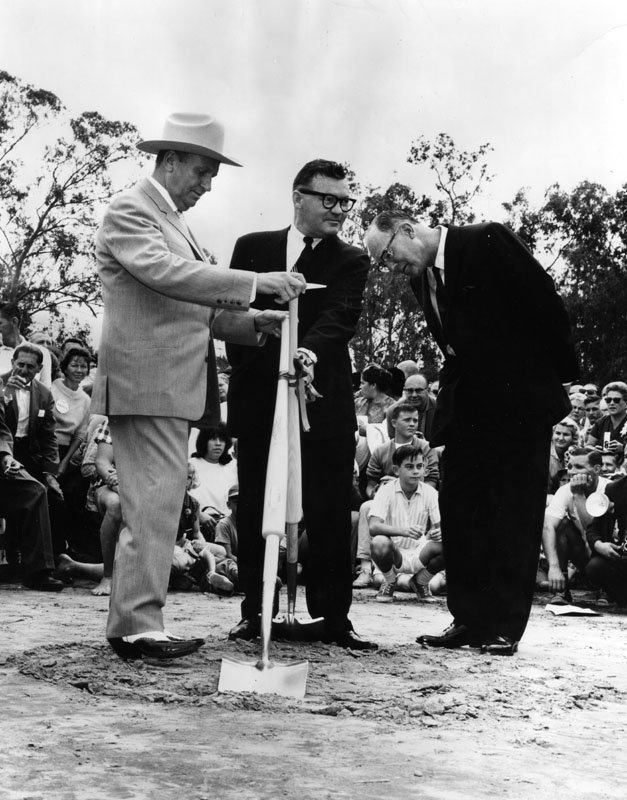
| (1964)* - The historic groundbreaking for Anaheim Stadium with Angels and City of Anaheim officials and large turnout of fans on hand, August 30, 1966. Participating in two-shovel ceremonies were, from left, Angels Chairman of the Board, Gene Autry, Anaheim's then Mayor Odra Chandler and Conractor Del Webb. The shovels had baseball bat handles. |
Historical Notes Work began almost as soon as the groundbreaking ceremony adjourned. Contractor Del E. Webb, who happened to own part of the New York Yankees, had pledged to complete the $15.8 million stadium by the opening day of the 1966 season. |
 |
|
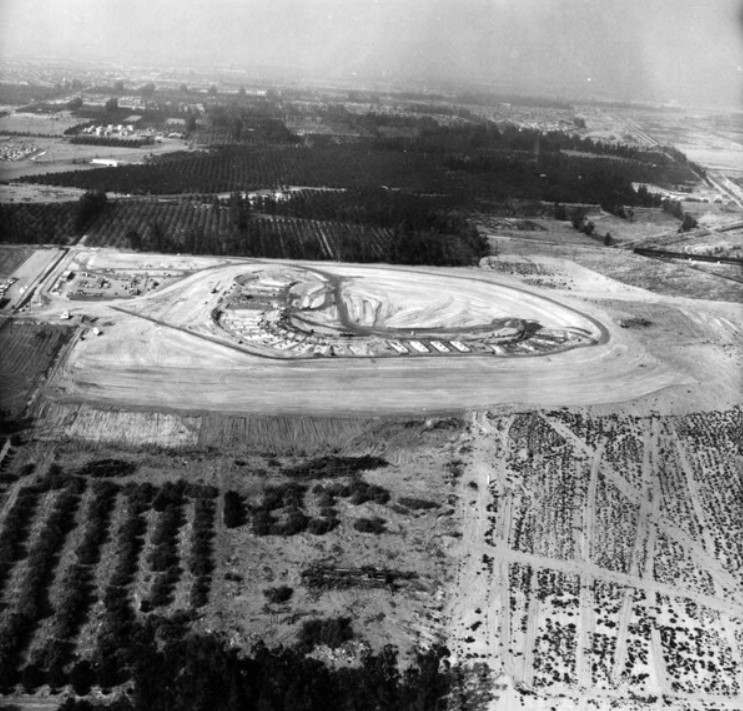
| (ca. 1964)* - Aerial view of the Anaheim Stadium site post-groundbreaking, but prior to construction, image shows view looking north, with orange groves in foreground and background. |
Historical Notes The stadium was built on a parcel of about 160 acres of flat land originally used for agricultural purposes in the southeast portion of Anaheim. |
 |
|
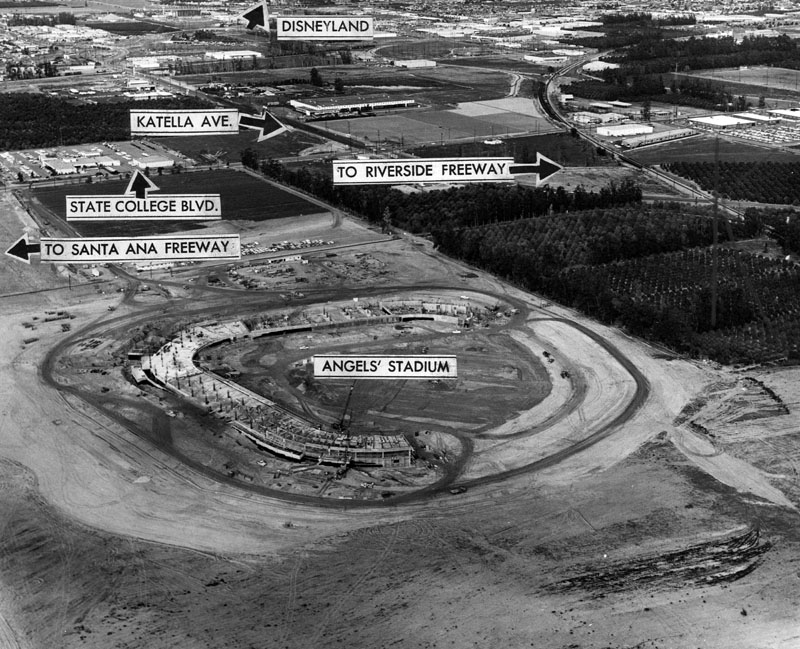
| (1965)* - Aerial view of the Anaheim Stadium construction site from February 1965 with landmarks labeled. |
Historical Notes Consistent with many major-league sports stadiums built in the 1960s, Anaheim Stadium is located in a suburban area, though one that is host to major tourist attractions. |
 |
|
| (1965)* – Aerial view showing the framework of the new stadium at Anaheim. At the top of photo is the Santa Ana Freeway with Orange Drive-in Theatre at top-center. Photo date: June 11, 1965 - LA Times - Framework |
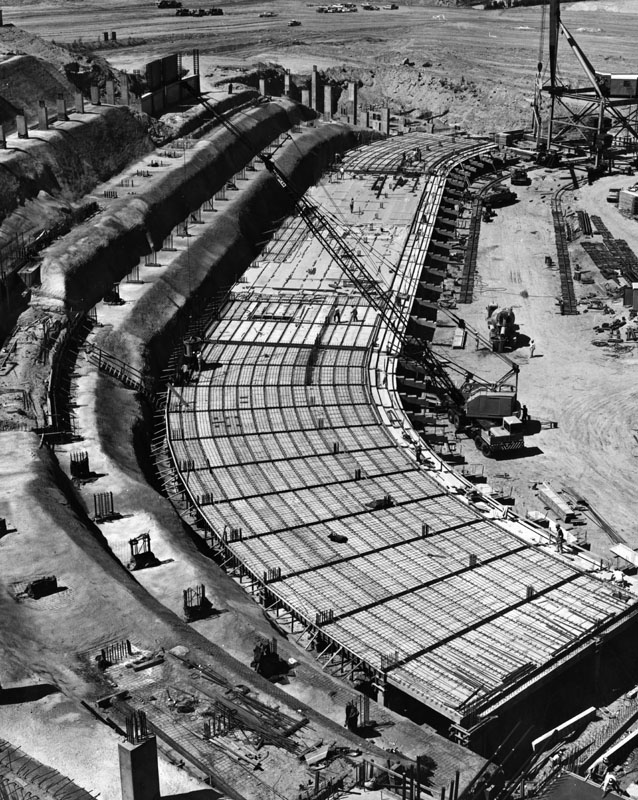 |
|
| (1965)* - View of a crane at work during the construction of the new Angel Stadium in Anaheim |
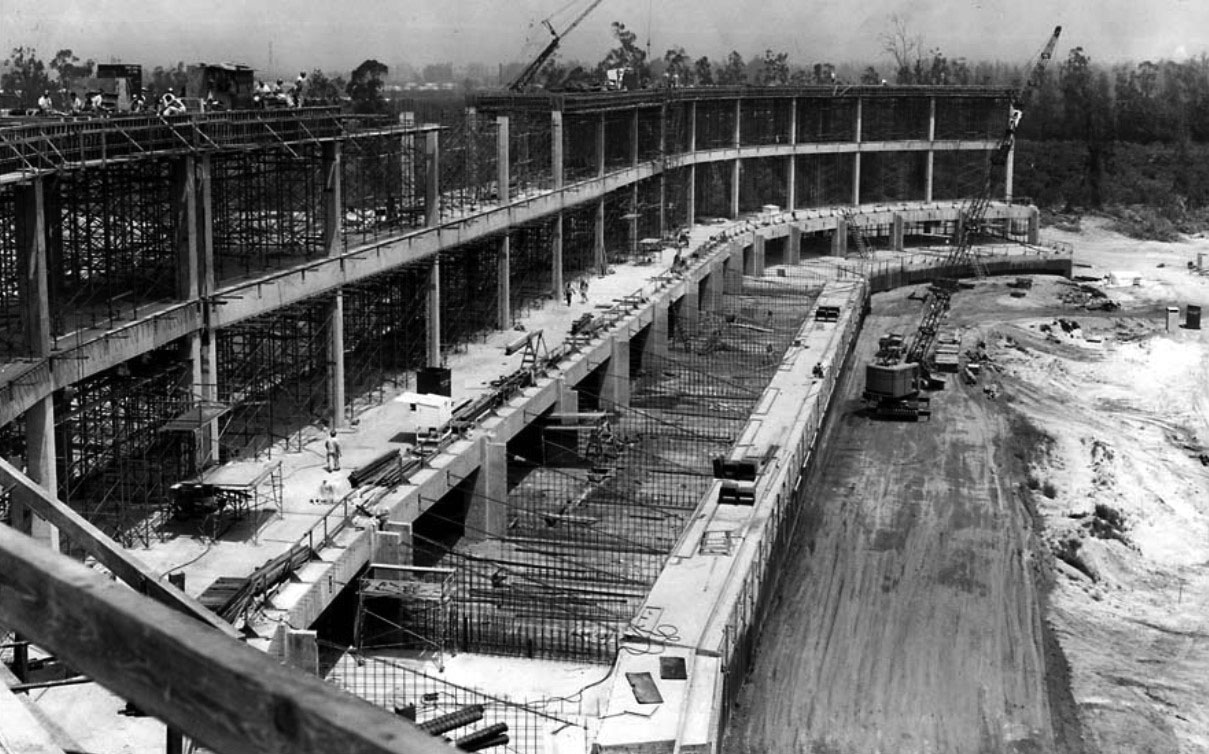 |
|
| (1965)* – Concrete is being poured during construction of Anaheim Stadium. The stadium was 21% completed when this image was taken on April 23, 1965. LA Times - Framework |
Historical Notes Over a 20 month construction period, Del Webb's construction workers poured 42,000 cubic yards of concrete, laid 7 million pounds of reinforcing steel and 8 million pounds of structure steel, and installed 1,900 light bulbs. |
 |
|
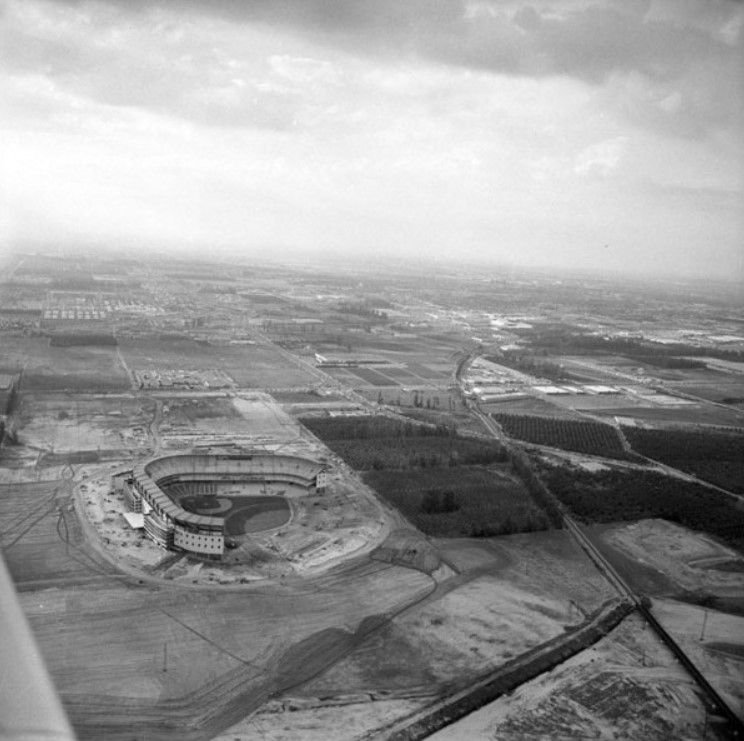
| (1966)* - Anaheim Stadium rises from a former cornfield in Anaheim. Courtesy of the Los Angeles Times Photographic Archive, UCLA Library. Used under a Creative Commons license. |
Historical Notes The stadium was built on a parcel of about 160 acres of flat land originally used for agricultural purposes by the Allec, Russell, and Knutzen families in the southeast portion of Anaheim. |
 |
|
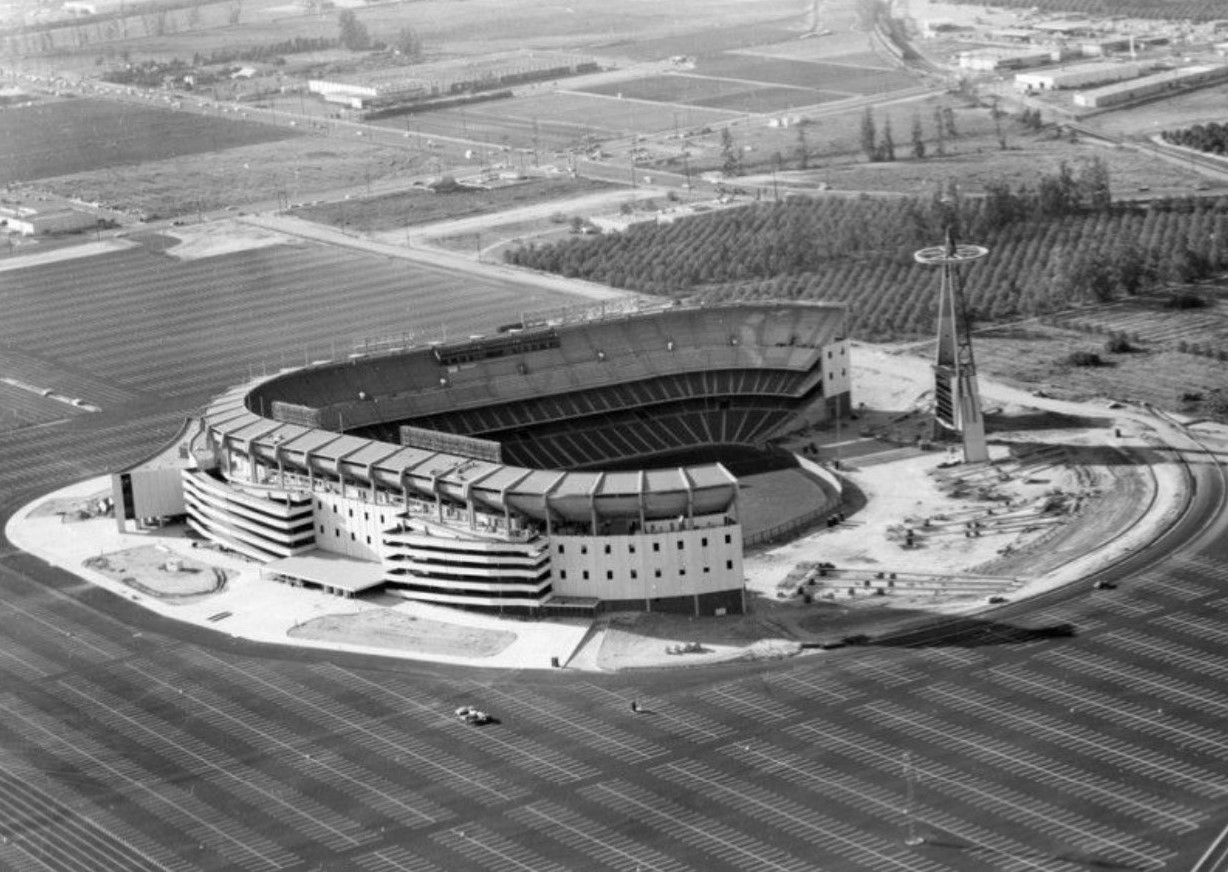
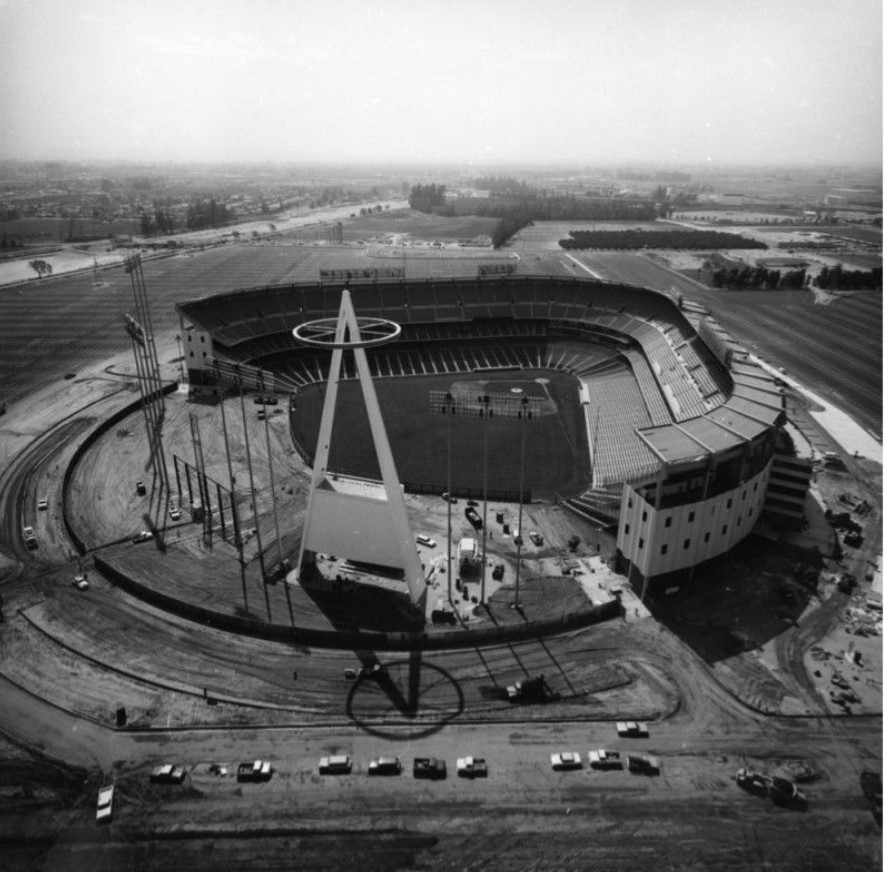
| (ca. 1966)* - Aerial view of the construction of the new Angel Stadium in Anaheim. Note the stadium lights laying in the foreground waiting to be installled. |
Historical Notes The field dimensions (333 feet instead of 347 or 350, for example) were derived from a scientific study conducted by the Angels. Based on the air density at normal game times (1:30 pm and 8 pm), the Angels tried to formulate dimensions that were fairly balanced between pitcher, hitter and average weather conditions. The Angels tinkered with those dimensions several times, expanding or contracting parts of the outfield by a few feet here and there, to try to refine that balance. 396 feet is the shortest center-field in the American League, and tied for 2nd-shortest in the major leagues with Petco Park behind only Dodger Stadium's 395 feet. |
 |
|
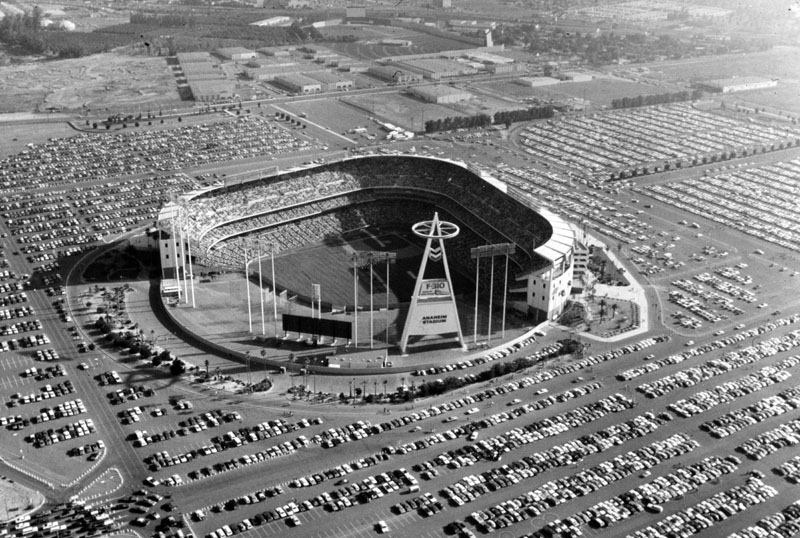
| (1966)* - View showing the Big A Socreboard during its unveiling. |
Historical Notes The Big A 230-foot high scoreboard support cost $1 million and was unveiled in 1966. It was moved to the parking lot in 1980. |
 |
|
| (1960s)* - One of the first games to be played at Anaheim Stadium (later known as Angel Stadium). Nothing caught the eye as much as the Big A: a 230-foot-tall A-shaped scoreboard that stood just behind the outfield fence. Naturally, a halo topped the structure. |
Historical Notes Angel Stadium, the fourth oldest active Major League Baseball stadium, was selected to host the 2010 Major League Baseball All-Star Game. The stadium also houses the studios and offices of the Angels' owned and operated flagship radio station, KLAA (830 AM). |
 |
|
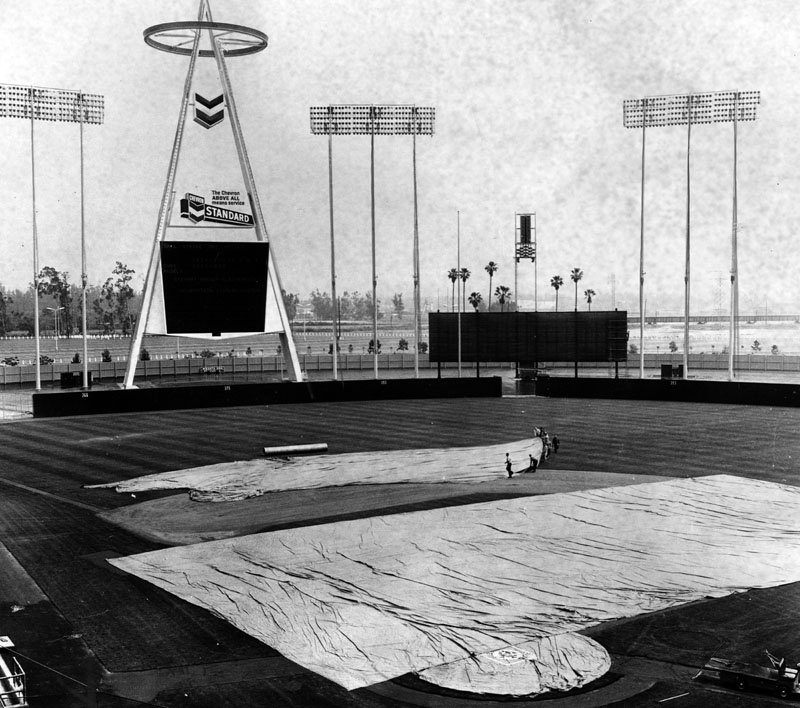
| (1967)* - View of the outfield and the Big A scoreboard at a rain-delayed game. Note that the stadium originally featured no bleachers or grandstands beyond the outfield. |
Historical Notes The design of the stadium was very similar to the popular Dodger Stadium, but without the outfield seats. Outfield bleacher seats were not in demand, Anaheim being in Orange County did not fit the image of the traditional bleacher bum. So no changes were necessary for this relatively new stadium. However, a new tenant wanted to move in, the Los Angeles Rams, and changes would be required to make this a multi-purpose stadium. Anaheim Stadium became a multi-purpose stadium between 1980 and 1996. When the deal was complete to bring the NFL Los Angeles Rams to Anaheim, major changes were needed. The stadium needed to become enclosed. Enclosing the stadium angered the baseball fans. By building grand stands in the outfield, the views of the mountains and infamous Big A scoreboard were going to be lost. The Big A scoreboard was moved to the parking lot. The additional stands increased the size of the stadium from 43,000 to 65,000. |
 |
|
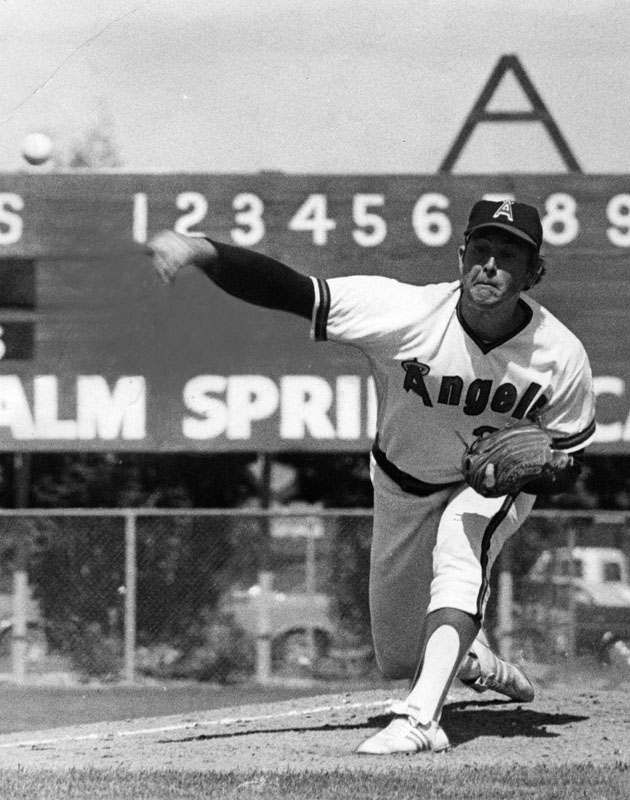
| (1970s)* - Pitcher Nolan Ryan throws a good one off the mound at Angels camp in Palm Springs. Nolan played on the Angels for eight seasons (1972 - 1979). |
Historical Notes In his first season with the Angels, Ryan, given a chance to pitch regularly as a starter for the first time in his career, had a league-leading 329 strikeouts—nearly a third more than the AL runner-up, and to that point, the fourth-highest total of the 20th century. Within five seasons, the season would only be Ryan's fourth-highest strikeout total. He also set a still-standing Major League record by allowing only 5.26 hits per nine innings, breaking Luis Tiant's 5.30 in 1968, as well as posting a 2.28 earned run average that year, to date the second lowest in franchise history, trailing only Dean Chance's 1.65 in 1964. Though Ryan's actual winning percentage hovered only slightly over .500, his strikeouts and no-hitters brought him media attention. |
 |
|
| (1982)* - This classic Reggie swing produced a classic Reggie home run to dead centerfield. He was a California Angel for 5 seasons (1982 - 1986). |
Historical Notes Reggie Jackson played 21 seasons and reached the post-season in 11 of them, winning six pennants and four World Series. His accomplishments include winning both the regular-season and World Series MVP awards in 1973, hitting 563 career home runs (sixth all-time at the time of his retirement), maintaining a .490 career slugging percentage, being named to 14 All-Star teams, and the dubious distinction of being the all-time leader in strikeouts with 2,597 (he finished with 13 more career strikeouts than hits). Jackson was the first major leaguer to hit one hundred home runs for three different clubs, having hit over 100 for the Athletics, Yankees, and Angels. |
 |
|
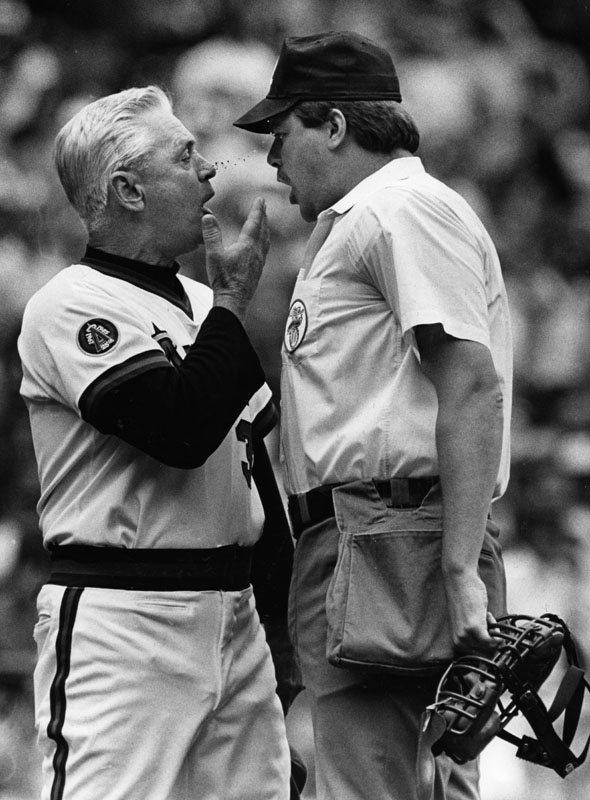
| (1982)* - Angels manager Gene Mauch (left) was ejected in the top of the first inning after questioning home plate umpire Tim Welke's strike-calling. |
Historical Notes Gene Mauch played in Major League Baseball as a second baseman for the Brooklyn Dodgers (1944, 1948), Pittsburgh Pirates (1947), Chicago Cubs (1948–49), Boston Braves (1950–51), St. Louis Cardinals (1952) and the Boston Red Sox (1956–57). Mauch was best known for managing four teams from 1960 to 1987. He is by far the winningest manager to have never won a league pennant, three times coming within a single victory. He managed the Philadelphia Phillies (1960-68), Montreal Expos (1969–75, Mauch was their inaugural manager), Minnesota Twins (1976–80), and California Angels (1981–82, 1985–87). His 1,902 career victories ranked 8th in major league history when he retired, and his 3,942 total games ranked 4th. He gained a reputation for playing a distinctive "small ball" style, which emphasized defense, speed and base-to-base tactics on offense rather than power hitting. Mauch gained a reputation for being loyal to his players and became known as the Little General. |
 |
|
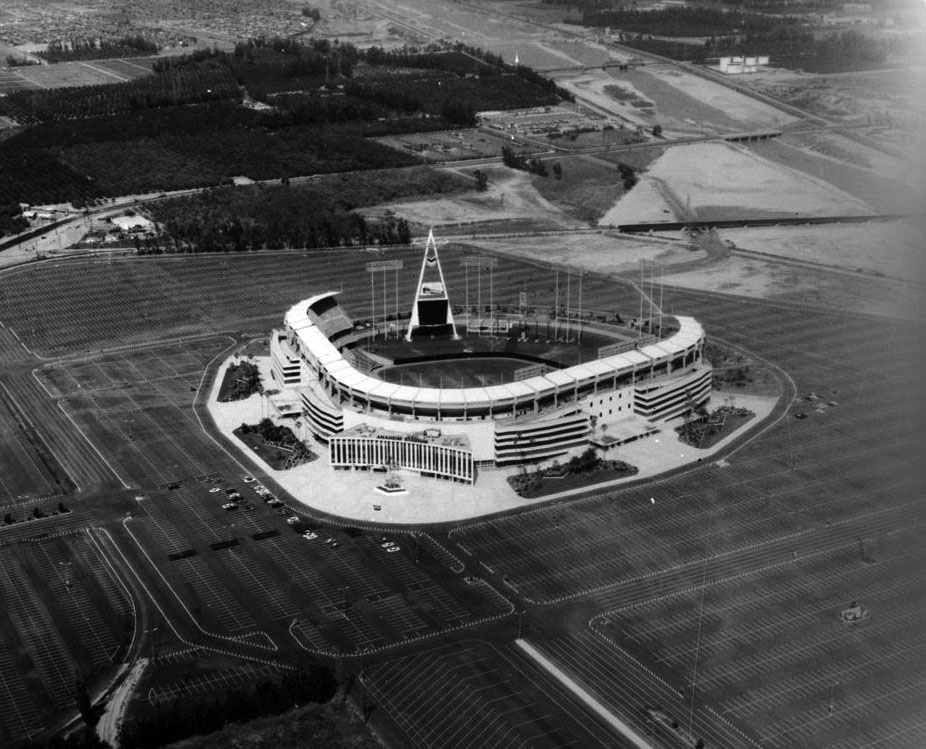
| (1968)^ - Aerial view of Anaheim Stadium. The parking lot looks empty except for a few cars near the stadium entrances. |
Historical Notes The original Anaheim Stadium seated 43,204 (later 43,250). The stadium underwent construction in 1979-80 for additional seating to accommodate the Los Angeles Rams of the NFL. Upon completion in 1981, the stadium seated 65,158 (later 64,593) for baseball. The Rams left Anaheim for St. Louis, MO in 1995. The new Angel Stadium of Anaheim has a seating capacity of approximately 45,050 for the Los Angeles Angels. |
 |
|
| (1970s)^ – Aerial view of Anaheim Stadium before it was totally enclosed. Photo Courtesy of Angels Baseball |
Historical Notes In the late 1970s, Anaheim Stadium tried to earn extra revenue any way it could. It staged more rock concerts, motocross events and brought in new (and briefly) successful tenants in soccer’s California Surf and the Southern California Sun of the short-lived World Football League. But just as they had wooed an unhappy Angels franchise out of Dodger Stadium 15 years earlier, local politicians were now sniffing out another disgruntled tenant in 1978 when they heard that the NFL’s Los Angeles Rams were looking to upgrade from their current situation at the ancient Los Angeles Memorial Coliseum. Anaheim and Orange County were hardly clandestine in their efforts to woo the Rams, even placing a full-page pitch to them in the Los Angeles Times. The ballpark would do more than just add 20,000 makeshift seats in right field, as had been planned for the Chargers back in 1966; this time the idea was to turn Anaheim Stadium into a fully enclosed, multi-purpose facility, tucking into the back of the second level 107 brand new luxury suites—all for the Rams to own and profit from. Like Gene Autry before him, Rams owner Carroll Rosenbloom was happily on board with the concept and told Anaheim he’d be theirs. Autry and the Angels were fine with the ambitious $33 million project to enclose and expand Anaheim Stadium to 67,000 seats, even if it meant wrecking the baseball ambience. Just to be sure there was no ill will, the Rams played nice and offered to buy Angels season tickets for every row that butted up against the front of the new luxury boxes. But when Autry discovered that the expansion pact also called for a high-rise business complex to be built for the Rams on part of the existing parking lot, smiles became snarls. The Angels sued Anaheim, triggering a 12-year battle in which the Angels, the Rams and the City of Anaheim all took turns suing one another over control of the parking lot. Finally, in 1994, it was ruled that the lots belonged to the city but needed to be fully used by the Angels, negating any chance for development. |
 |
|
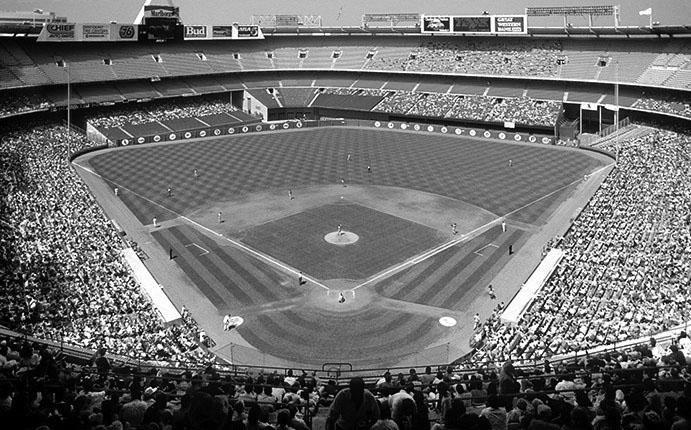
| (1980s)^ - Anaheim Stadium after being enclosed to accommodate football. The field dimensions were kept symmetrical in front of a purely asymmetrical bleacher setup. Photo Courtesy of Angels Baseball |
Historical Notes The Big A scoreboard was moved to the south end of the parking lot when Anaheim Stadium was enclosed in 1980. Talk of bringing it back during the ballpark’s second makeover ended when it was determined it would be too costly to do so. In 1998, the stadium was renamed Edison International Field of Anaheim after local utility Edison International reached a deal giving it naming rights over the stadium for 20 years, and during this time, the stadium was referred to as the Big Ed. However, after the 2003 season, Edison International exercised its option to exit the sponsorship deal. On December 29, 2003, the Angels announced that from then on the stadium would be known as Angel Stadium (in full, Angel Stadium of Anaheim), some locals can still be caught calling the venue by its original name; Anaheim Stadium as well. After the name change in 2004, its original nickname The Big A was restored. Despite efforts to cover them up with the Angels' halo insignia, Edison's insignia can still be found on the ends of seating rows throughout the ballpark. |
* * * * * |
More Historical Early Views
Newest Additions
Early LA Buildings and City Views
History of Water and Electricity in Los Angeles
* * * * * |
References and Credits
* LA Public Library Image Archive
^*Library of Congress: Washington Park
^^Rule 19 Blog - Vernon Tigers
#*Facebook: Photos of Los Angeles
^#Nuestra Señora la Reina de los Ángeles: losangelespast.com
^**Hidden Los Angeles - Facebook.com: Sandy Koufax
^^*Skyscraperpage.com: Team Photo
^^^KCET: When the Los Angeles Angels Flew to Anaheim
^*^Anaheim Public Library Image Library
*#*Pinterest.com: Memories in the SFV, 60's, 70's, & 80's
*#^Gizmodo.com: How 19 Earthmovers Carved Dodger Stadium
^#^Calisphere: University of California Image Archive
**#Sports-Venues.info: Anaheim Stadium
#**Classic Hollywood/LA/SFV - Facebook.com
#^^100 Years of Scoreboard Watching
*^Wikipedia: Dodger Stadium; Angels Stadium; Nolan Ryan; Reggie Jackson; Los Angeles Angels (PCL); Los Angeles Angels of Anaheim; Gilmore Field; Chutes Park; Gene Mauch; Hollywood Stars; Bill Russell; Davey Lopes; Tommy Lasorda; L.A. Dodgers - 1959 Season; Walter Alston; Sandy Koufax; Johnny Podres; Tommy Lasorda; Vince Scully
< Back