Los Angeles Central Library |
Downtown Los Angeles |
Introduction |
The Los Angeles Public Library is one of the city's most recognizable civic landmarks. Located at 630 West Fifth Street, the Central Library opened on July 6, 1926, at a time when Los Angeles was rapidly transforming into a major American city.
|
The Completed Landmark |
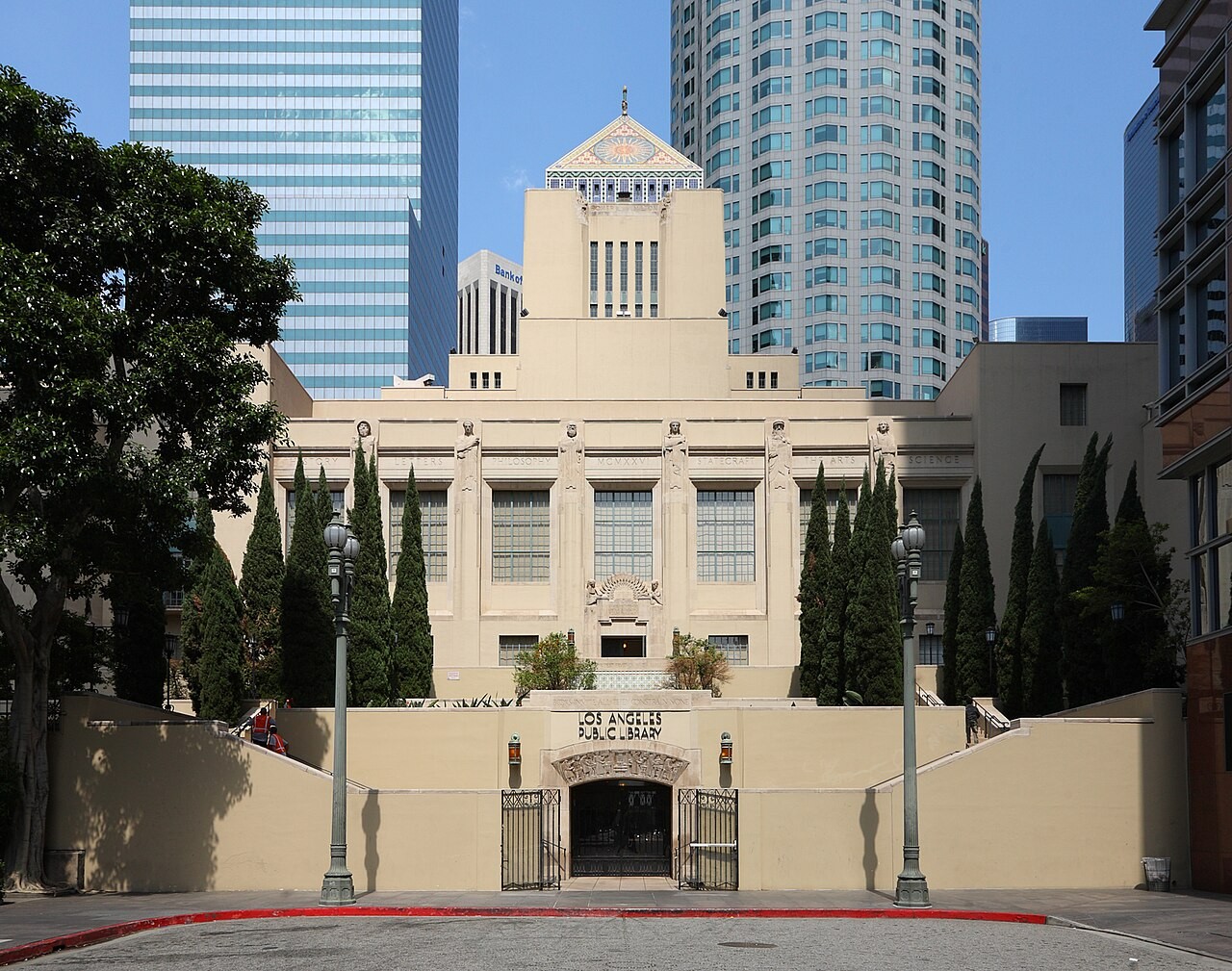
This opening view shows the Central Library as it stands today. Despite the rise of modern towers around it, the building remains a powerful visual anchor in the heart of downtown. |
 |
|
| (2009)* - South Hope Street entrance of the Los Angeles Central Library, looking toward the main facade. Photo by Matthew Field / Wikipedia, 2009. |
| Historical Notes
The structure seen today combines the original 1926 Goodhue Building with the Tom Bradley Wing, a 330,000-square-foot addition completed in 1993. Together they form the Richard J. Riordan Central Library, the third largest public library in the United States by book and periodical holdings. The pyramid-topped tower is the building's defining feature. Covered in colorful mosaic tile, it symbolizes the pursuit of knowledge through a program called the Light of Learning, developed by University of Nebraska philosophy professor Hartley Burr Alexander. Sculptural figures in limestone by artist Lee Lawrie, along with inscriptions across the facade, reflect themes of history, science, literature, and art. The building was designated Los Angeles Historic-Cultural Monument No. 46 in 1967 and listed on the National Register of Historic Places in December 1970. |
Building the Central Library |
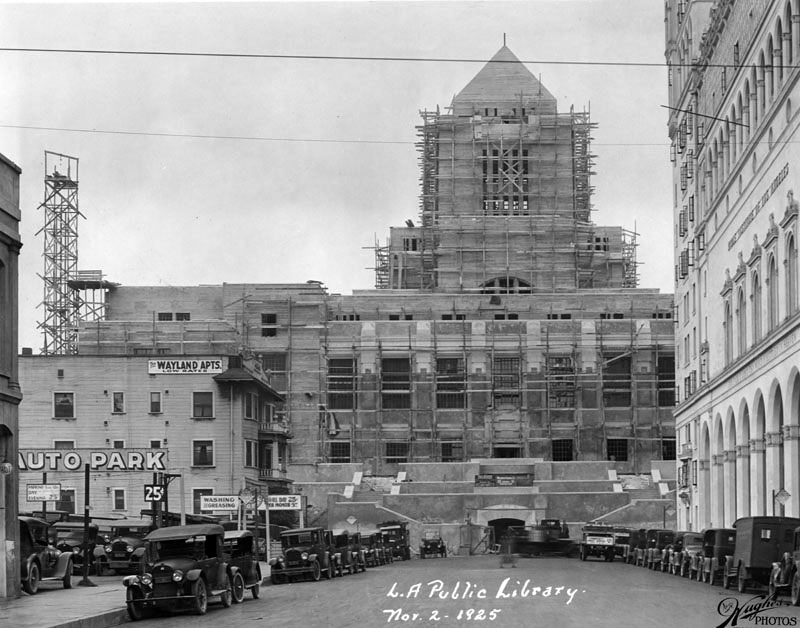
Before it became a landmark, the Central Library was an active construction site. These views capture the building as it neared completion, still wrapped in scaffolding and surrounded by a growing downtown.
|
.jpg) |
|
| (1925)* - Construction of the Los Angeles Public Library, southeast corner of Fifth Street and Grand Avenue, 1925. The structure is nearly complete and covered in scaffolding. Automobiles fill the Savoy Auto Park in the foreground. |
| Historical Notes
This view shows the library nearly finished, with scaffolding covering most of the exterior. Workers used these frameworks to install stonework, complete decorative elements, and finish the upper portions of the tower. The Savoy Auto Park visible in the foreground charged twenty-five cents for all-day parking. Automobiles throughout the frame reflect the growing dominance of car travel in Los Angeles during the 1920s, when the city was shifting rapidly away from its earlier streetcar network. |
 |
|
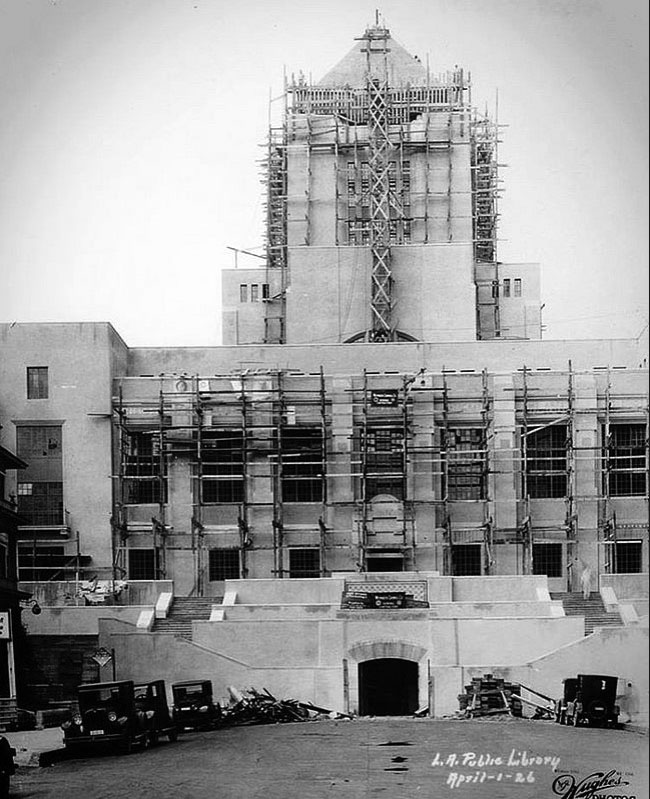
| (1925)* - Construction of the Los Angeles Public Library, looking north on Hope Street, 1925. The scaffolding covers the south facade and tower. A sign reads "Weymouth Crowell Co. — General Contractors." The Bible Institute, later the Church of the Open Door is visible at right. |
| Historical Notes
From this angle, the scaffolding emphasizes the vertical rise of the building and its central tower. The upper levels and decorative crown were among the final elements to be completed. Hope Street ends at the library's south facade in a cul-de-sac, giving the building a commanding presence from this approach. Goodhue designed each of the four entrances with a distinct character; the Hope Street side was conceived as a temple-like portico rising from ascending terraces. |
 |
|
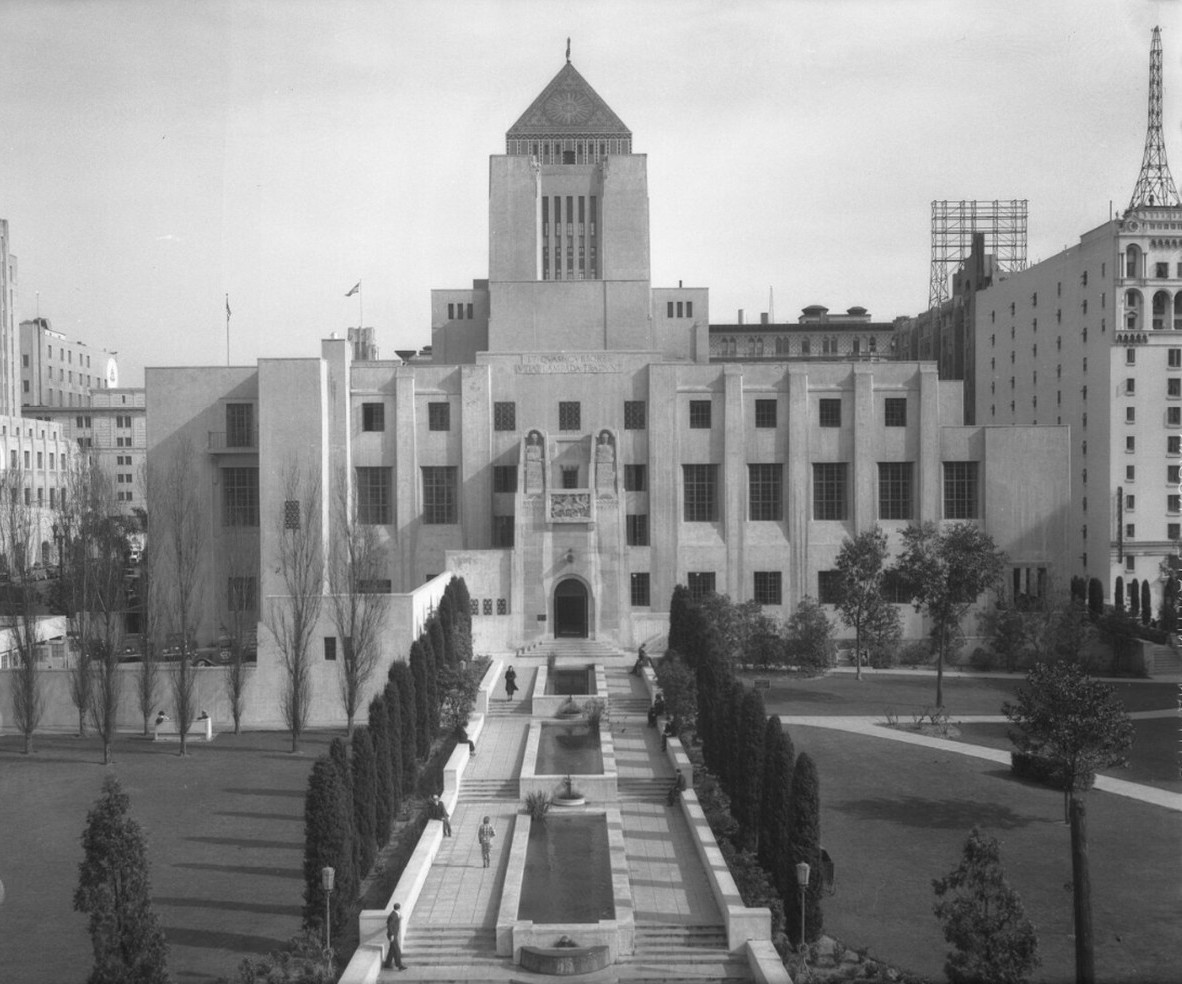
| (1926)* – The Central Library nearing completion, looking north on Hope Street, 1926. Much of the scaffolding has been removed, revealing the finished facade and tower. |
| Historical Notes
By 1926, much of the scaffolding had been removed, revealing the finished facade and its decorative detail. The library opened to the public on July 6, 1926, with a formal dedication ceremony on July 15. In the weeks before opening, 300,000 books, 4,000 catalog drawers, and tons of records were transferred from the library's previous home at the Metropolitan Building on Fifth Street. The new facility offered 190,000 square feet of space and thirteen public reading rooms — a major expansion in both scale and capacity. |
A New Civic Landmark |
With construction complete, the Central Library took its place as one of the defining buildings in downtown Los Angeles. These early exterior views show the building settled into its surroundings and open to the city. |
 |
|
| (ca. 1935)* - The Flower Street facade of the Los Angeles Central Library, looking east, ca. 1935. The Church of the Open Door is visible to the right. |
| Historical Notes
Goodhue added the Flower Street entrance in 1923 after the city acquired adjacent properties along that block, expanding the building's western footprint. Each of the four entrances was given a distinct architectural character. On this facade, sculptor Lee Lawrie placed two limestone figures named Phosphor and Hesper, representing the morning and evening stars, flanking the entry portal. The Library Board originally expected a Spanish Colonial Revival design similar to Goodhue's work for the 1915 Panama-California Exposition in San Diego. By the early 1920s, however, he had shifted toward cleaner, more modern forms. The Central Library, along with the Nebraska State Capitol, is now considered among the most innovative work of his career. |
Inside the Central Library |
The Central Library was designed not only for function but to move people. Its interior spaces combine practical design with an ambitious program of art, symbolism, and craftsmanship that Goodhue believed every great public building deserved. |
 |
|
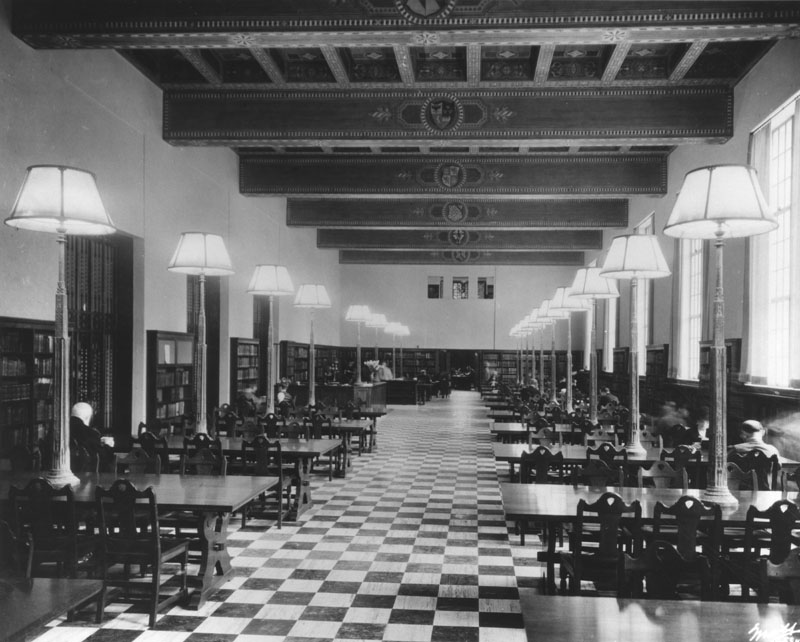
| (1926)* - Interior of the History Department, Los Angeles Central Library, looking toward the Travel and Biography section, 1926. Long reading tables with individual lamps fill the room beneath painted ceiling beams. |
| Historical Notes
Originally known as the Reference Room, this was the largest reading room in the building when the library opened. Long tables, individual lamps, and high ceilings created an environment designed for sustained study and research. Goodhue believed that public buildings should combine function with artistic expression, and the painted ceiling beams and patterned floors visible here reflect that conviction. The decorative stencilwork on the ceilings throughout the main level was executed by Los Angeles artist Julian Garnsey, who also designed the dome of the Rotunda. |
 |
|
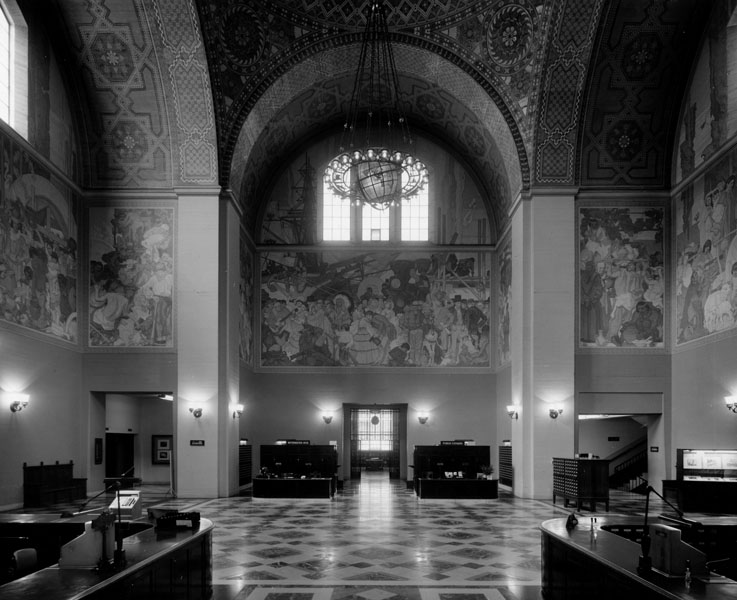
| (ca. 1929)* - The Central Library rotunda showing checkout desks, the card catalog, and Dean Cornwell's murals on the upper walls. |
| Historical Notes
The Rotunda served as the heart of the library, where visitors checked out books, consulted the card catalog, and moved between reading rooms. The murals on the upper walls were painted by Dean Cornwell, an illustrator who wanted to establish himself as a fine arts muralist. He won the commission with a design that incorporated the full height of the upper walls, including the lunettes that other competing artists had left blank. Cornwell spent nearly six years on the project. The four major panels, each forty feet wide, were installed in 1933 and depict four eras of California history: Cabrillo's Discovery, the Building of the Missions, the Founding of the Pueblo of Los Angeles, and the Americanization of California. The area sustained smoke damage during the arson fire of April 29, 1986, but was carefully restored during the renovation completed in 1993. |
 |
|
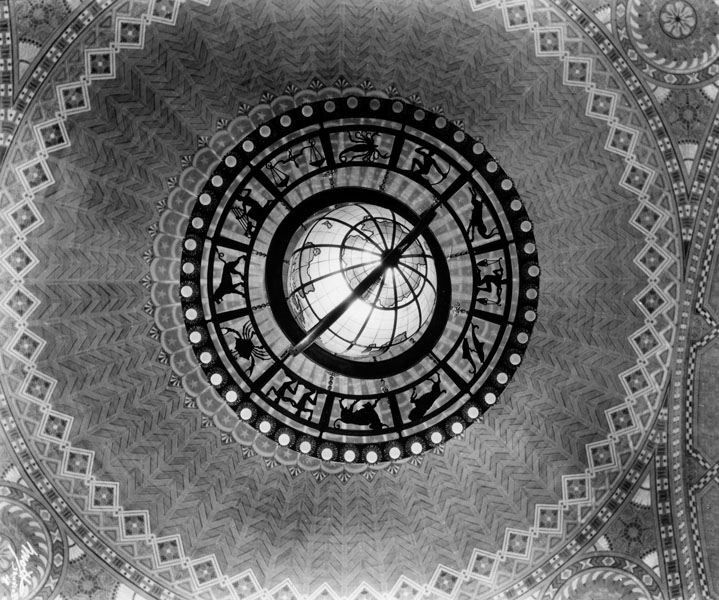
| (ca. 1929)* - The Zodiac Chandelier in the rotunda of the Los Angeles Central Library |
| Historical Notes
The Zodiac Chandelier was designed by Goodhue Associates and modeled by Lee Lawrie. Cast in bronze, it measures nine feet in diameter and weighs one ton. The globe at its center is encircled by the signs of the zodiac, and the fixture is lit by 48 bulbs — one for each of the 48 states in the Union when the building opened in 1926. The chandelier hangs beneath the dome's sunburst ceiling, connecting the interior decorative program to the pyramid and torch visible on the exterior tower above. The sunburst on the dome mirrors the sunburst on the pyramid, reinforcing the building's central theme of light and learning at every scale. |
A Landmark Under Threat and Saved |
Over the decades, the Central Library has remained a defining feature of downtown Los Angeles. It survived a prolonged threat of demolition in the 1970s, two arson fires in 1986, and an earthquake in 1987, emerging from each challenge through the efforts of preservationists, civic leaders, and ordinary Angelenos who recognized what was at stake. |
 |
|
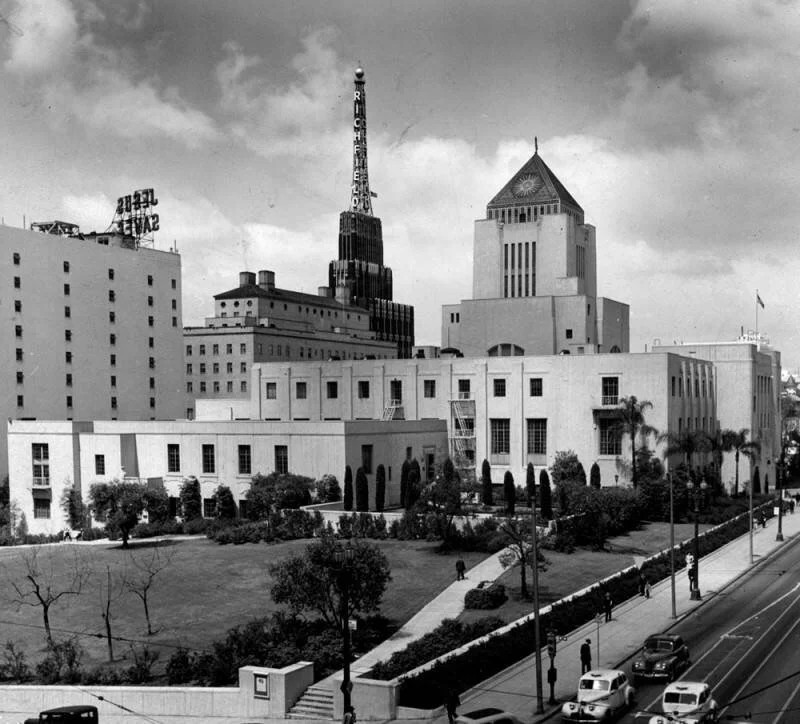
| (1949)* - The Los Angeles Central Library viewed from Fifth and Grand streets. The Richfield Tower rises behind the building at left; the California Club is visible beyond. |
| Historical Notes
By 1949, the library had been a working civic institution for more than twenty years and downtown Los Angeles had grown considerably around it. The Richfield Tower visible behind the building was a striking Art Deco skyscraper completed in 1929, clad in black and gold tile. It would itself be demolished in 1969 to make way for the Atlantic Richfield Plaza complex, a reminder that even celebrated landmarks can disappear when preservation efforts fall short. The Central Library faced its own demolition threat in the 1970s, when city officials proposed replacing it rather than funding a costly renovation. That prospect galvanized preservation advocates across Los Angeles and played a direct role in the founding of the Los Angeles Conservancy in 1978. Saving the Central Library became one of the organization's first major victories and shaped how the city approached its historic built environment for decades to come. On April 29, 1986, an arsonist set the library ablaze. More than 250 firefighters from 49 companies responded, and the battle lasted over seven hours. Some 400,000 volumes were destroyed and 700,000 more were damaged by water and smoke. A second fire struck on September 3 of that year, destroying 25,000 additional books from the music collection. The twin disasters finally forced action on a renovation plan that had been stalled for nearly two decades. A public fundraising campaign co-chaired by Mayor Tom Bradley raised $10 million toward replacing the lost collection. The restored and expanded library, with the new Tom Bradley Wing added, reopened on October 3, 1993. |
.jpg) |
|
| (2013)* – The Los Angeles Central Library tower. Photo by Carol Highsmith, Library of Congress. |
| Historical Notes
It is hard to imagine downtown Los Angeles without the Central Library. The pyramid tower remains the building's defining feature nearly a century after it was built. Atop the pyramid, a hand holds a torch as a beacon. At the base of the finial, a coiled snake represents wisdom. The original ceramic finial has been removed for preservation; a replica stands in its place, and the original is now displayed on the library's main floor. Surrounding the tower, Lee Lawrie arranged allegorical figures of eight great thinkers and writers, presented in pairs and each holding an identifying attribute. Hartley Burr Alexander called them the Seers of Light: David the Psalmist and Saint John of the Apocalyptic Vision, Homer and Milton, Shakespeare and Goethe, and Plato and Dante. Together they embody the Light of Learning theme that runs through every element of the building, from the pyramid above to the murals and chandelier within. The pyramid's influence did not stop at the library's walls. When architects John Parkinson, Albert Martin, and John Austin designed Los Angeles City Hall just two years later, they looked directly to this tower. City Hall's own stepped pyramid cap, completed in 1928 and rising 454 feet above downtown, drew on the Library's design as one of its acknowledged sources. The two pyramids still face each other across the same downtown skyline today, separated by less than half a mile — the civic library and the seat of city government, both reaching upward with the same ancient form, built within two years of each other at the moment Los Angeles was becoming a world city. |
Then and Now |
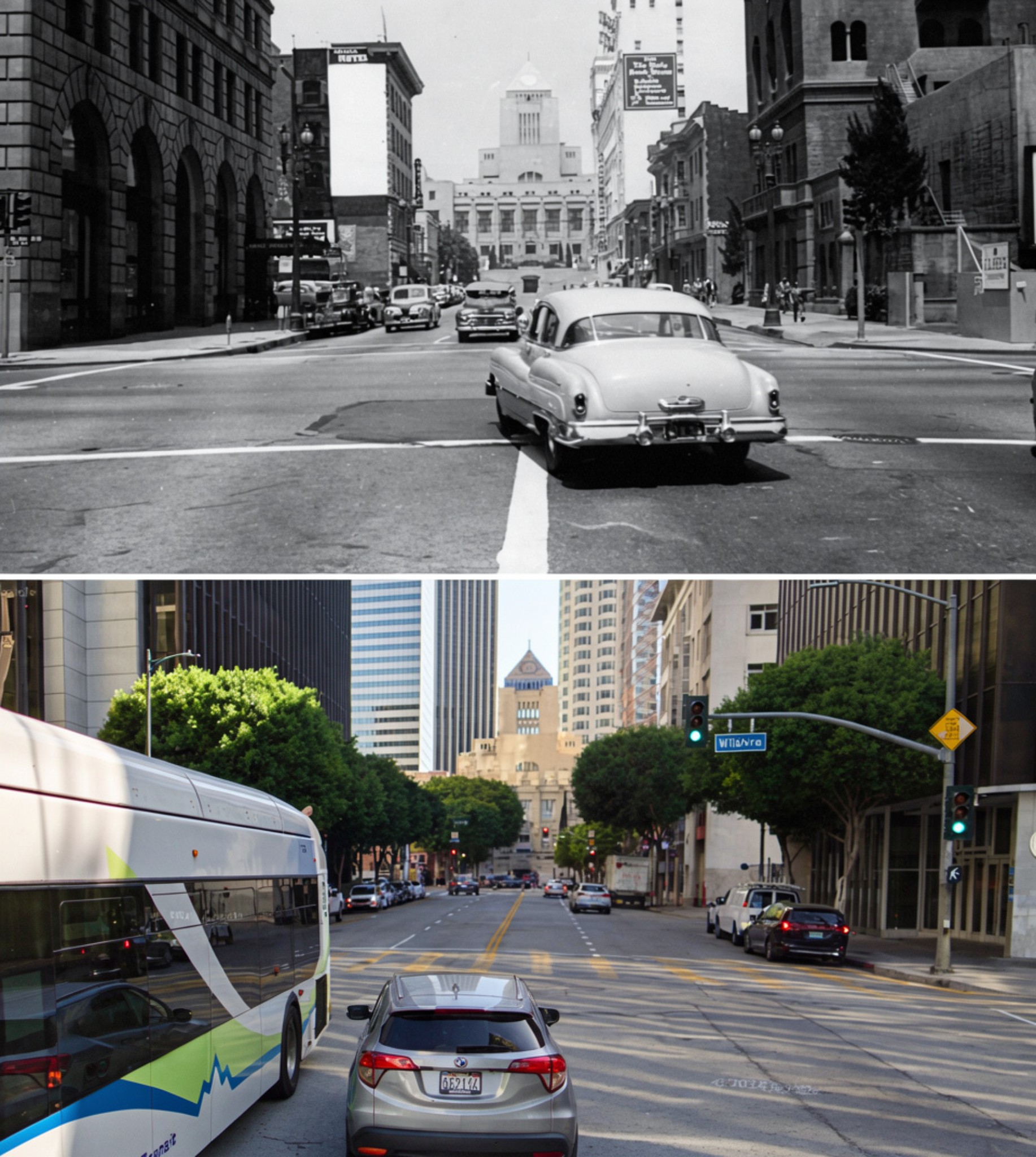
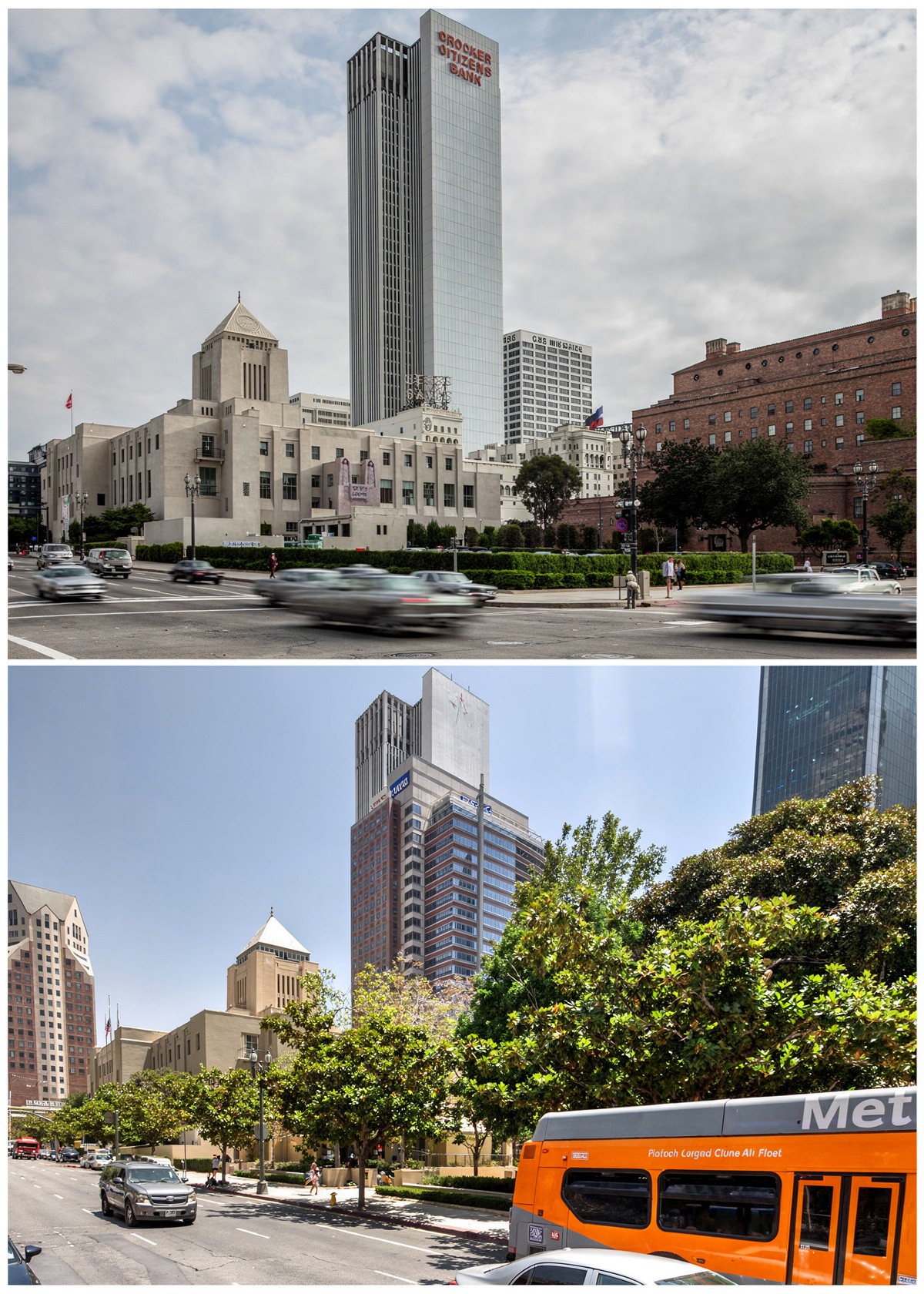
The Central Library has remained remarkably consistent in form, even as the city around it has transformed completely. These comparisons show both what has changed and what endures. |
 |
|
| (1951 vs 2024)* – Then and Now: Looking north on Hope Street toward the Los Angeles Central Library. Photo comparison by Jack Feldman. |
| Historical Notes
In 1951, the Central Library was among the most prominent structures visible from this approach. By 2024, it sits in the shadow of towers that include the U.S. Bank Tower, originally known as the Library Tower. That name was not accidental. When the library faced its deepest crisis in the 1980s, a preservation plan allowed it to sell unused air rights to private developers. The proceeds helped fund the building's restoration, while those rights made possible what became the tallest building on the West Coast. The building's form, materials, and symbolic design remain essentially unchanged from Goodhue's original plans. The pyramid still catches the afternoon sun. The torch still rises at its apex. The inscriptions carved into the limestone facades carry the words Hartley Burr Alexander wrote nearly a century ago. Nearly a century after it opened, the Central Library remains exactly what it was intended to be: a civic monument to knowledge at the center of the city. |
 |
|
| (1971 vs 2022)* – Then and Now: Looking toward the Central Library at the corner of Flower and Fifth streets. Top photograph colorized for clarity. Photo comparison by Jack Feldman. |
| Historical Notes
The 1971 photograph was taken during a period when the library's future was actively uncertain. Proposals to demolish and replace the building had been circulating since the late 1960s. These were driven by concerns about overcrowding, fire safety, and the cost of bringing the aging structure up to modern standards. The renovation that eventually saved the building — designed by Hardy Holzman Pfeiffer Associates and completed in 1993 — added a 330,000-square-foot wing while carefully restoring the original Goodhue Building. The Central Library reopened on October 3, 1993, drawing an estimated 80,000 visitors on its first day back. In 2026, the Central Library marks its centennial under the theme "Central 100." The time capsule sealed in the cornerstone during construction was opened on January 29, 2026, revealing documents, photographs, and records capturing Los Angeles at two distinct moments — the 1880s and the early 1920s. The city that placed those materials in the wall could not have imagined what the building above them would endure and become. |
* * * * * |
|
Other Sections of Interest |
|
Water and Power in Early LA |
|
Newest Additions |
New Search Index |

A new SEARCH INDEX has been added to help navigate through the thousands of topics and images found in our collection. Try it out for a test run.
Click HERE for Search Index |
* * * * * |
< Back