Gaylord Apartments |
3355 Wilshire Boulevard, Los Angeles |
Introduction |
When the Gaylord Apartments opened its doors on April 9, 1924, it introduced Los Angeles to something new: high-rise urban living designed as a permanent home. Built directly across Wilshire Boulevard from the Ambassador Hotel, the 13-story Renaissance Revival tower brought New York-style apartment house living to a city still defining itself. Its architects, Walker and Eisen, gave the building a scale and dignity that made it one of the most recognizable structures along the boulevard from the day it was completed.
|
 |
|
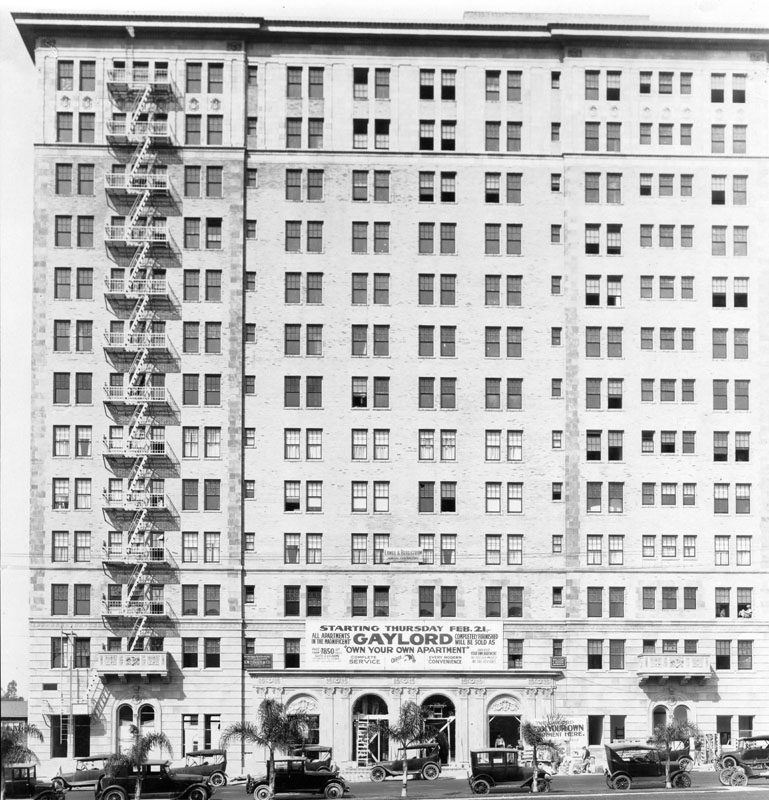
| (ca. 1929)* - View of the Gaylord Apartments at 3355 Wilshire Boulevard, directly across from the Ambassador Hotel. A large promotional banner above the main entrance announces an "own your own apartment" offering, with furnished units starting at $7,850 and financing over 17 years. Smaller signs identify architects Walker and Eisen and contractors Lange and Bergstrom. |
| Historical Notes
The banner captures a pivotal moment in the building's history. After its cooperative ownership model faltered in the mid-1920s, the Gaylord repositioned itself to attract buyers seeking both luxury and stability on one of the city's most fashionable streets. The offer reflected a bold early attempt to combine apartment living with ownership, an idea well ahead of its time in Los Angeles. Units were marketed with large kitchens and a central refrigeration system, among the first in the city to allow tenants to freeze their own ice cubes. |
 |
|
| (ca. 1925)* - Aerial view of the Gaylord Apartments and the surrounding Wilshire Boulevard corridor, showing the building's relationship to the Ambassador Hotel and the residential and commercial district developing to the west. |
| Historical Notes
By the mid-1920s, this stretch of Wilshire Boulevard was beginning its transformation into one of Los Angeles’s most desirable residential corridors. Large apartment buildings like the Gaylord rose alongside established landmarks such as the Ambassador Hotel, signaling a shift from low-density development to a more urban, upscale character. In the years that followed, the corridor would gain additional prominence with the arrival of destinations such as the Brown Derby (1926) and Bullocks Wilshire (1929), helping to solidify Wilshire’s reputation as both a fashionable address and a major commercial thoroughfare. Even at this earlier date, the Gaylord stood prominently along the boulevard, directly across from the Ambassador’s broad front lawn. |
The Man Behind the Name |
Henry Gaylord Wilshire was one of the more unusual figures in the history of Los Angeles real estate. An outspoken socialist who declared that all men could be classified as either fools or socialists, he was also a land speculator of considerable ambition. In 1895, Wilshire began developing 35 acres west of Westlake Park as an exclusive residential subdivision. He donated a strip of land to the city for a boulevard on two conditions: it would carry his name, and it would be permanently closed to railroad lines and commercial trucking.
|
Builders, Architects, and a Grand Opening |
In 1923, developers J.B. Lilly and Paul Fletcher purchased land on the northwest corner of Wilshire Boulevard and Kenmore Avenue, directly across from the Ambassador Hotel, which had opened in 1921 and quickly become the social center of both Hollywood society and old-money Los Angeles. Construction of the Gaylord began in January 1923.
|
A Cooperative That Did Not Hold |
The Gaylord was conceived as one of Los Angeles's first cooperative apartment buildings. Buyers were offered the chance to elect their own board of governors and shape the community as co-owners rather than renters. A sales agent promoted the arrangement as a democratic and progressive way to live, and some buyers paid mortgages of $14,250 or more for their units.
|
 |
|
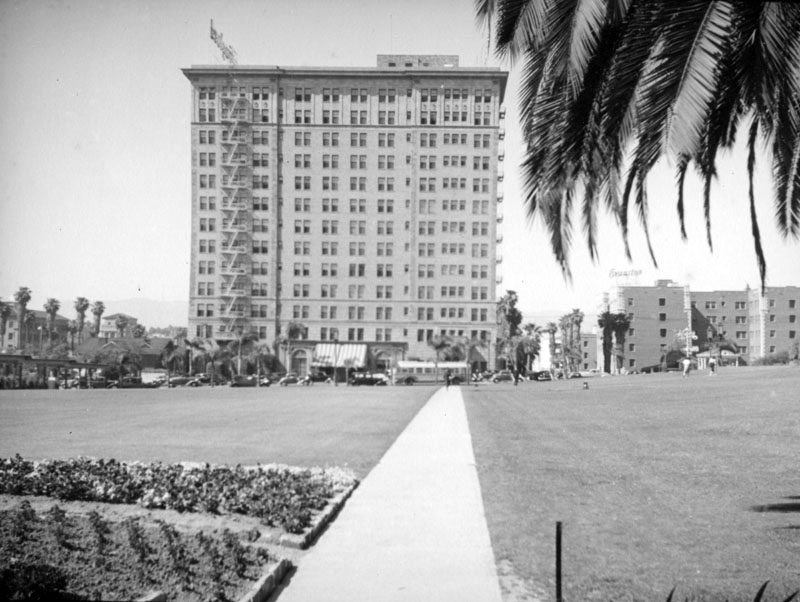
| (ca. 1938)* - View of the Gaylord and the neighboring Evanston Apartments as seen from the lawn of the Ambassador Hotel, showing the mature residential density along this block of Wilshire Boulevard. |
| Historical Notes
Architects Walker and Eisen designed the Gaylord in a Renaissance Revival style that set the tone for the residential towers that followed along Wilshire through the late 1920s and into the 1930s. The six-story Evanston Apartments, visible east of the Gaylord, was located at 630 South Kenmore Avenue and built in the late 1920s. It was later demolished, and its site is now occupied by the 1967 Wilshire Square building designed by Langdon and Wilson. The surrounding corridor, which also included the Asbury, Langham, Fox Normandie, Piccadilly, and Windsor apartment houses, drew comparisons at the time to the great residential avenues of New York. |
 |
|
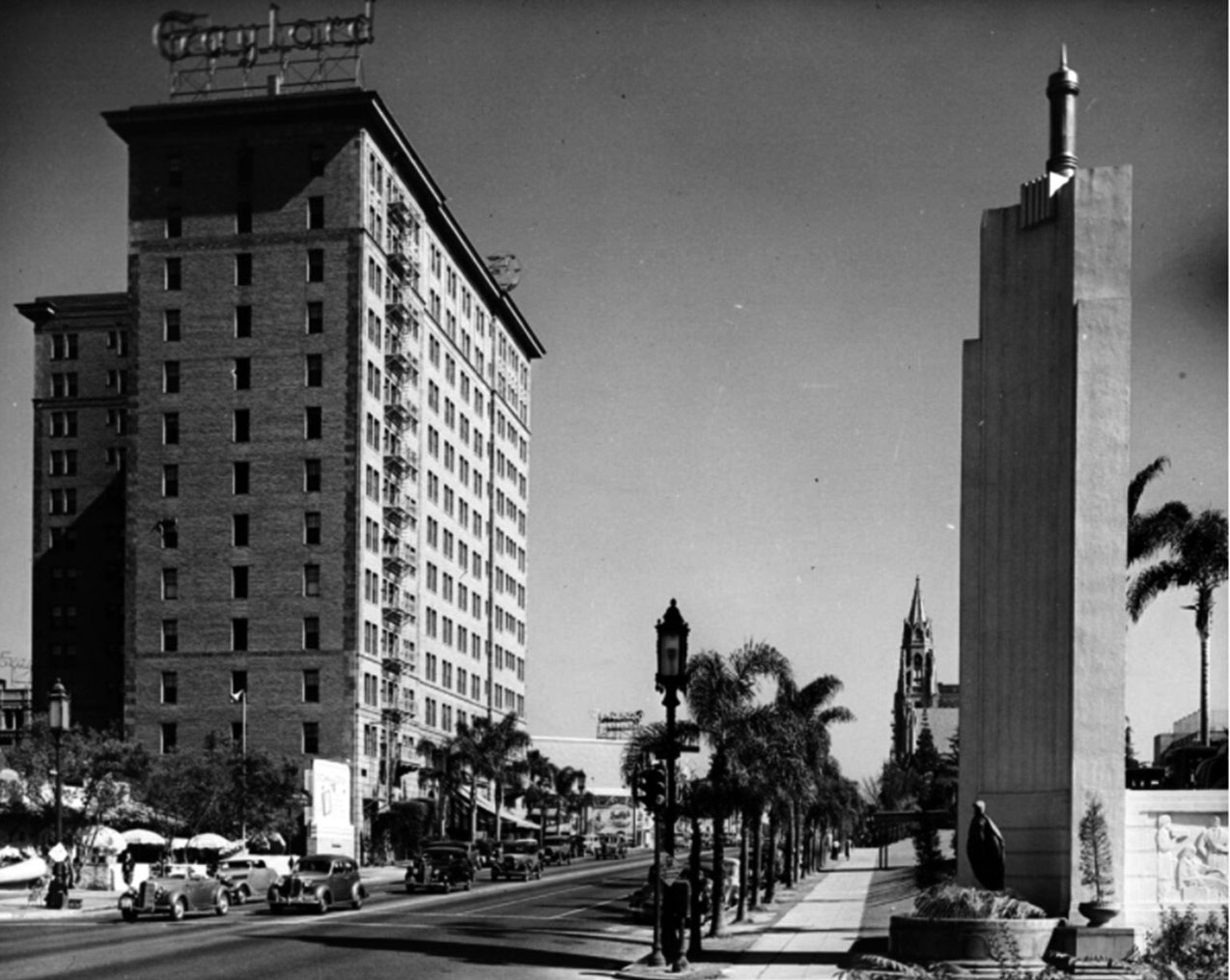
| (1938)* - Looking east on Wilshire Boulevard toward the Gaylord Apartments and the entrance to the Ambassador Hotel. |
| Historical Notes
This eastward view captures Wilshire Boulevard at a notable moment in the Ambassador's own history. In 1938, the firm of Walker and Eisen, the same architects who designed the Gaylord, was engaged to add a new entrance pylon to the Ambassador Hotel at 3400 Wilshire Boulevard. The Cocoanut Grove nightclub addition to the hotel was also completed around this time. By 1938, the Ambassador had already hosted six Academy Awards ceremonies and established the Cocoanut Grove as one of the premier entertainment venues in the country. The view from the Gaylord's side of the boulevard captures two buildings whose fates were intertwined from the beginning — designed by the same firm, built across the street from one another, and together anchoring the most fashionable residential and entertainment corridor in Los Angeles. |
 |
|
| (1938)* - Looking west on Wilshire Boulevard with the Gaylord Apartments on the right. The Wilshire Christian Church, Wilshire Boulevard Temple, and the Wilshire Professional Building are visible in the distance. |
| Historical Notes
These street-level views document Wilshire Boulevard at the height of its prestige as a residential corridor. The density of institutional and cultural landmarks visible from the Gaylord's block, including two major houses of worship and a professional office tower, illustrates how rapidly the corridor had matured since the days when Henry Gaylord Wilshire first donated a strip of barley field to the city. |
A Notable Address |
From its earliest years, the Gaylord attracted prominent residents. Silent film actress May Allison lived at the building from 1925 to 1928, appearing in several features including Flapper Wives and Her Indiscretion and marrying Photoplay magazine editor James Quirk while a resident. Richard Nixon reportedly maintained an apartment at the Gaylord during his 1962 campaign for governor of California.
|
 |
|
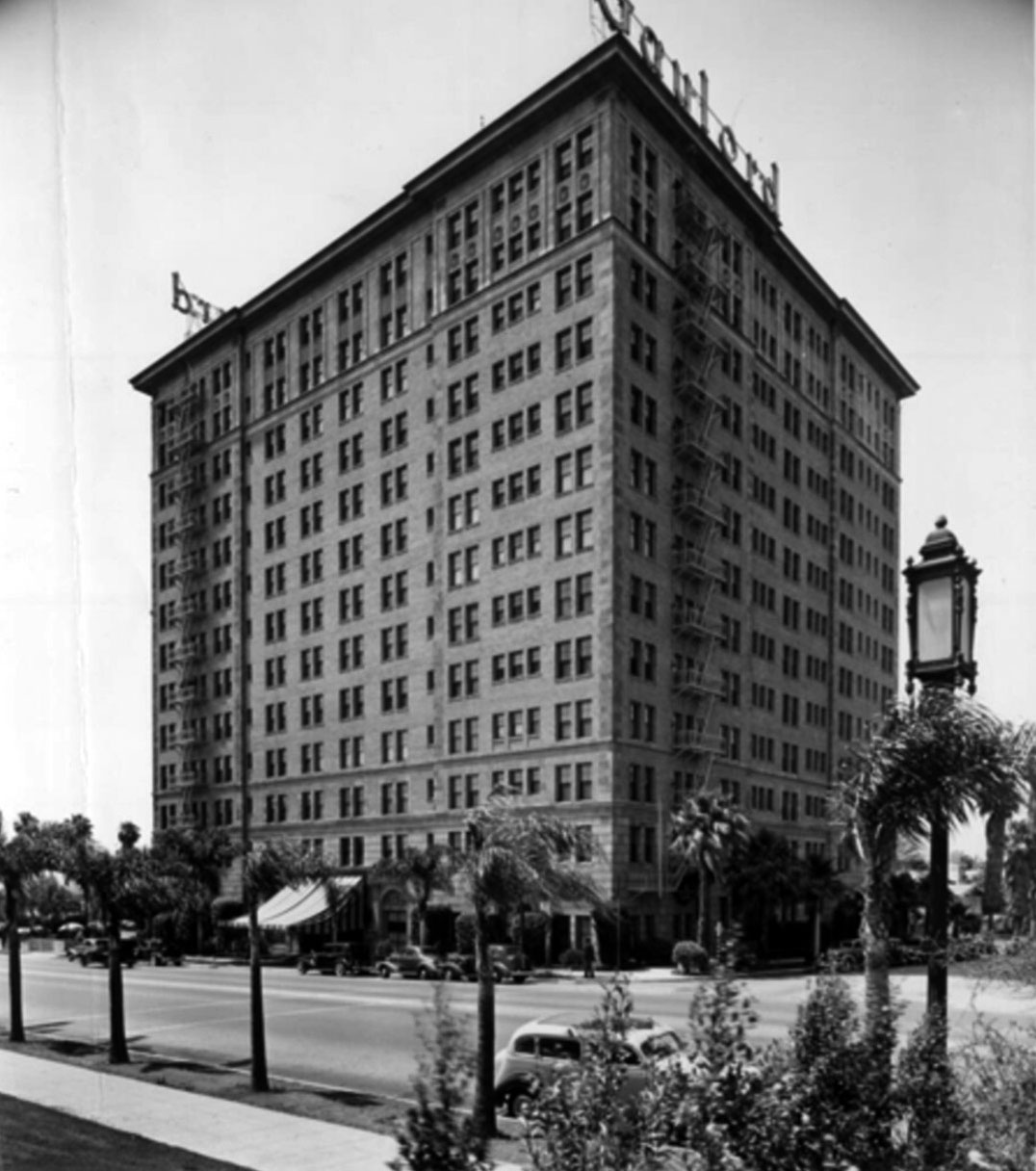
| (1940s)* - The Gaylord Apartments at 3355 Wilshire Boulevard, showing the building's established presence on the corridor by midcentury. |
| Historical Notes
By the 1940s, the Gaylord had settled into a stable existence as one of Wilshire's enduring institutions. The ground floor restaurant space underwent several transformations over the decades. It operated first as the Gay Room, then became the Secret Harbor in 1951, run by brothers Seymour and Harold Dimsdale, who were among the leading restaurateurs on Wilshire during that era. The Secret Harbor gave way briefly to the Golden Anchor before the space was reinvented in 1962 as the HMS Bounty, a nautical-themed bar and restaurant that became one of the best-known gathering places on the boulevard and remains in operation today. |
 |
|
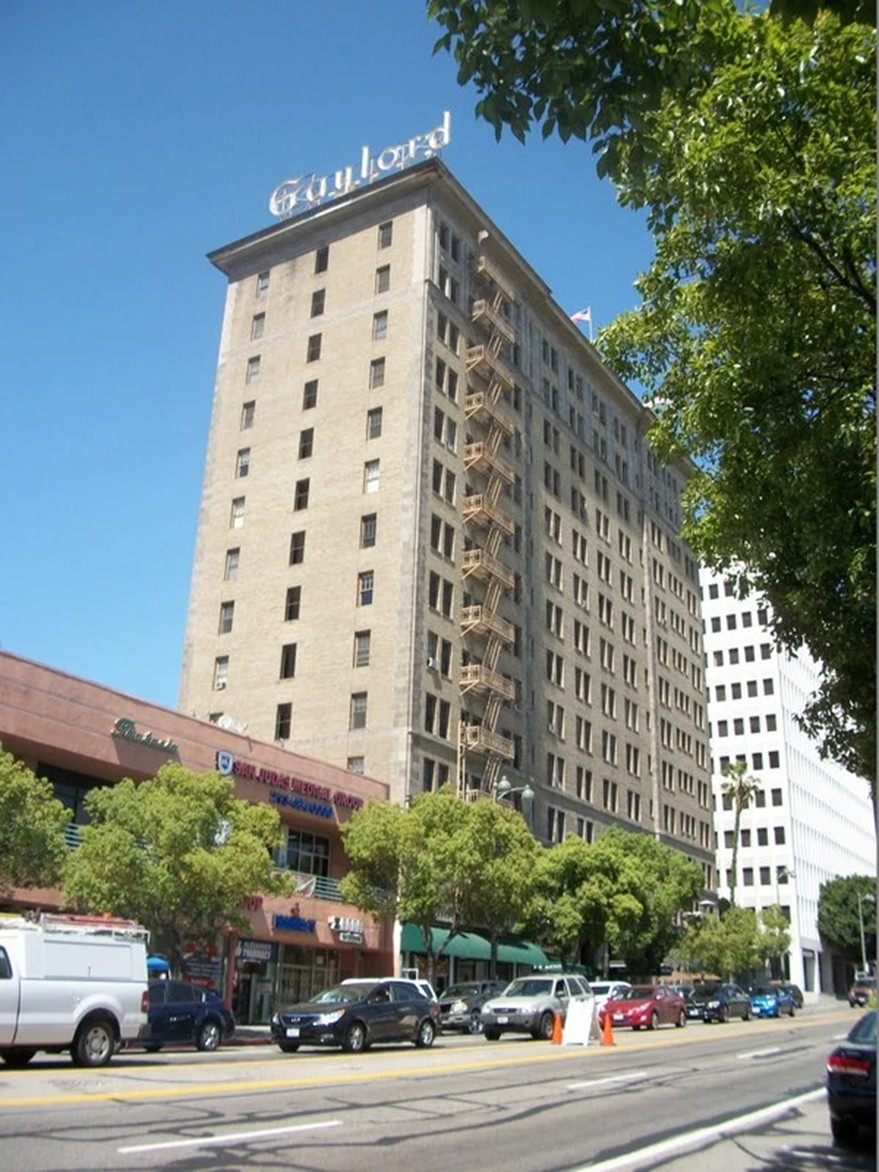
| (2013)* - Looking across Wilshire Boulevard toward the Gaylord Apartments, now within the dense urban fabric of Koreatown. Photo by Hadley Meares. |
| Historical Notes
Beginning in the 1970s, an influx of Latino and Korean immigrants reshaped the area now known as Koreatown, bringing new commercial and cultural energy to a corridor that had grown quieter since its 1920s peak. When the Ambassador Hotel was demolished in 2006 to make way for the Robert F. Kennedy Community School, a gathering of longtime patrons and neighborhood figures was held at the Gaylord and the HMS Bounty to mark the occasion. The building its neighbor had once overshadowed had outlasted it by nearly two decades. The Gaylord Apartments stands today as one of the few surviving examples of the grand residential towers that once lined Wilshire Boulevard. It is a record of how the city imagined itself in the 1920s, a place where ambition, architecture, and urban life came together in a form that has proven, against considerable odds, to endure. |
* * * * * |
|
Other Sections of Interest |
|
Water and Power in Early LA |
|
Newest Additions |
New Search Index |

A new SEARCH INDEX has been added to help navigate through the thousands of topics and images found in our collection. Try it out for a test run.
Click HERE for Search Index |
* * * * * |
< Back