Third Street Tunnel
The Third Street Tunnel was built to solve a major problem in early Los Angeles. Bunker Hill stood between downtown and neighborhoods to the west, making travel slow and difficult. In 1893, residents asked the City Council to build a tunnel through the hill. The plan called for a tunnel about 1,080 feet long with room for vehicles and sidewalks.Voters approved funding in 1898, and construction soon began. Work was dangerous, and in 1900 a cave-in trapped thirteen men. Ten were rescued, but three died. The tunnel opened in March 1901. At first it was unpaved and unlit, with basic improvements added the following year. |
 |
|
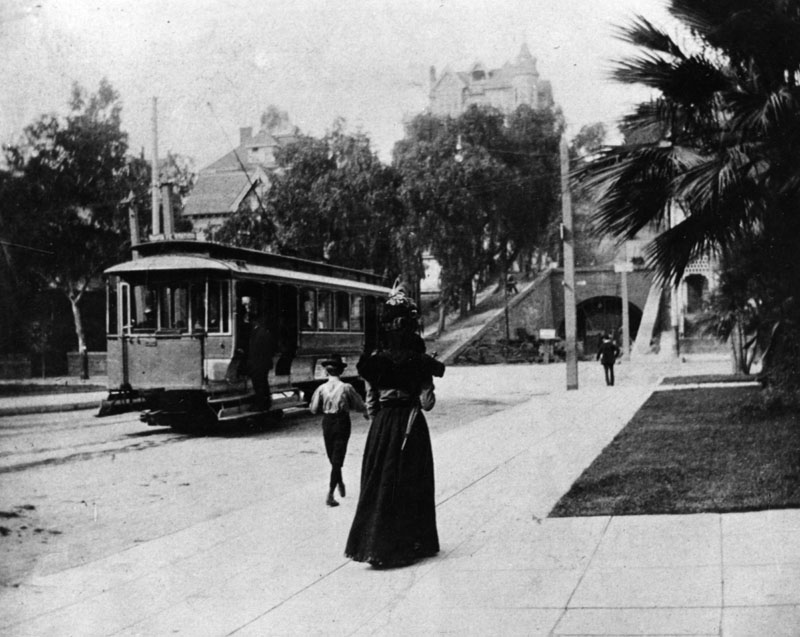
| (1901)* - View looking west on 3rd St toward Hill St showing the newly completed 3rd Street Tunnel through Bunker Hill. A conductor is seen standing on the outside steps of a streetcar as a woman carrying a parasol and a young boy walk by. Edwin B. Crocker's mansion is seen above on Bunker Hill. Angels Flight has not been built yet. |
| Historical Notes
This photograph shows the Third Street Tunnel soon after it opened. The tunnel cut directly through Bunker Hill, making it much easier to travel between downtown and neighborhoods to the west. At this time, streets were unpaved and traffic included streetcars, horse-drawn wagons, and pedestrians. Above the tunnel stands the Crocker Mansion, one of many large homes that once lined Bunker Hill. Angels Flight had not yet been built, showing this image dates to the earliest years of the tunnel’s use. |
 |
|
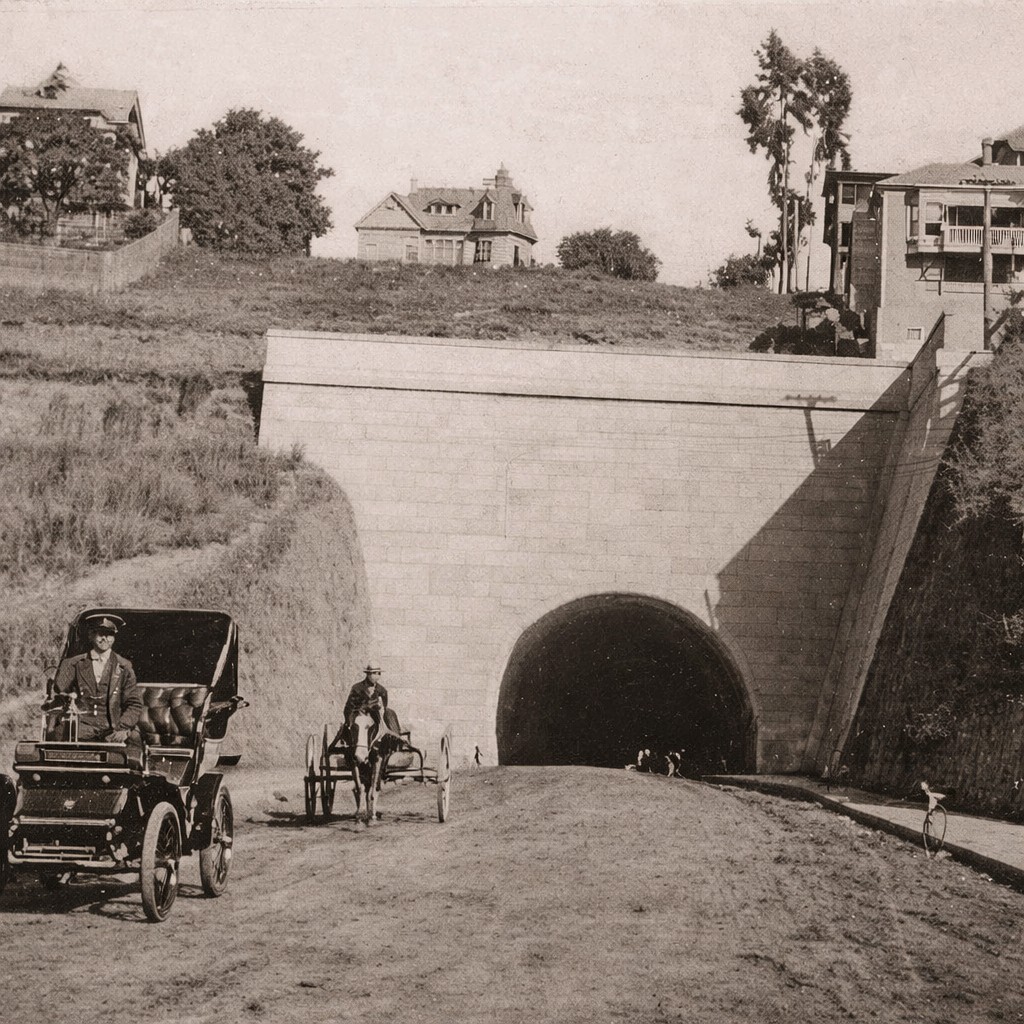
| (1903)* - View of the western terminus of the Third Street Tunnel. An early model automobile and a horse-drawn carriage can be seen after they exit from the tunnel while a bicycle is parked along the curb. |
| Historical Notes
This view shows vehicles exiting the west portal of the tunnel. An early automobile appears alongside a horse-drawn carriage, showing how quickly transportation was changing in Los Angeles. The tunnel made daily travel faster and more direct. Its success helped push development westward and increased traffic through this narrow passage. |
 |
|
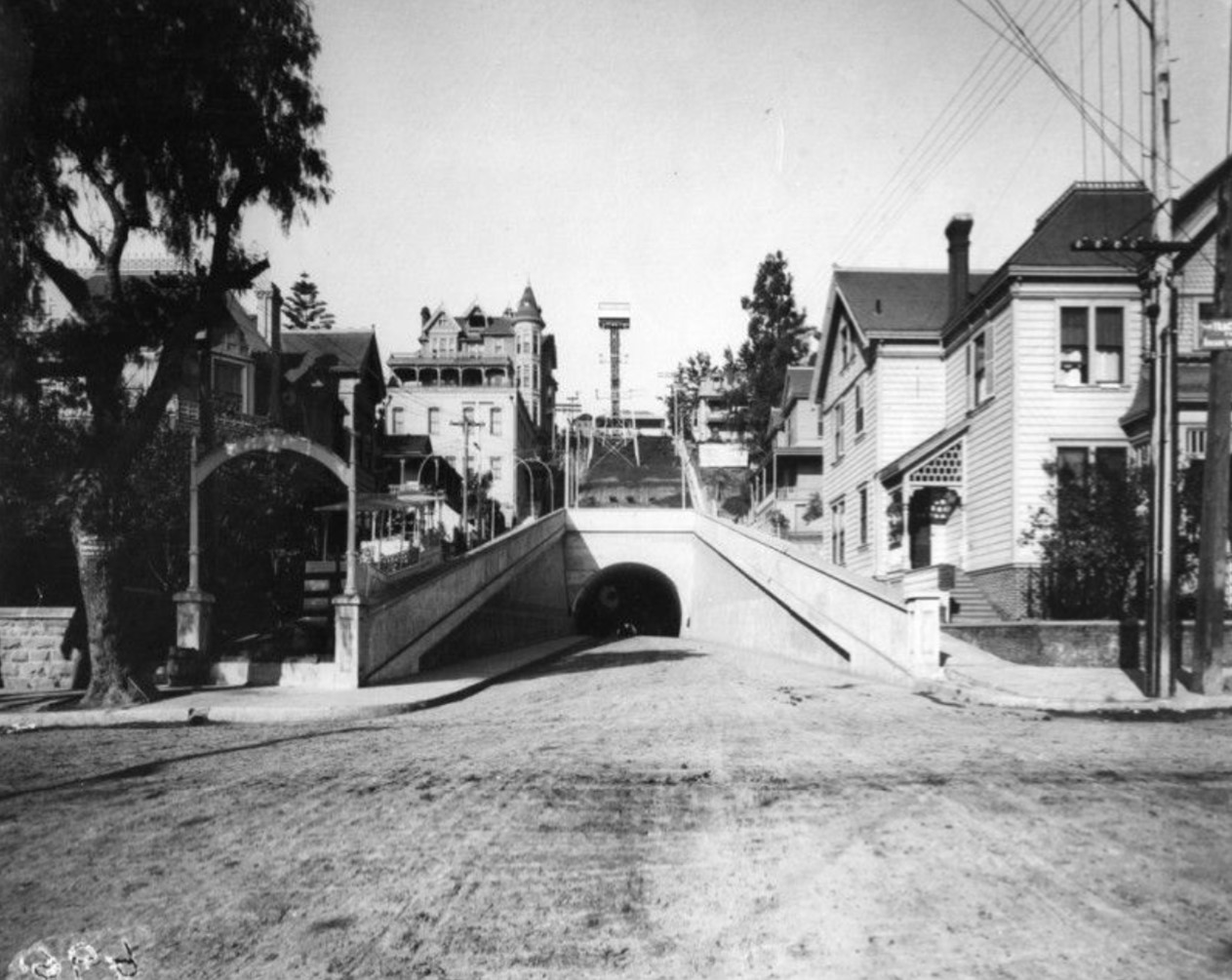
| (1901)* - View looking west on 3rd Street at Hill Street showing the terminus of the recently completed Third Street Tunnel located at the base of Bunker Hill. Angels Flight, also completed in 1901, is seen on the left. Crocker Mansion stands at the top of Bunker Hill. |
| Historical Notes
This image shows the tunnel entrance at the base of Bunker Hill shortly after Angels Flight opened in 1901. The short railway carried passengers up the steep hill while the tunnel handled traffic below. Together, the tunnel and Angels Flight solved two major problems, moving people through the hill and up the hill. The Crocker Mansion remains visible at the top, showing how transportation and residential life existed side by side. |
.jpg) |
|
| (ca. 1901)* – Looking west on 3rd Street toward Hill Street showing the Third Street Tunnel and Angels Flight. |
| Historical Notes
This view shows the Third Street Tunnel and Angels Flight from farther east on Third Street. Horse-drawn vehicles dominate the street, reflecting everyday travel at the time. The tunnel entrance appears simple and practical. Angels Flight quickly became a familiar and popular feature, especially for residents living atop Bunker Hill. |
 |
|
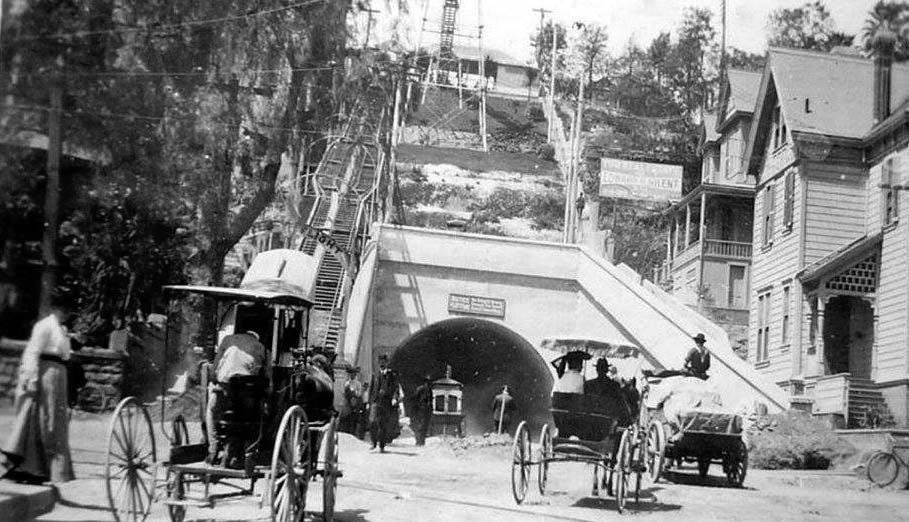
| (ca. 1905)* – Panoramic view showing a horse-drawn wagon and two horse-drawn carriages heading toward the entrance to the Third Street Tunnel shortly after it opened. On the left can be seen the newly constructed Angels Flight. |
| Historical Notes
This panoramic image shows wagons and carriages approaching the tunnel several years after it opened. Traffic moved slowly, and safety inside the tunnel was a concern. A sign above the entrance warned drivers not to travel faster than walking speed. The tunnel was narrow, unlit, and shared by many types of users. |
 |
|
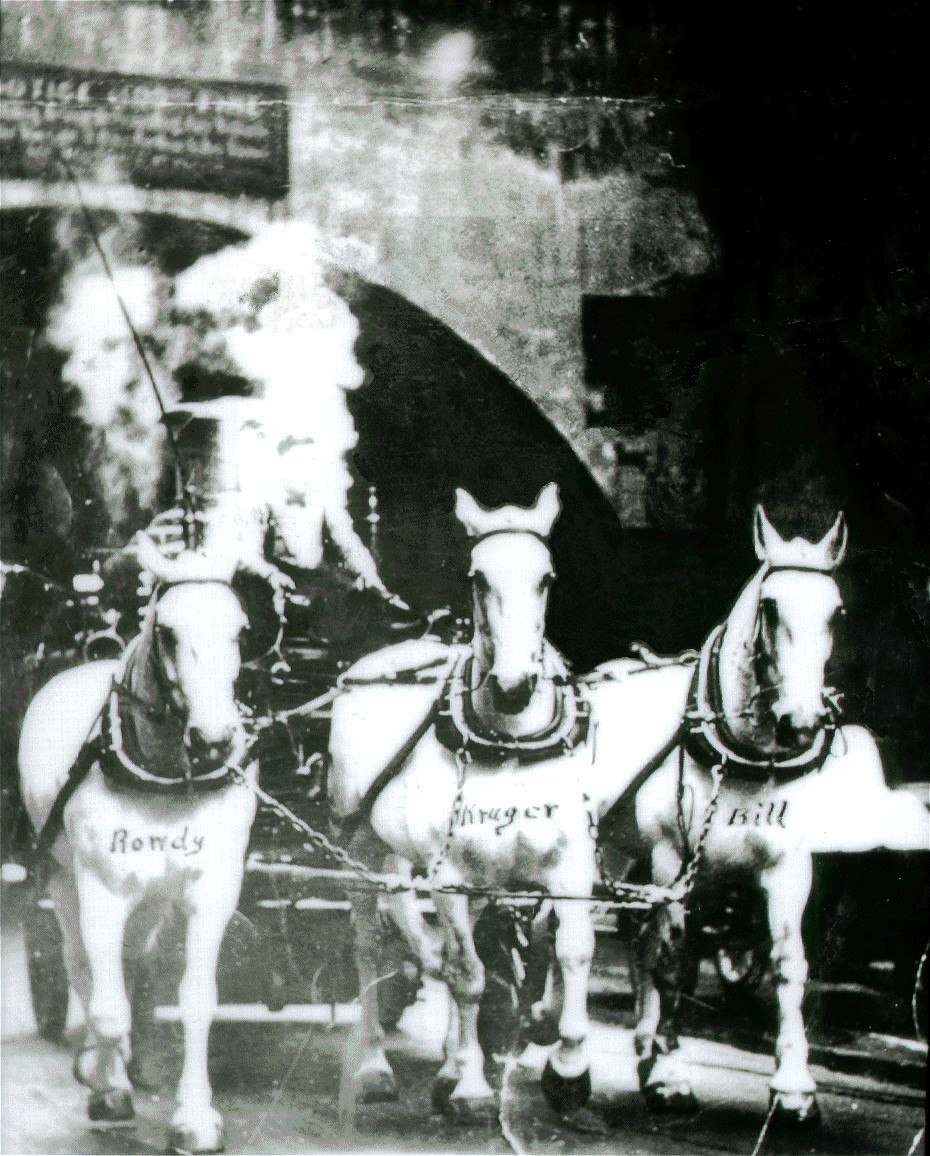
| (ca. 1904)* - Engine 3, running out of the Third Street Tunnel. The driver is Miller, and the horses are named Rowdy, Kruger, and Bill. Photo Source: LAFD Historical Archive |
| Historical Notes
The sight of horses racing through the streets to respond to alarms was a common and memorable scene in early Los Angeles. Powered by steam generated from burning coal, the engines used this steam to move pistons that operated water pumps, allowing them to deliver substantial amounts of water to fires. The year 1911 marked a significant transition, as it was the last year all 25 horse-drawn steam fire engines remained in service in Los Angeles. |
 |
|
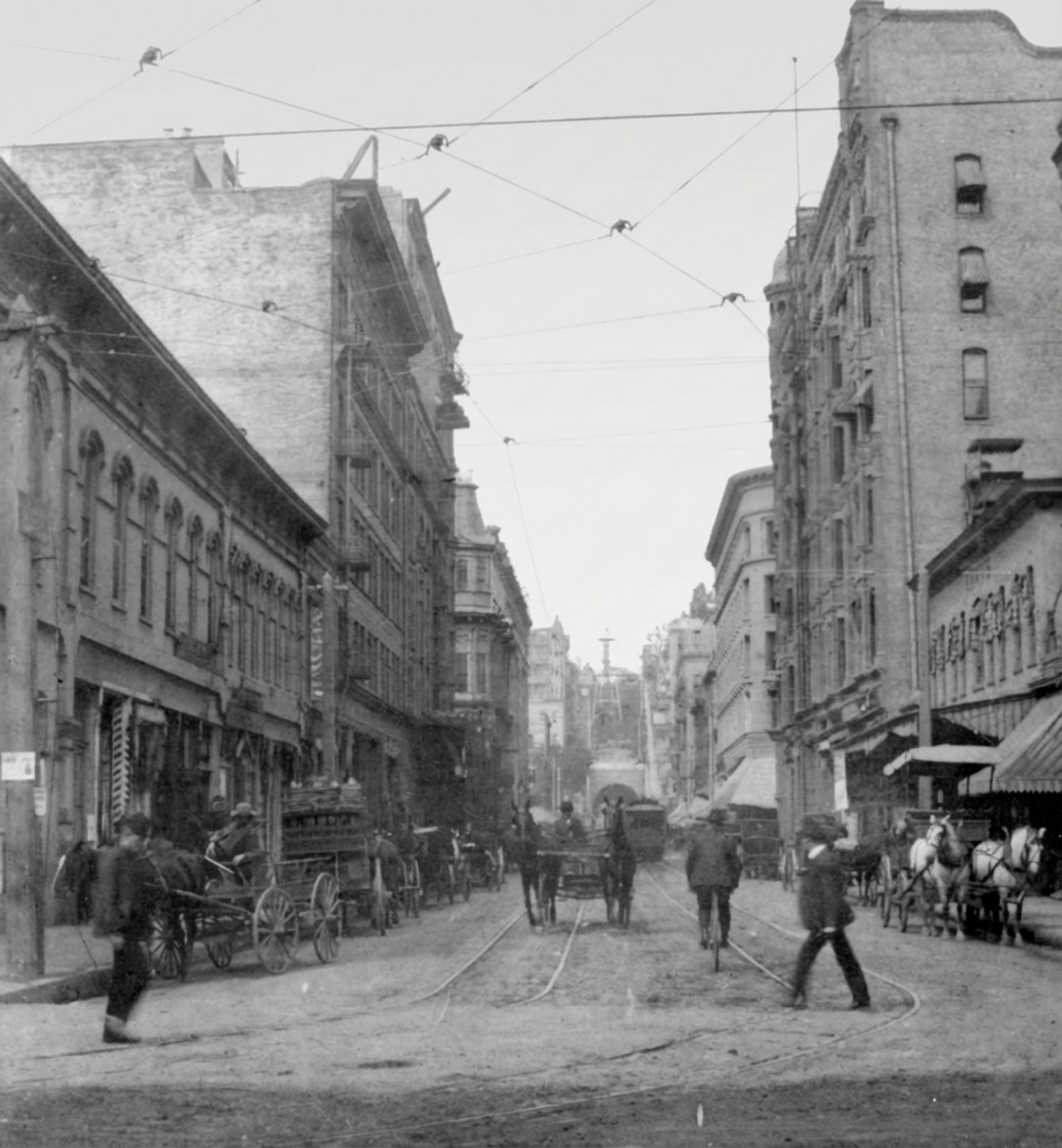
| (ca. 1901)* - Half of a stereoptic view of 3rd Street, looking west past office buildings to the newly constructed 3rd Street Tunnel under Bunker Hill in the far distance. Horse-drawn vehicles and a streetcar are on the unpaved street. |
| Historical Notes
This view looks west along Third Street toward the tunnel in the distance. The street is unpaved, and streetcars share the roadway with wagons and pedestrians. The tunnel appears as a new landmark, showing how the city was pushing past the natural barrier of Bunker Hill. |
 |
|
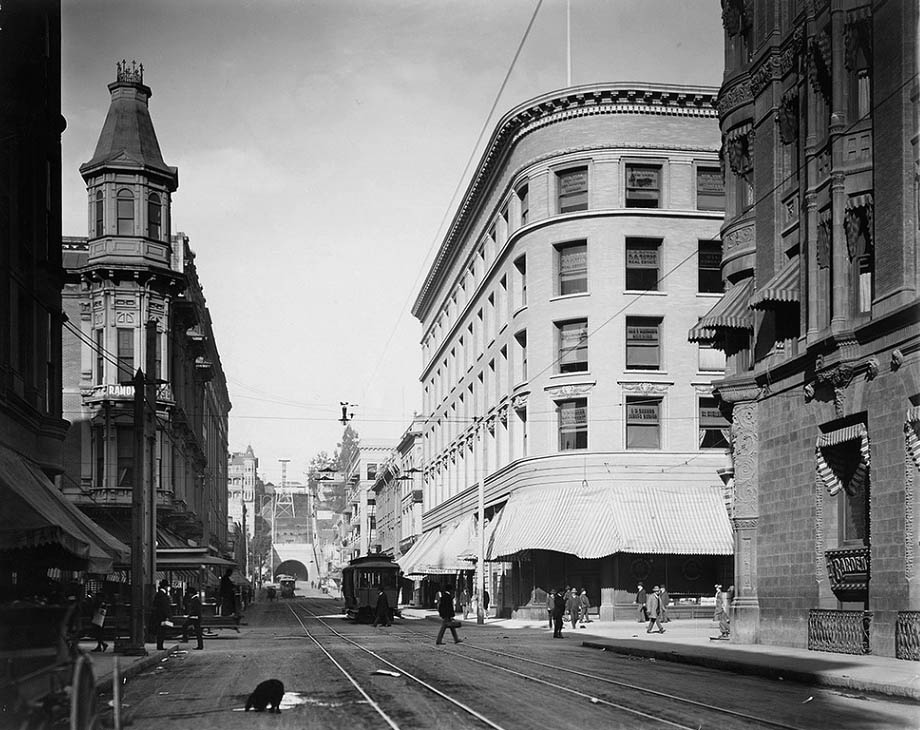
| (ca. 1901)* - View of 3rd Street looking west from Spring Street. A dog appears to be drinking from a puddle of water in the street (lower left). The 3rd Street Tunnel is seen in the distance with an observation tower perched above it. The Ramona Hotel with the beautiful corner tower is seen on the left, SW corner of 3rd and Spring. |
| Historical Notes
Looking west from Spring Street, this image shows Third Street leading toward the tunnel. Puddles and dirt streets were common sights at the time. The Ramona Hotel stands on the southwest corner, while the Douglas Building appears on the northwest corner. Both buildings helped define the edge of downtown Los Angeles. |
 |
|
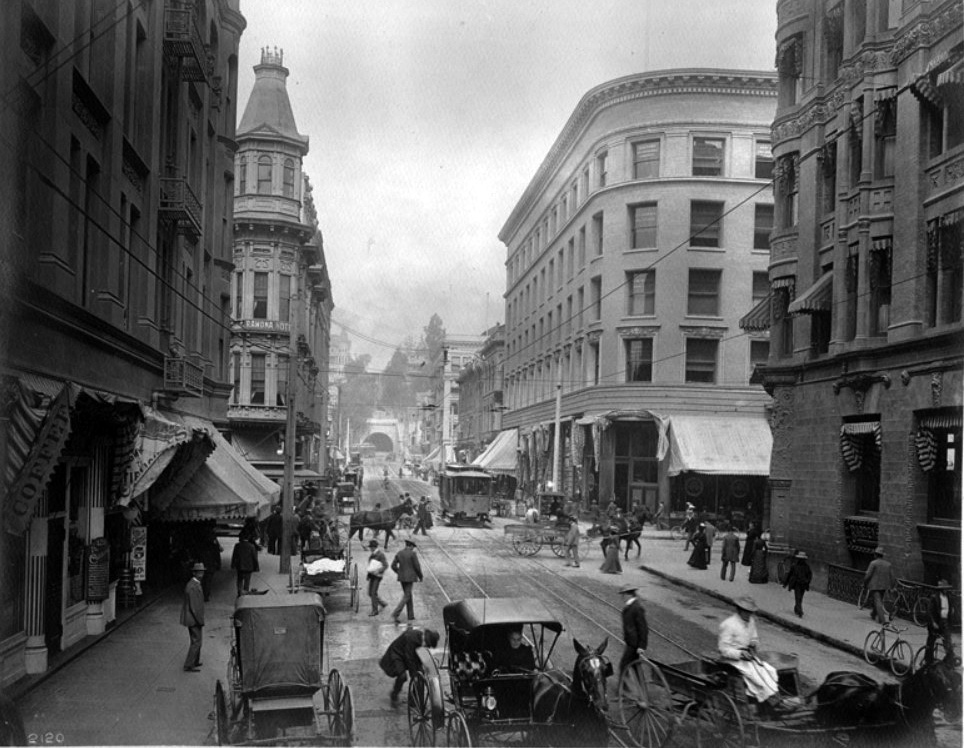
| (ca. 1901)* - View looking west on 3rd Street toward Spring Street with the 3rd Street Tunnel seen in the distance. Streetcar, horse-drawn carriages, and pedestrians share the streets. The Ramona Hotel with its 4-story tower can be seen on the SW corner of 3rd and Spring streets. The Douglas Building on the NW corner is still standing today. |
| Historical Notes
This image shows a busy Third Street filled with streetcars, wagons, and pedestrians. The tunnel is visible in the distance beneath Bunker Hill. The Ramona Hotel and Douglas Building frame the street scene and help modern viewers recognize this early downtown location. |
* * * * * |
Third Street Tunnel - Before and After
 |
|
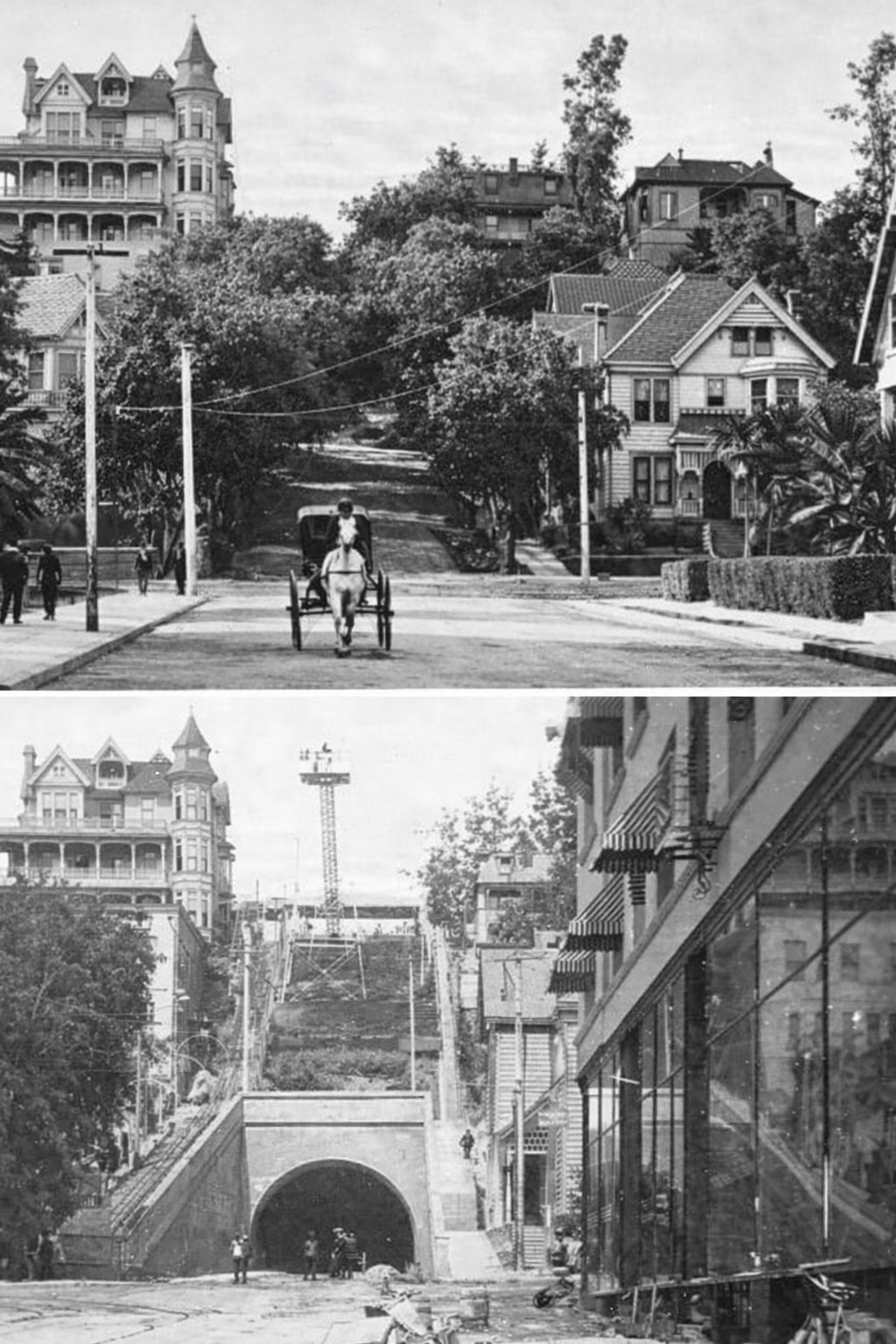
| (1885 vs. 1901)* – Looking west on 3rd Street toward Hill Street, before and after the construction of the 3rd Street Tunnel and Angels Flight, with the Crocker Mansion seen at the upper left on top of Bunker Hill. Photo comparison by Jack Feldman. |
| Historical Notes
Before the tunnel was built, Third Street stopped at the steep face of Bunker Hill. Travelers had to go around the hill, slowing movement across the city. The 1901 image shows how the tunnel and Angels Flight cut directly through the hill. Together, they changed how people moved and marked the beginning of major changes to Bunker Hill. |
 |
|
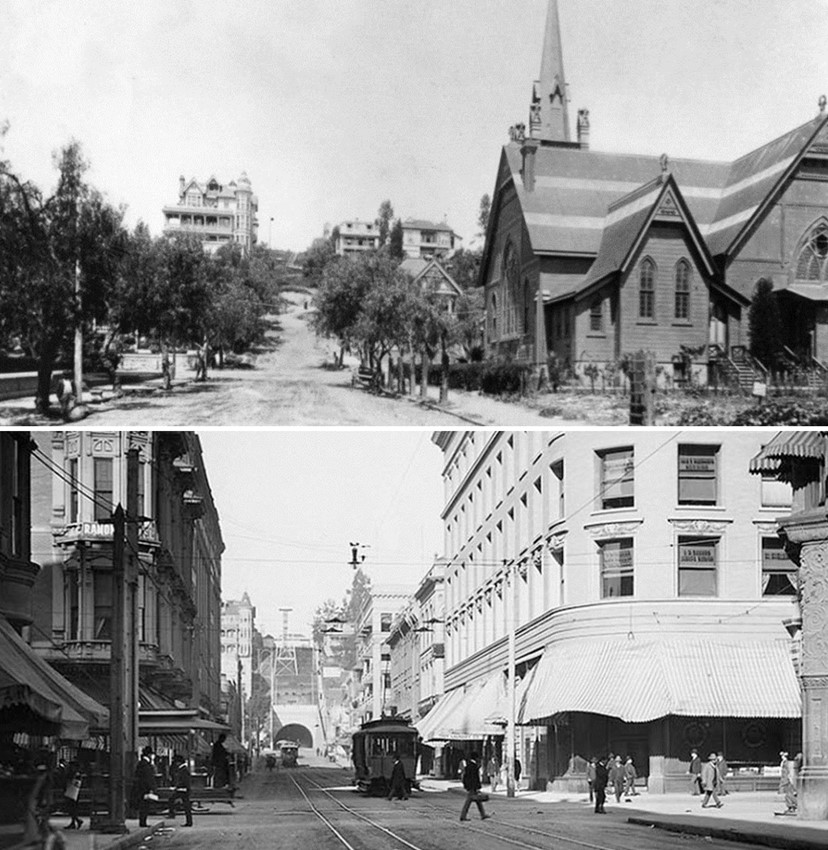
| (1885 vs. 1901)* – A view looking west on 3rd Street near Spring Street shows Bunker Hill in the distance before and after the construction of the 3rd Street Tunnel and Angels Flight. Photo comparison by Jack Feldman. |
| Historical Notes
In 1885, Bunker Hill blocked the view west from Spring Street. Access beyond the hill was limited. By 1901, the tunnel opened a direct route. The Douglas Building on the right still stands today and helps anchor the comparison. This Classic Revival style building was declared an LA Historic-Cultural Monument in 2009. |
* * * * * |
Third Street Tunnel - Then and Now
 |
|
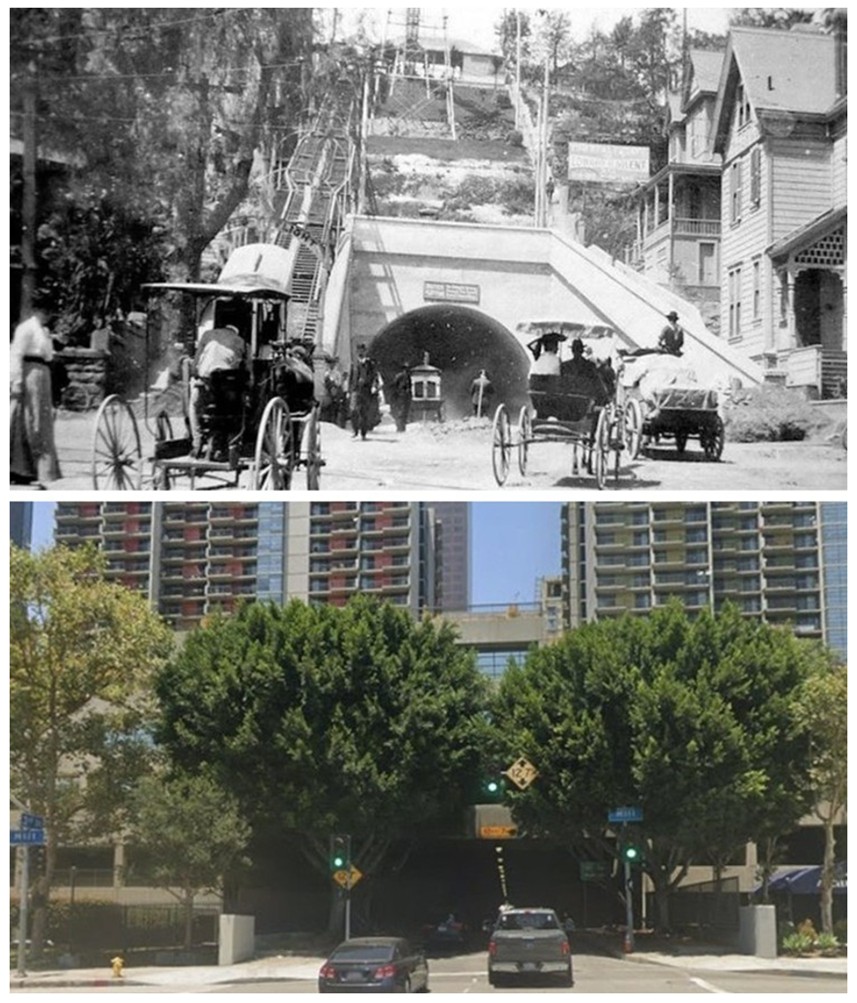
| (1905 vs 2022)* - Traffic heading into the Third Street Tunnel at Hill and 3rd Streets. Photo comparison by Jack Feldman. |
| Historical Notes
This view shows traffic entering the Third Street Tunnel from Hill Street in the early 20th century and more than a century later. While modes of transportation have changed dramatically, the tunnel continues to serve the same basic function—moving people and vehicles beneath Bunker Hill. The hillside above the tunnel, once lined with stairways, homes, and small boarding houses, has been completely transformed. Today, the area is dominated by Angelus Plaza, a large residential complex built as part of the Bunker Hill redevelopment era. Opened in 1970, Angelus Plaza was designed as senior housing and remains one of the most prominent residential structures overlooking the tunnel. |
 |
|
| (1901 vs. 2017) - Photo comparison by Jack Feldman. |
| Historical Notes
This comparison illustrates the dramatic transformation of the area surrounding the Third Street Tunnel. Nearly all early structures visible in the 1901 view have been removed, replaced by much larger-scale development. Despite these changes, the tunnel itself remains one of the few features still in continuous use from early Los Angeles, serving as a physical link between the city’s past and present. |
 |
|
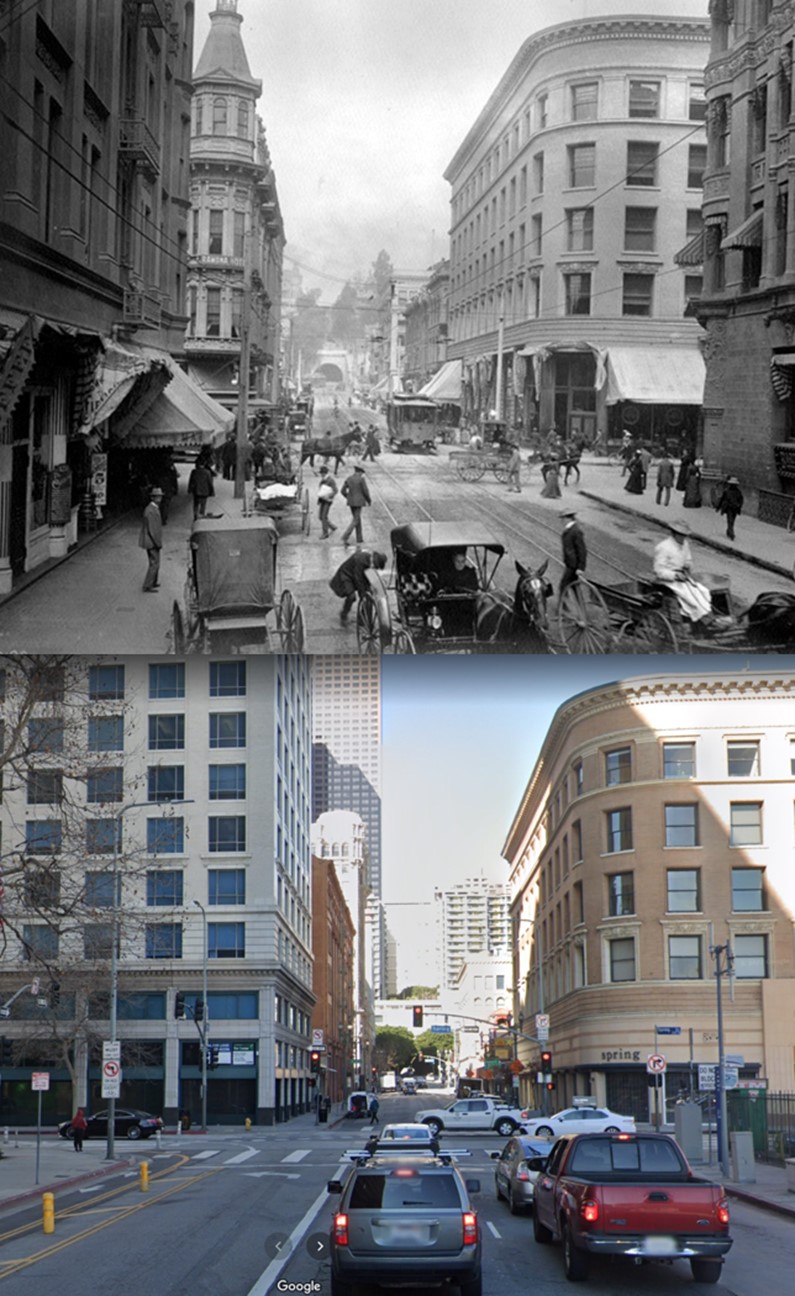
| (1901 vs 2022)* - Looking west on 3rd Street toward Spring Street with the Third Street Tunnel seen in the distance. Photo comparison by Jack Feldman. |
| Historical Notes
In the modern view, the tunnel appears closer than in early photographs. This visual shift occurred because the tunnel was extended eastward to Hill Street during the late 1960s. This extension was part of the Bunker Hill redevelopment project, which substantially reshaped the street grid and erased much of the original hillside neighborhood. |
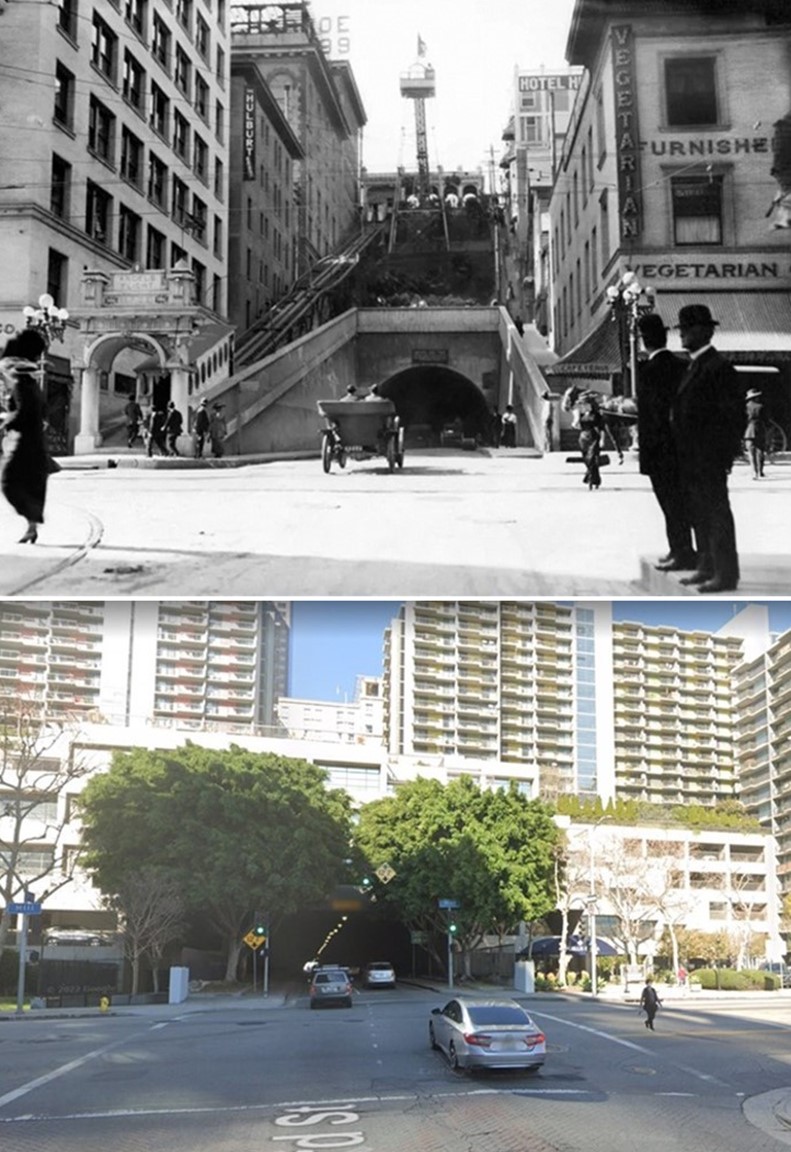 |
|
| (1910s vs. 2022)* - Looking west on 3rd Street at Hill Street, showing the Third Street Tunnel and the earlier location of Angels Flight. Photo comparison by Jack Feldman. |
| Historical Notes
During the Bunker Hill redevelopment period, Angels Flight was dismantled in 1969 and placed in storage. It was later relocated one block south and reopened in 1996. The removal and relocation of Angels Flight symbolized the broader transformation of Bunker Hill, as historic hillside features gave way to modern infrastructure and redevelopment. |
* * * * * |
|
Other Sections of Interest |
|
Water and Power in Early LA |
|
Newest Additions |
New Search Index |

A new SEARCH INDEX has been added to help navigate through the thousands of topics and images found in our collection. Try it out for a test run.
Click HERE for Search Index |
* * * * * |
< Back