Angels Flight
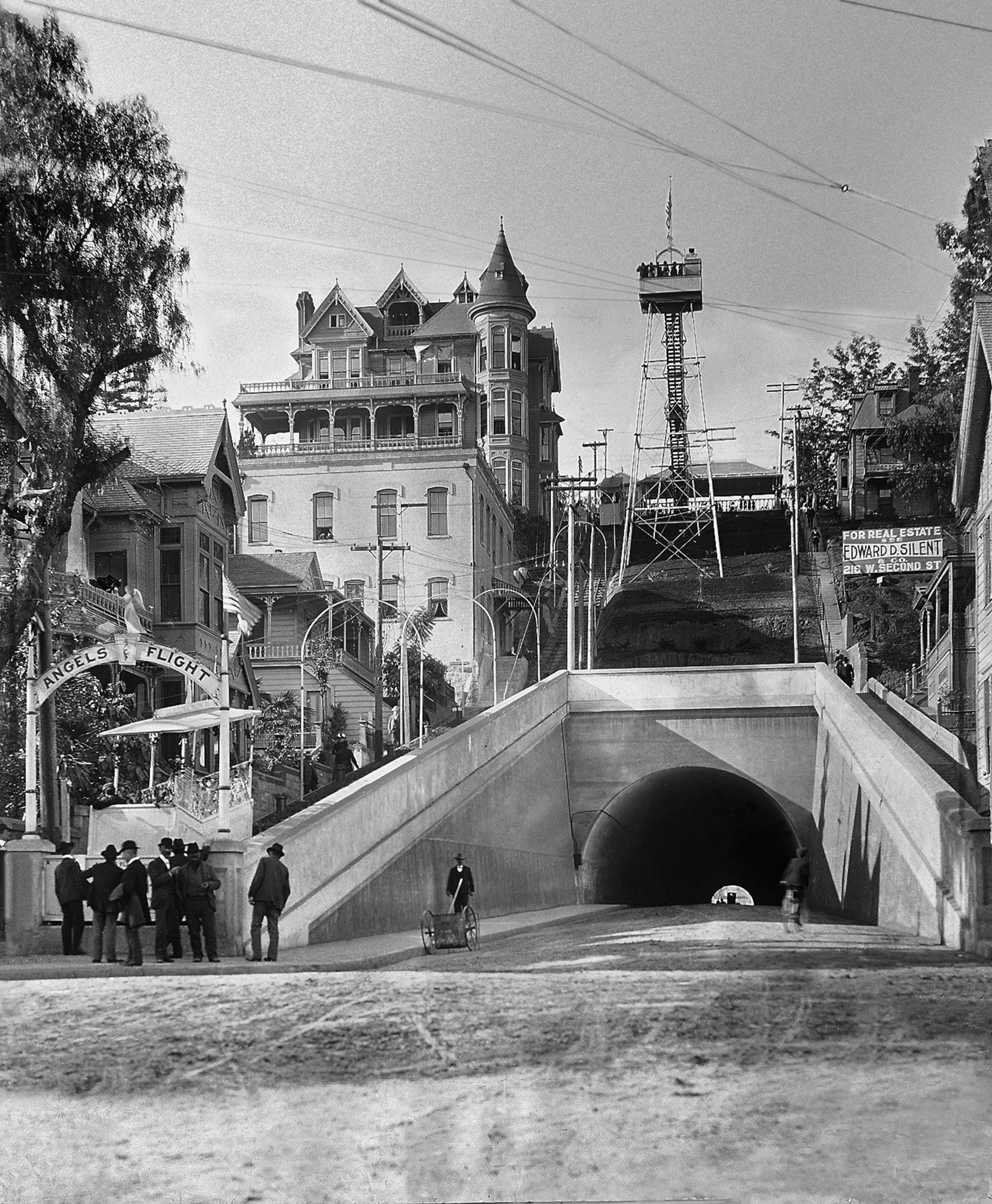
Angels Flight opened at the end of 1901 as a practical solution to one of downtown Los Angeles’ most challenging geographic obstacles. While the Third Street Tunnel allowed traffic to pass through Bunker Hill, pedestrians still faced a steep climb to reach the residential streets above. Angels Flight provided that vertical connection, linking Hill Street at Third Street with Olive Street at the top of the hill.Financed by Colonel J. W. Eddy, the incline railway was originally promoted as the Los Angeles Incline Railway. Although it quickly became known as “the shortest railway in the world,” its purpose was practical rather than symbolic. It served residents, workers, and visitors moving daily between the city’s commercial center and the hillside neighborhood above. |
 |
|
| (1901)* - Photo of Angels Flight at the grand opening of the incline railway, December 31, 1901. |
| Historical Notes
Angels Flight officially opened on December 31, 1901, immediately drawing public attention. Built beside the Third Street Tunnel approach at Hill Street, it formed part of a coordinated effort to improve circulation through and over Bunker Hill. From the start, the incline combined transportation with spectacle, attracting riders who came as much for the experience and view as for the convenience. |
 |
|
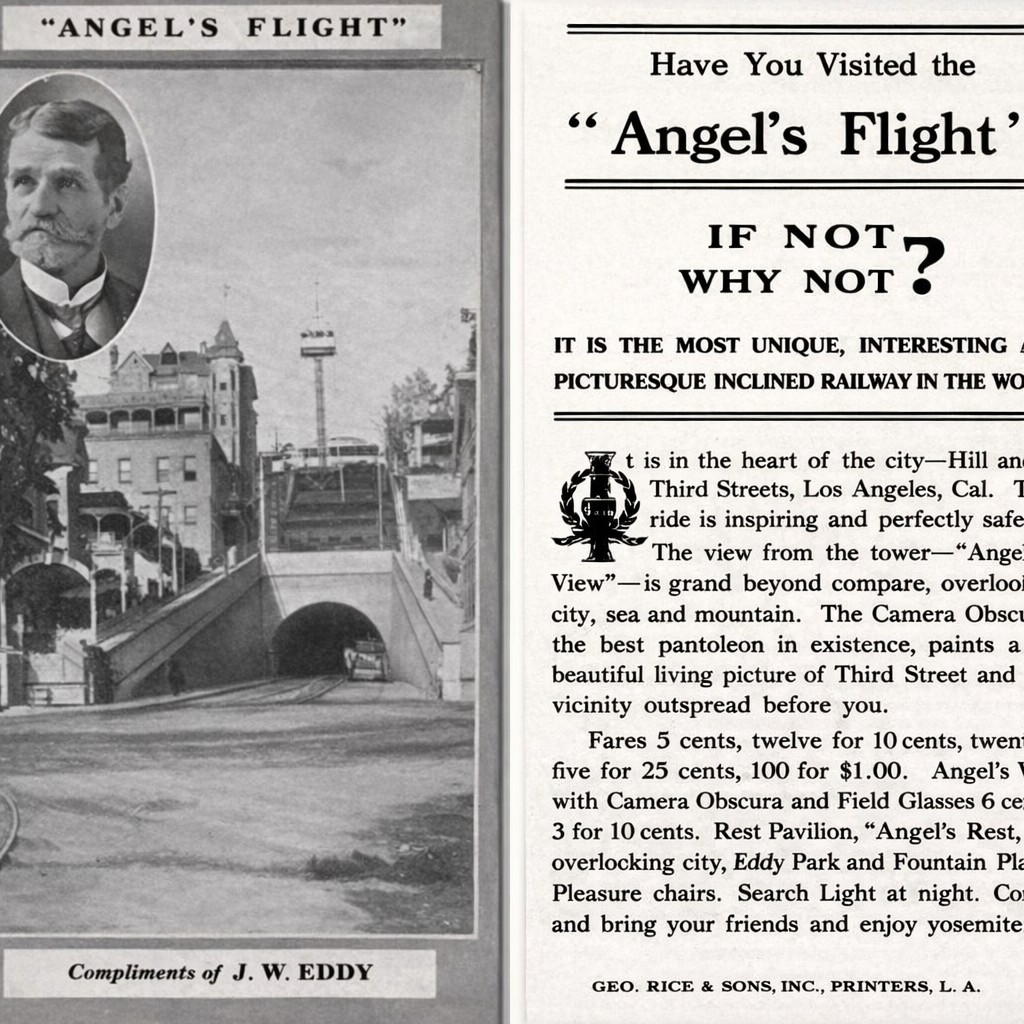
| (ca. 1901)* – Brochure for Angels Flight, compliments of J. W. Eddy. “Have You Visited the Angels Flight? If Not Why Not?” |
| Historical Notes
Early brochures promoted Angels Flight as a destination rather than simply a utility. They emphasized panoramic views from the hilltop, the observation tower, and the Camera Obscura, all designed to make the short ride feel like a complete outing. The modest fares shown in the brochure reflect how accessible the attraction was, appealing to everyday riders as well as visitors. |
 |
|
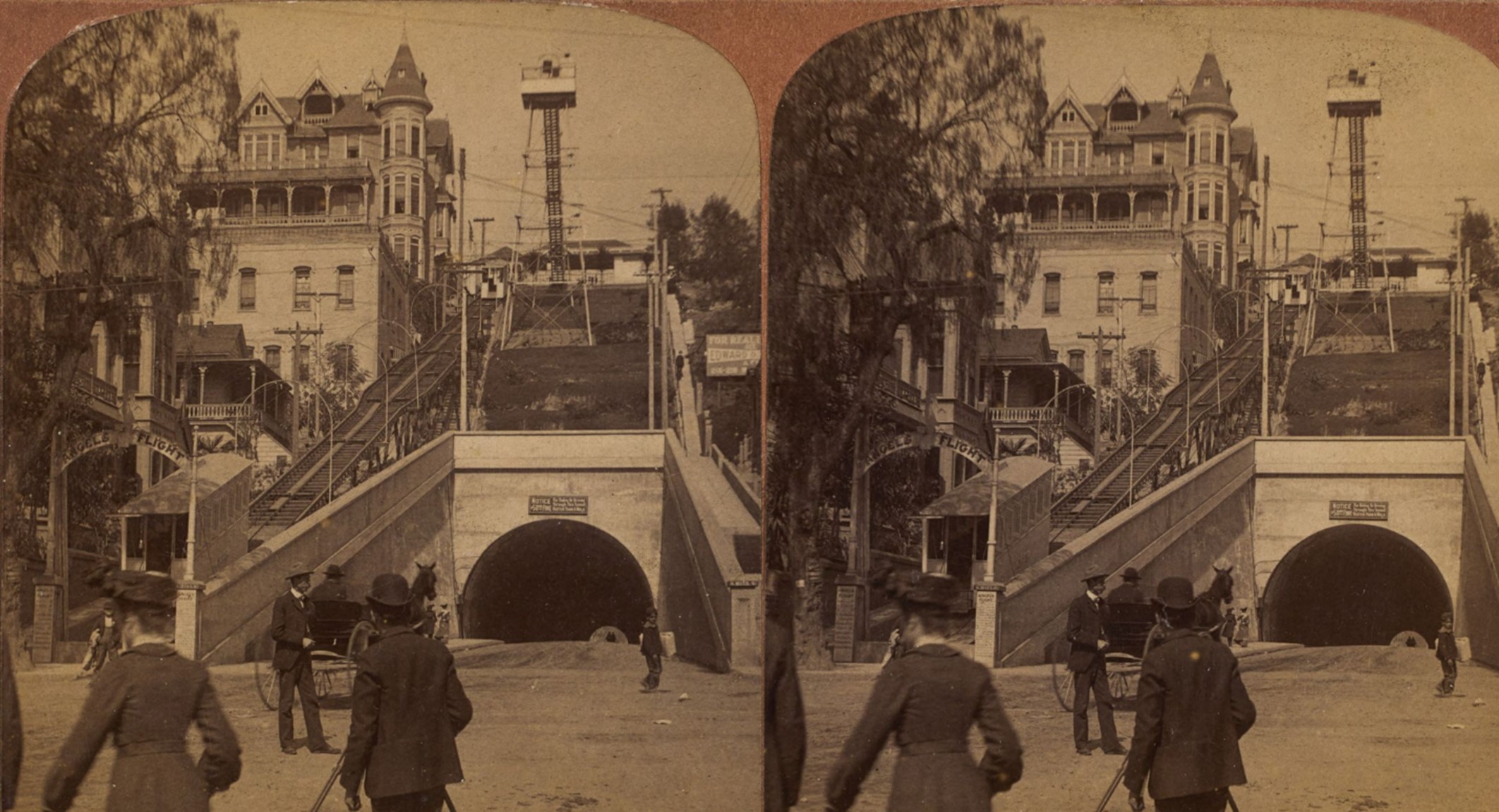
| (ca. 1905)* – Stereoscopic view of Angels Flight incline railway with the Third Street Tunnel below and an observation tower above. Photo from the Ernest Marquez Collection. |
| Historical Notes
By 1905, Angels Flight had been rebuilt into the form most closely associated with its historic appearance. The original segmented incline was replaced with a single straight track supported by timber trestles and set at a uniform 33 percent grade. New cars were introduced at this time, later known as Sinai and Olivet. This reconstruction established the classic configuration that remained in service for decades. |
 |
|
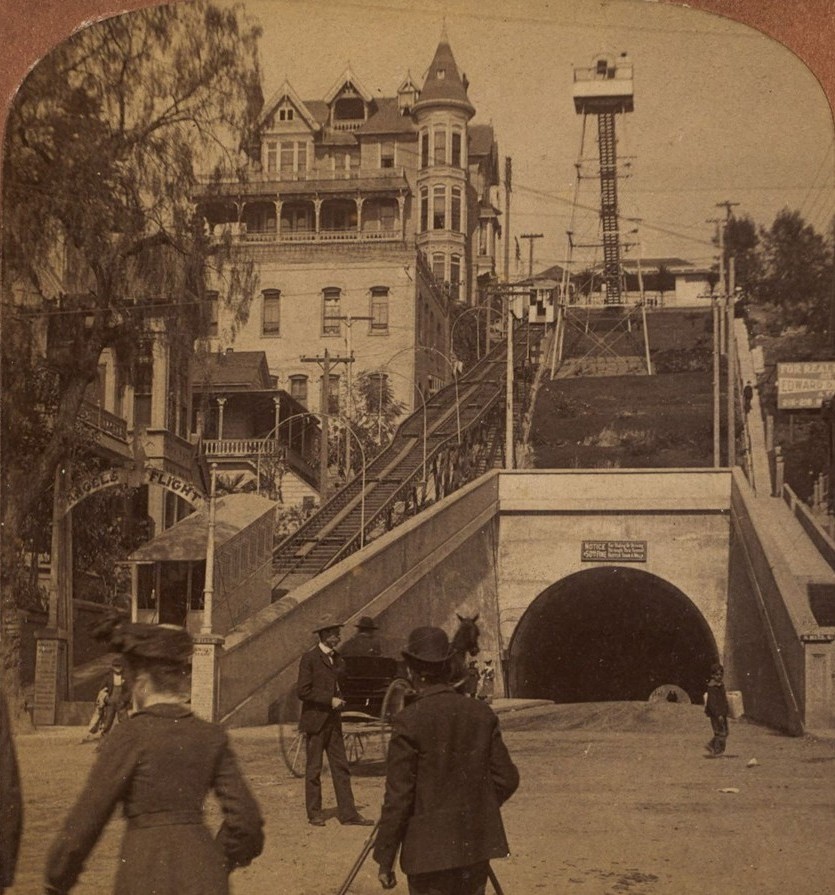
| (ca. 1905)* – Left panel of a stereoscopic view showing Angels Flight at Hill and Third Streets. |
| Historical Notes
This closer view emphasizes the incline’s relationship to the surrounding streets. Angels Flight was designed for pedestrians, offering a quick alternative to long stairways and steep hillside routes. Behind the railway, Bunker Hill remained a dense residential neighborhood, with homes and boarding houses lining the slopes above downtown. |
 |
|
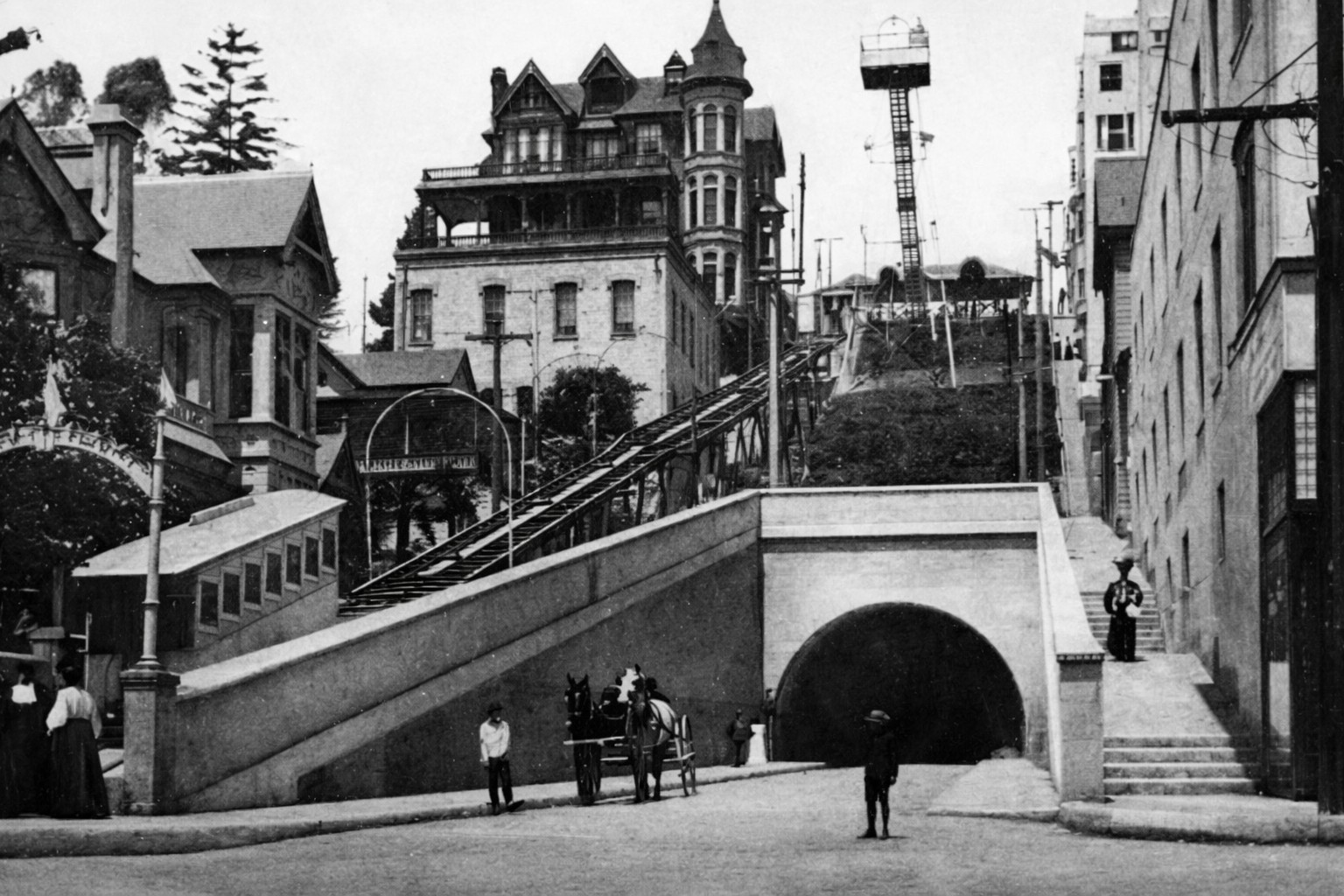
| (ca. 1903)* - Postcard view of Third Street looking west at Hill Street. A horse and carriage exit the Third Street Tunnel while Angels Flight stands to the left. Stairways are visible on the right. |
| Historical Notes
The image highlights how the tunnel and incline complemented each other. The tunnel allowed traffic to pass through Bunker Hill, while Angels Flight provided access up the hill for pedestrians. Stairways remained an important parallel route, reflecting the many ways people navigated the steep terrain. |
 |
|
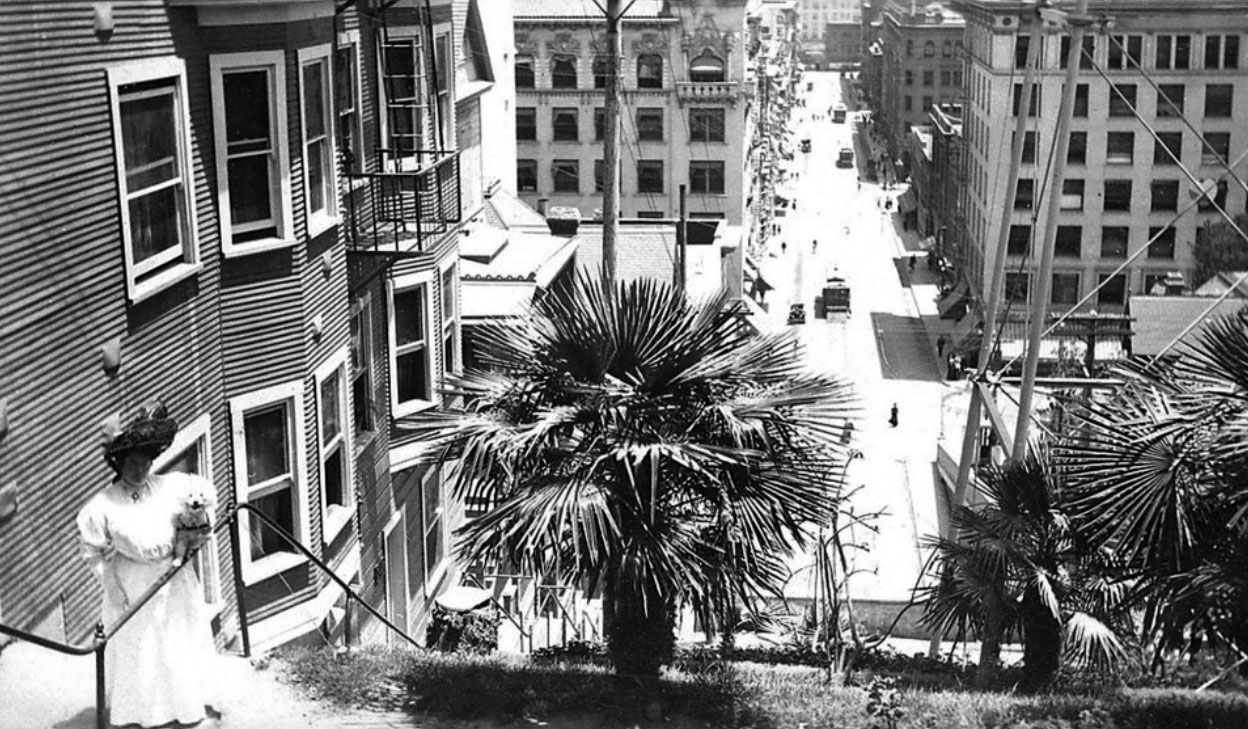
| (1902)* - View looking down from the top of Angels Flight east on Third Street. A woman holding a small dog is posing on the stairway adjacent to the Bunker Hill furnicular. The bottom of the observation tower is seen at right. |
| Historical Notes
A stairway of approximately 150 steps ran parallel to the Angels Flight funicular railway on Bunker Hill, providing pedestrians an alternative route up the steep urban incline between Hill and Olive Streets during the early 20th century. |
 |
|
| (ca. 1905)* - View showing Angels Flight and observation tower at the 3rd Street tunnel. A horse-drawn carriage approaches the tunnel opening and several pedestrians are on the sidewalk at left. Legible signs include: "Angels Flight", "S. Hill St.", "Notice, $50.00 fine for riding or driving through this tunnel faster than a walk". |
| Historical Notes
This scene captures the concentration of movement at Hill and Third Streets. Traffic flows through the tunnel, pedestrians gather at the base of the incline, and riders move upward toward the hilltop. The warning sign reflects early concerns about safety and congestion in the narrow tunnel below. |
 |
|
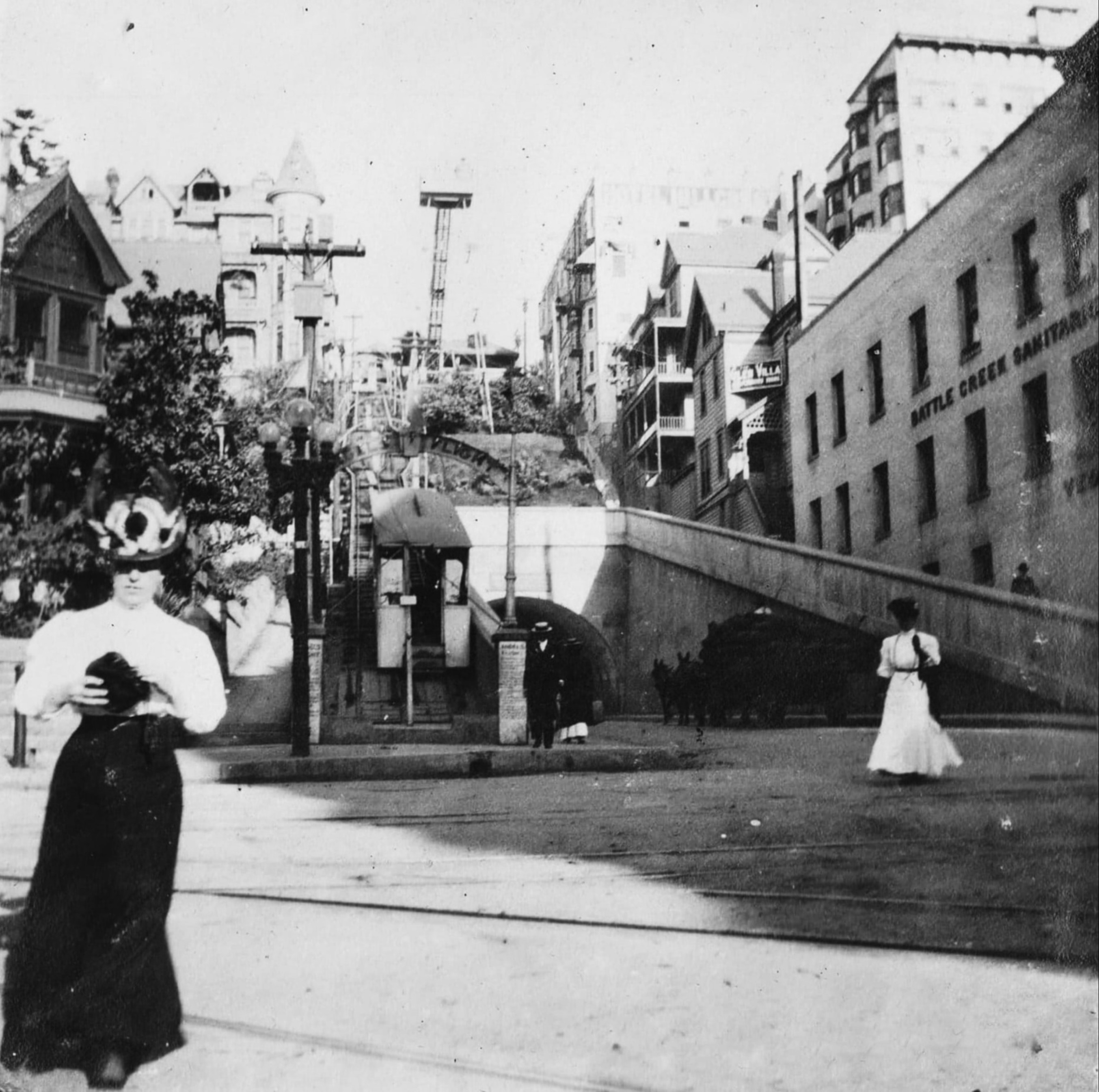
| (ca. 1905)* - Pedestrians wearing the latest styles cross the street in front of Angels Flight with the 3rd Street Tunnel seen in the background. The sign on the building to the right reads ‘Battle Creek Sanitarium’. This builidng would later be converted into an Apartment House. |
| Historical Notes
Street level details like storefront signs help place Angels Flight within an active commercial district. Health oriented restaurants and cafeterias were common in early Los Angeles and often clustered near busy intersections. These businesses benefited from steady foot traffic generated by the incline and tunnel. The original Battle Creek Sanitarium was a health resort in Battle Creek, Michigan, founded by the Seventh-day Adventist Church. It was known for its focus on health and wellness and its strict vegetarian diet. |
 |
|
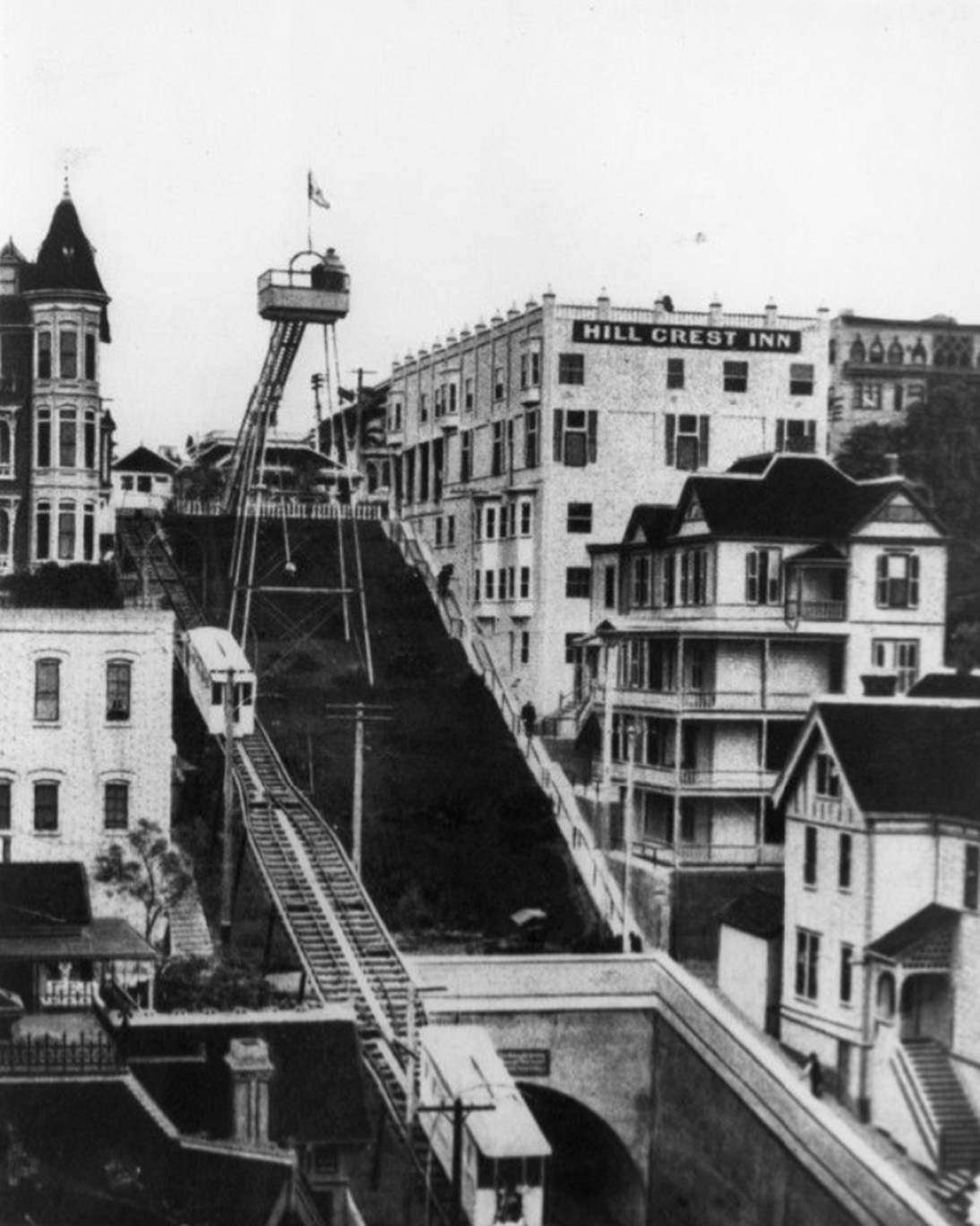
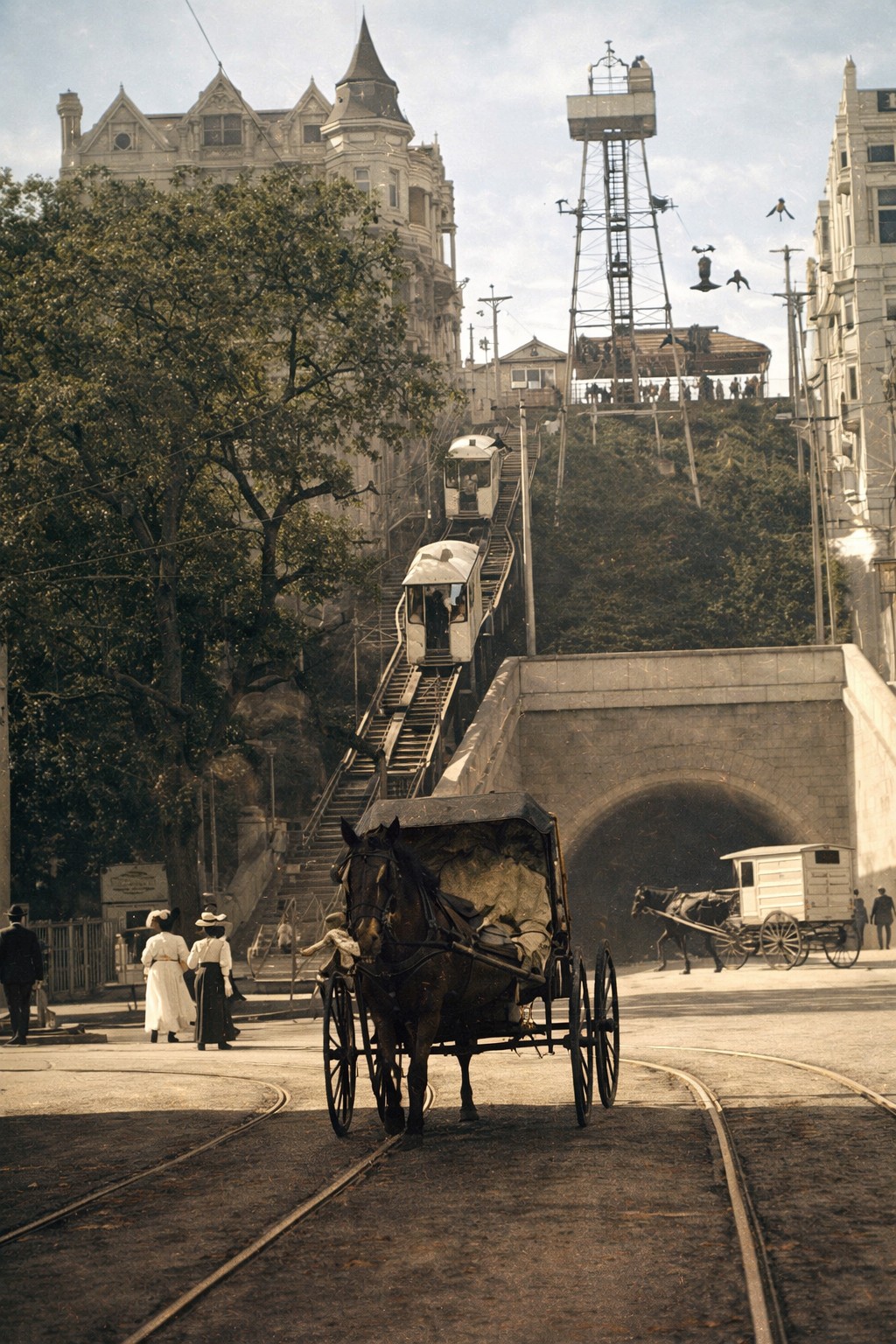
| (ca. 1907)* - Angels Flight - A view from a nearby roof shows 2 cars on the rail, houses, and Hill Crest Inn on the right side, the observation tower above in the middle, and the Third Street Tunnel below. There is a partial view of the Crocker Mansion on the left. |
| Historical Notes
When the construction on the Third Street tunnel began in 1900, Mrs. Crocker filed a petition claiming that the mansion was endangered by the street tunnel which was “unsafe, improperly constructed and a veritable death trap.” According to the Los Angeles Times, “the walls of her house are settling, the foundations giving way and the plaster is falling off…Unless something is done, the building is liable to topple into a hole.” The house never did topple and was alive and well in 1902 when Angels Flight began operating and dropping riders off practically on the Crocker doorstep. The Victorian building was razed in June 1908 and the cornerstone for the Elk’s Annex was laid the following September. |
 |
|
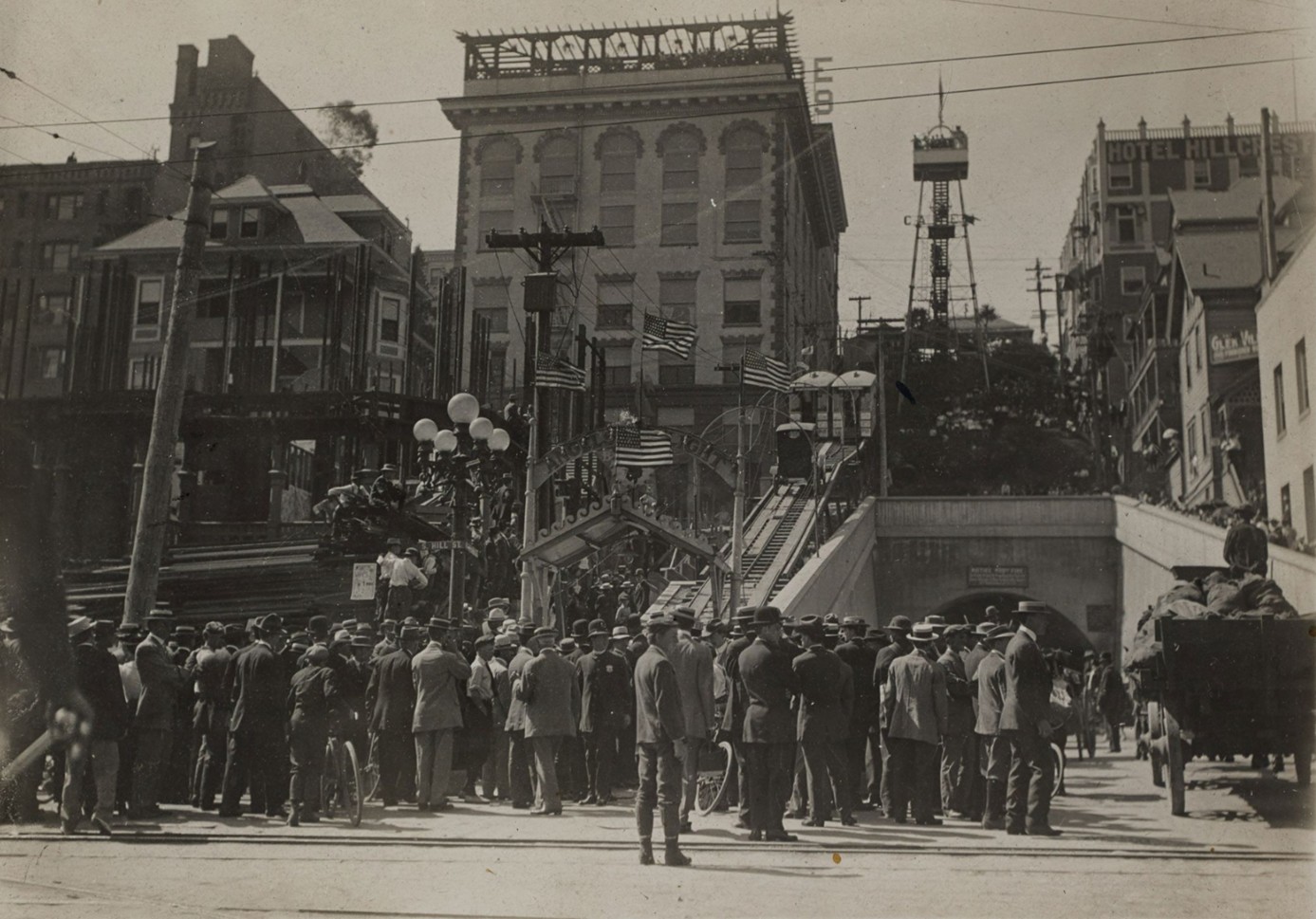
| (ca. 1907)* - Street scene at Hill and Third Streets in front of the newly constructed Angels Flight. Two cars are seen ascending and descending the incline while traffic enters the Third Street Tunnel in the distance. Photo enhancement by Jack Feldman. |
| Historical Notes
This image shows Angels Flight operating as part of a broader transportation system. Streetcars, wagons, pedestrians, and tunnel traffic converge at this intersection, while the incline carries foot traffic up the hill. The two counterbalanced cars move simultaneously, one rising as the other descends, a simple system that proved reliable and efficient. |
 |
|
| (1909)* - Image of a crowd of people gathered around the Angels Flight incline railway watching F.R. Pendelton send his Cartercar automobile up the incline on September 2, 1909. |
| Historical Notes
This well known event illustrates Angels Flight’s role as a public stage for spectacle. Crowds gathered to watch an automobile attempt the steep grade, highlighting the novelty of both the incline and early cars. The scene reflects how quickly Los Angeles embraced new technology and public demonstrations. |
 |
|
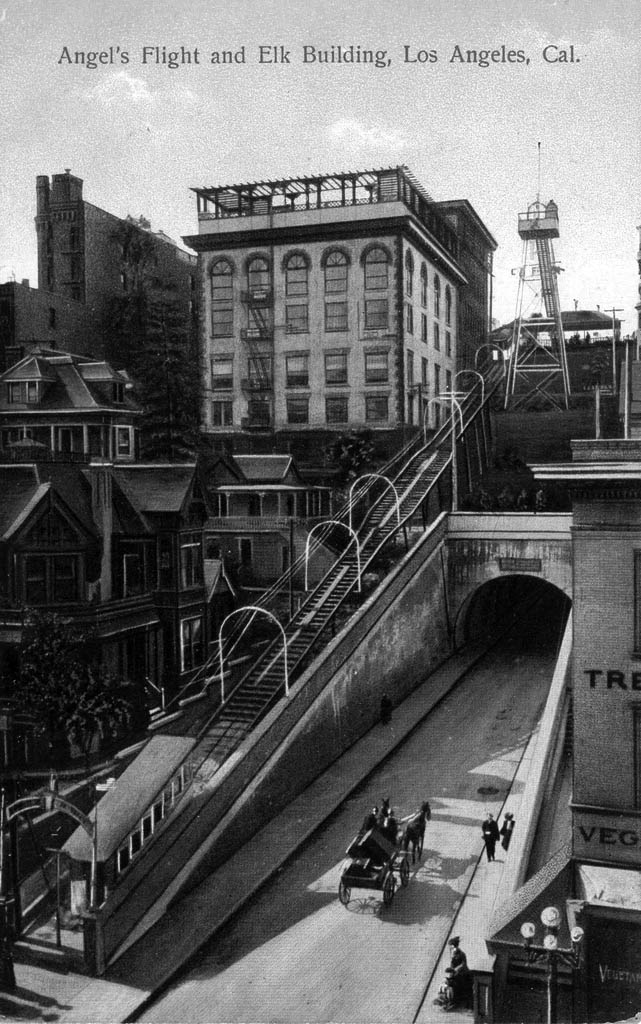
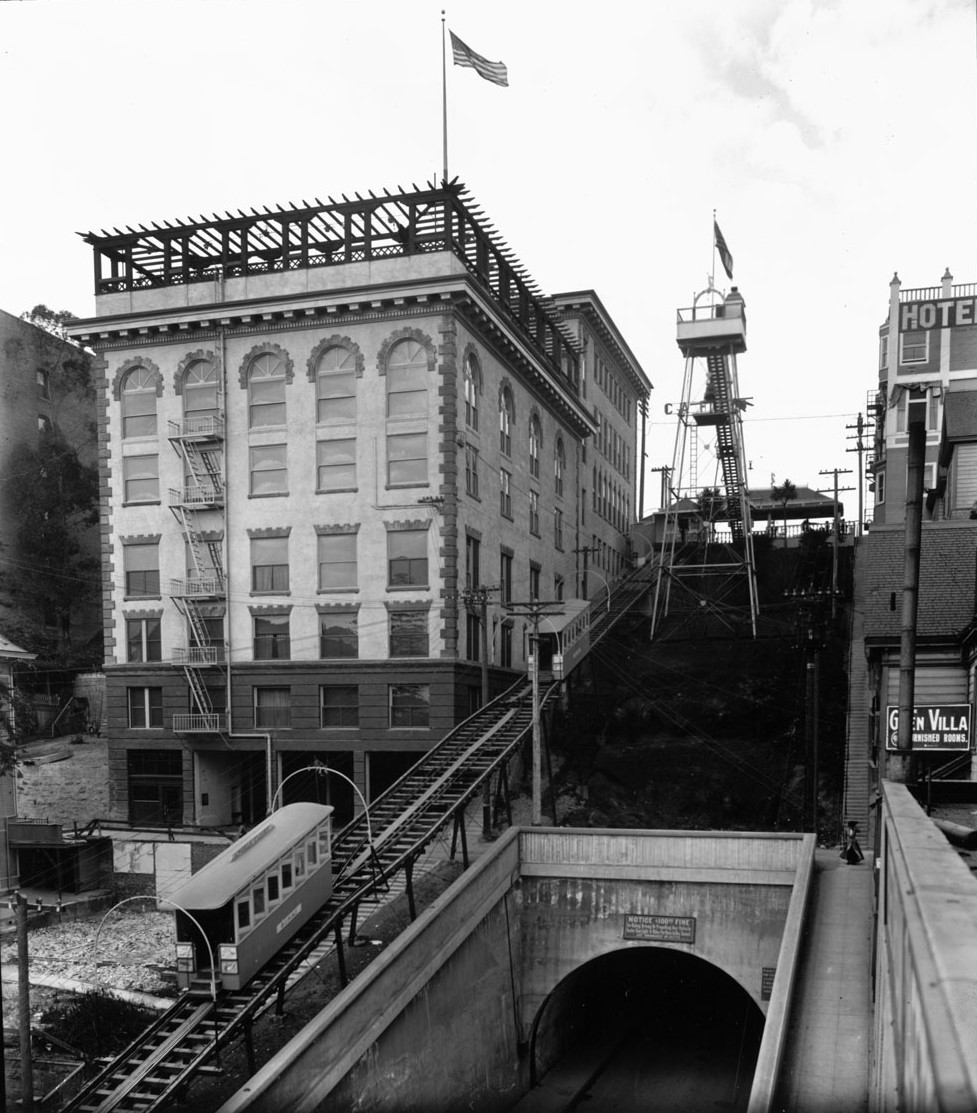
| (ca. 1910)* - Postcard view showing Angels Flight and the newly constructed Elks building near the top of the hill. A wagon approaches the Third Street Tunnel. |
| Historical Notes
By the early 1910s, large institutional buildings had begun to replace private mansions on Bunker Hill. The Elks building marked a shift in the hill’s character while maintaining its prominence. Angels Flight remained the most direct pedestrian link between these hilltop destinations and downtown streets. The Elks Lodge No. 99 building on Bunker Hill in Los Angeles has a rich history dating back to 1908-1910. Strategically located at the upper terminal of the Angels Flight funicular railway, it was built to host the 1909 national Elks gathering. The main building on Clay Street housed various facilities, including an auditorium and dormitories, while an annex on South Olive Street provided additional amenities. The Elks' presence was closely tied to Angels Flight, with the railway even incorporating the organization's initials into its lower arch. However, the Elks' time on Bunker Hill was brief; by 1925, they had moved to larger quarters near Westlake Park. The buildings were then taken over by the Loyal Order of Moose, reflecting the dynamic urban development of early 20th century Los Angeles. |
 |
|
| (ca. 1910)* - View of Angels Flight and the Third Street Tunnel with the Elks building now visible above. A woman walks down the stairway at right. |
| Historical Notes
This image shows three parallel routes through the same landscape. Vehicles pass through the tunnel, riders use the incline, and pedestrians descend the stairs. Together, these routes illustrate how transportation systems were layered to meet different needs. |
 |
|
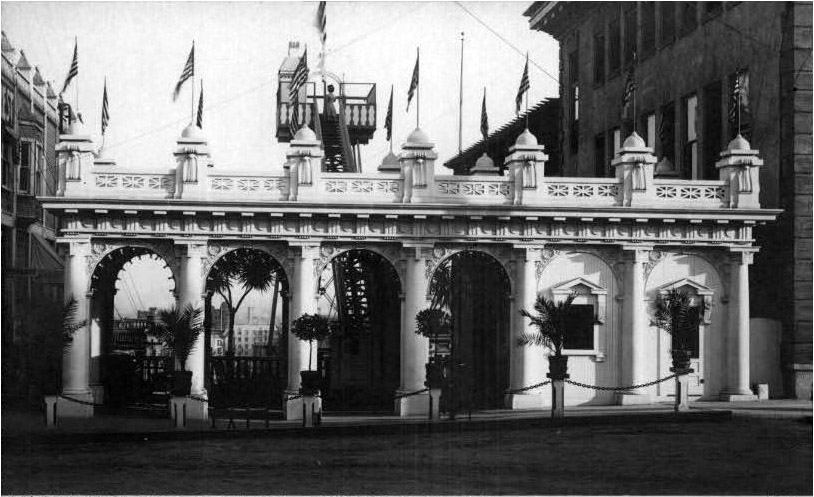
| (ca. 1910)* - View of Angels Flight’s upper terminal near Olive Street with the observation tower behind. |
| Historical Notes
Over time, Angels Flight received more substantial station structures. What began as a modest installation evolved into a recognizable landmark with defined terminals and supporting features. These improvements reinforced the railway’s role as a permanent part of the city’s infrastructure. |
 |
|
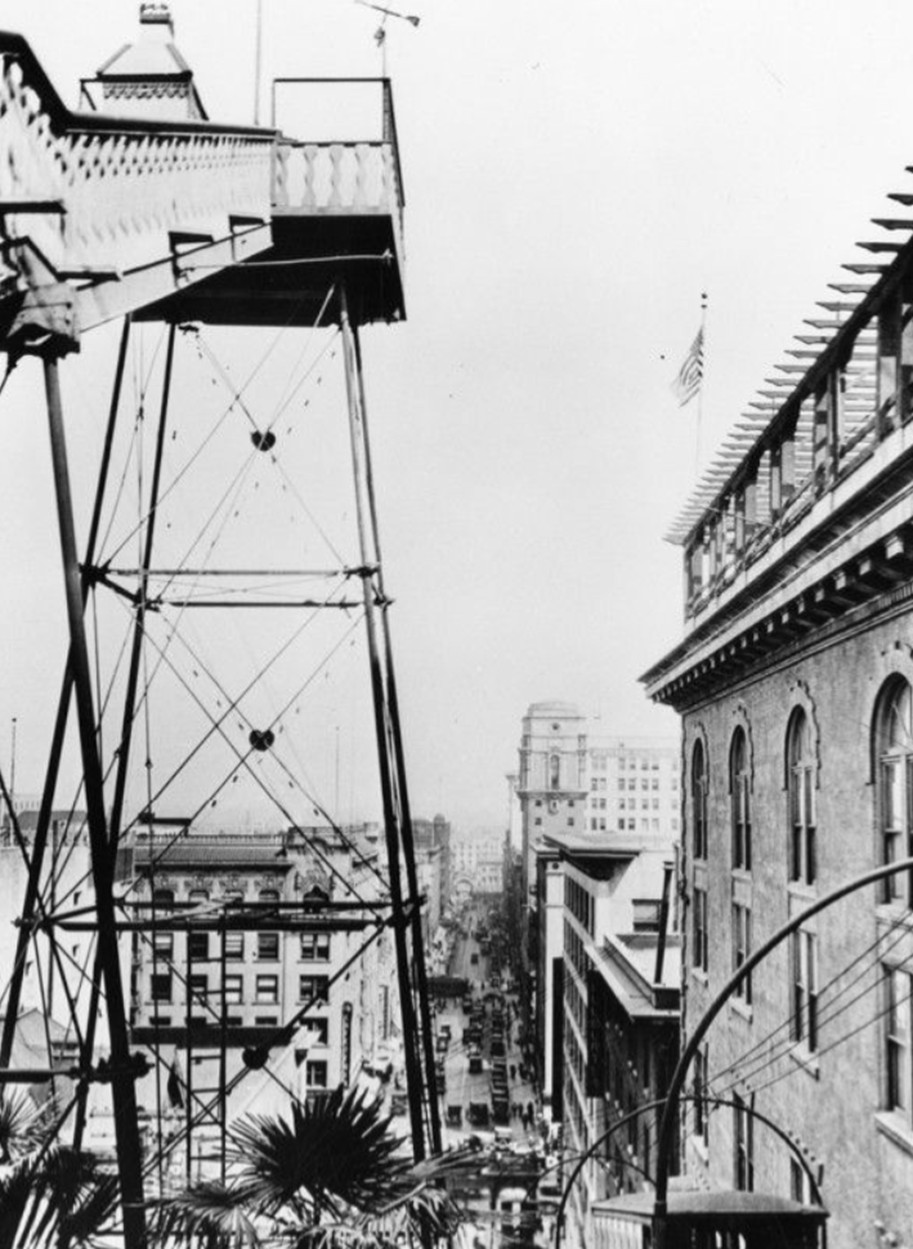
| (ca. 1910s)* - Standing at the top of Olive Street just under the observation tower, the cable car is descending on the right of the picture. |
| Historical Notes
From this vantage point, Third Street appears as a straight corridor into the commercial core. The incline shortened the daily journey for residents traveling between home and work. Increasing automobile traffic hints at the changes that would soon reshape downtown streets. |
 |
|
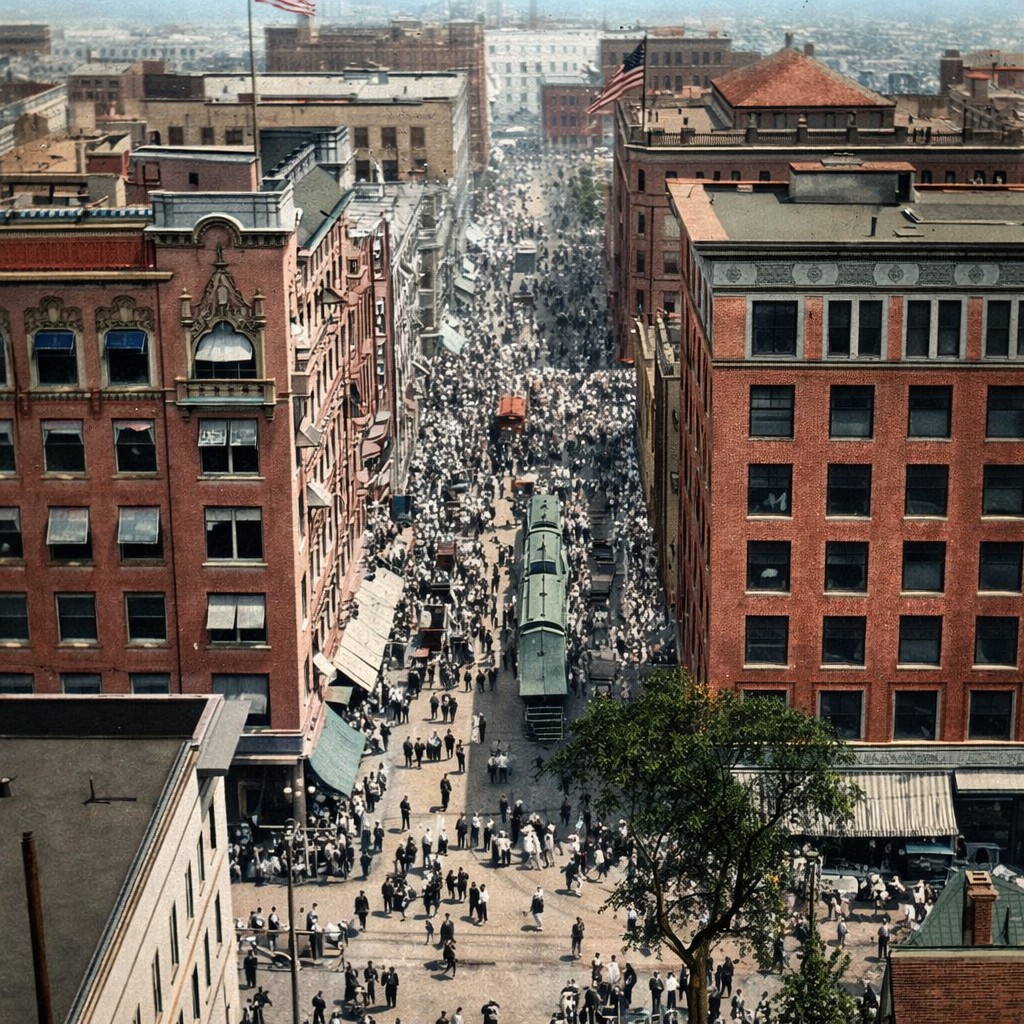
| (ca. 1910s)* – Postcard view looking east on Third Street from the observation tower with crowds filling the street. |
| Historical Notes
Large crowds often gathered at Hill and Third Streets for events, parades, and daily activity. The intersection served as a focal point where multiple transportation modes converged. The popularity of the observation tower reflects a time when downtown viewpoints were attractions in themselves. |
 |
|
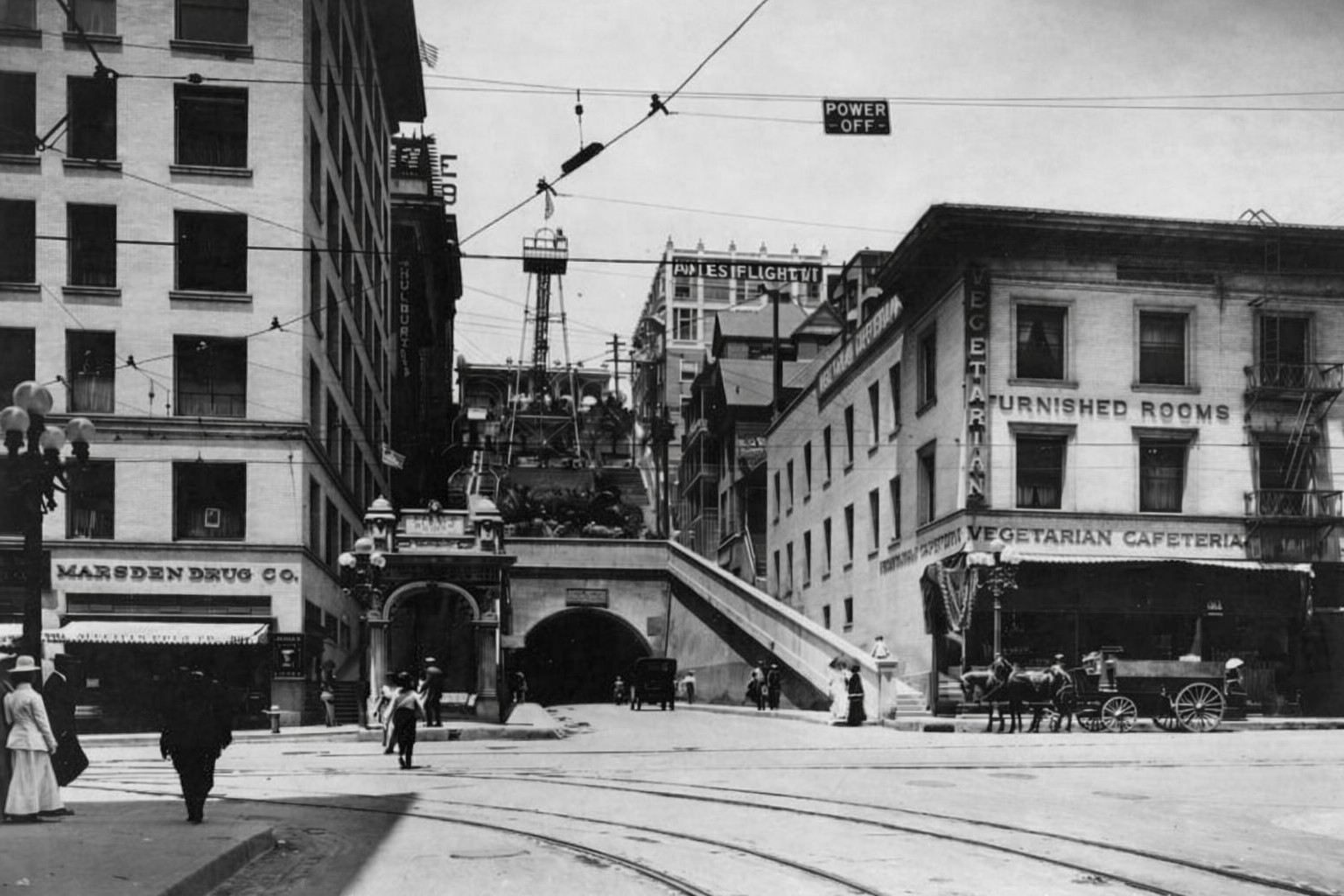
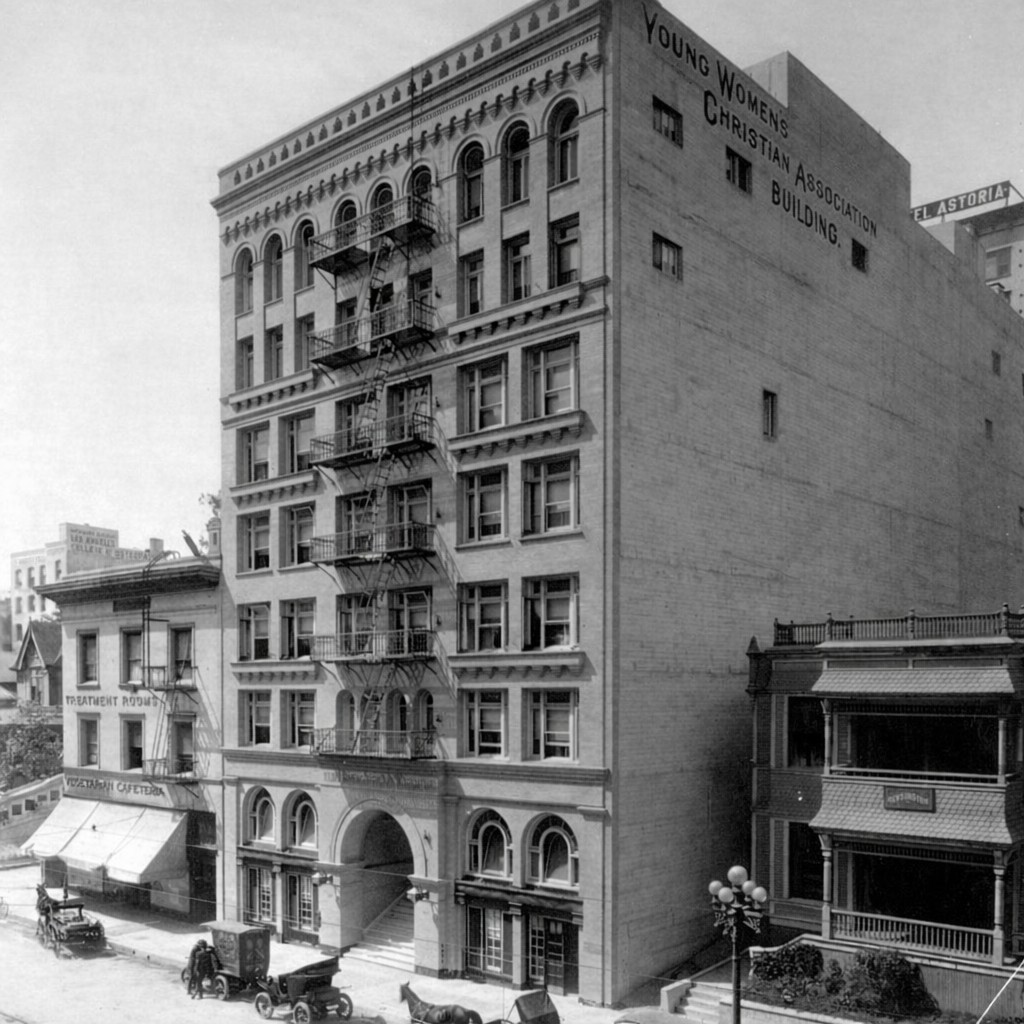
| (ca. 1907)* - Seen from directly across Hill Street are, from left to right, Marsden Drug Co., the arch for Angels Flight, 3rd Street Tunnel with observation tower at the top of the hill, Vegetarian Cafeteria with a horse-drawn wagon in front, and the YWCA Building with top floors visible. |
| Historical Notes
An archway labeled "Angels Flight" greeted passengers on the Hill Street entrance, and this name became the official name of the railway in 1912 when the Funding Company of California purchased the railway from its founders. |
 |
|
| (ca. 1907)^ - View of the west side of Hill Street showing the YWCA Building. Several horse-drawn wagons, early model cars and trucks are parked along the curb. The Third Street tunnel is just to the left of the 'Vegetarian Cafeteria'. Across Third Street can be seen one of the two Angels Flight cars stopped at the lower terminus. |
| Historical Notes
This scene highlights the overlap of transportation eras. Horse drawn vehicles and automobiles share curb space near streetcars and the incline. Angels Flight reduced congestion by lifting pedestrians off the street and up the hill in a short ride. |
 |
|
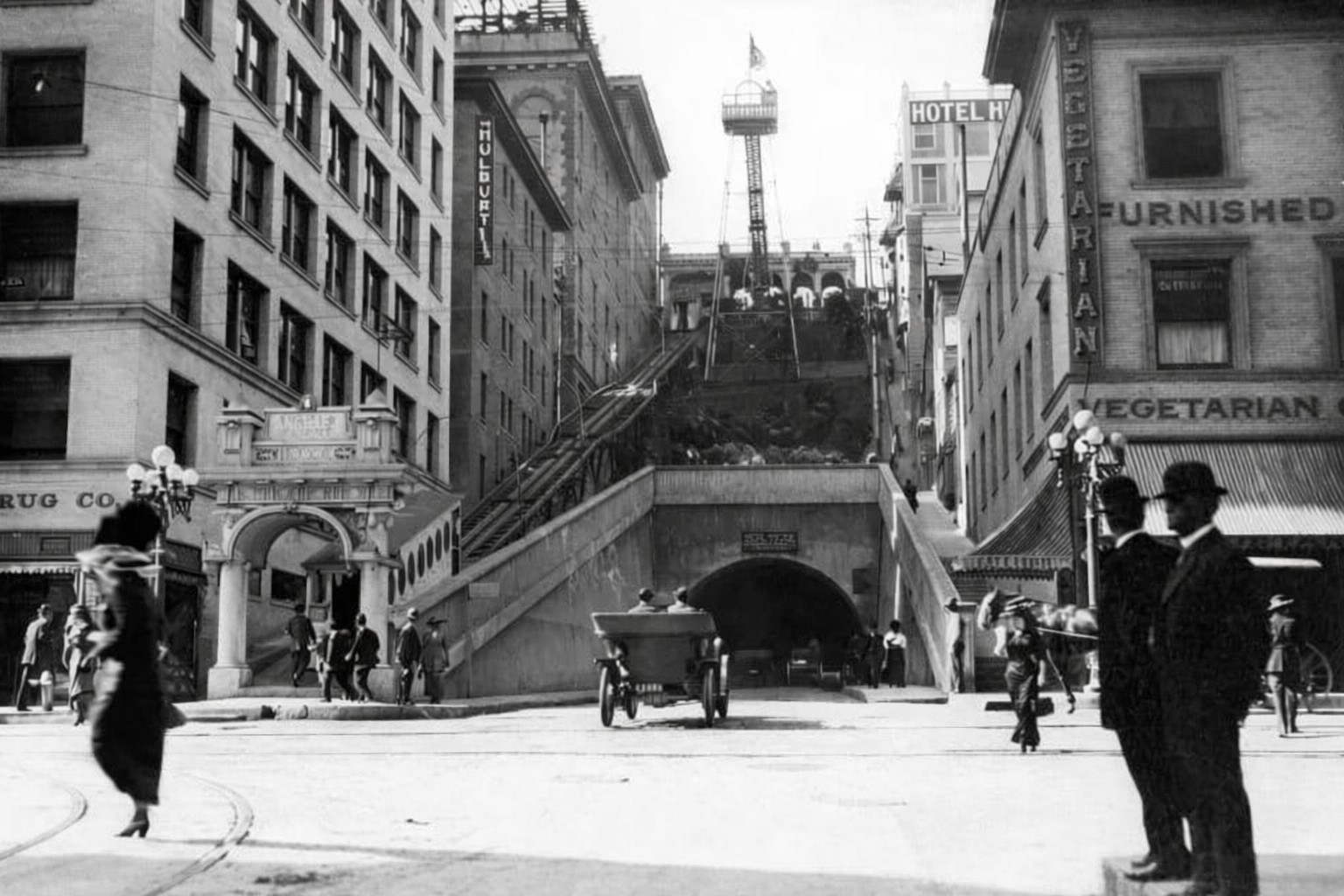
| (ca. 1910)* - View toward the Third Street Tunnel and Angels Flight from near the northeast corner of Third and Hill Streets. |
| Historical Notes
From this angle, the intersection reads as a gateway through and over Bunker Hill. The tunnel channels traffic beneath the hill while Angels Flight carries people upward. The repeated appearance of nearby storefronts helps anchor these views within the early downtown streetscape. |
Then and Now
 |
|
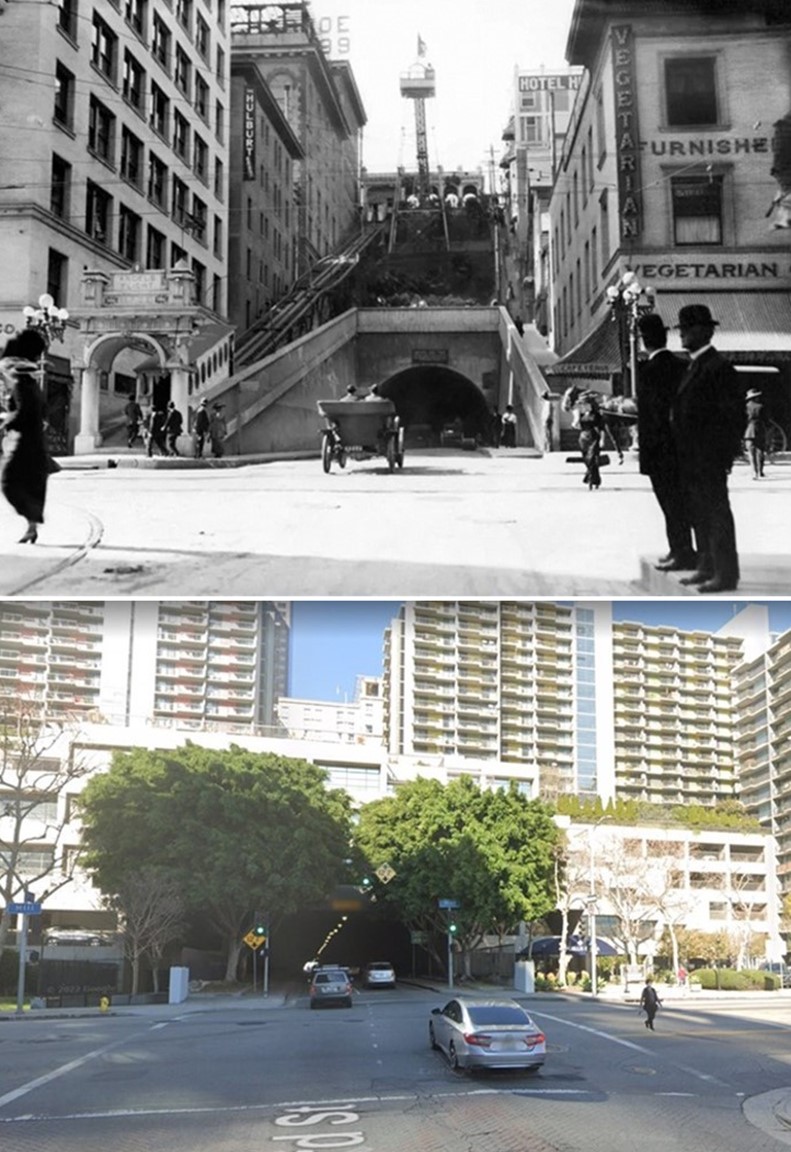
| (1910s vs. 2022)* - Looking west on Third Street at Hill Street showing the Third Street Tunnel and the original location of Angels Flight. Photo comparison by Jack Feldman. |
| Historical Notes
Angels Flight operated at this location from 1901 until 1969, when it was dismantled during the Bunker Hill redevelopment period. The cars were placed in storage and later rebuilt and reopened nearby in 1996. Although relocated, Angels Flight remains one of the clearest survivors of the old Bunker Hill circulation system. |
 |
|
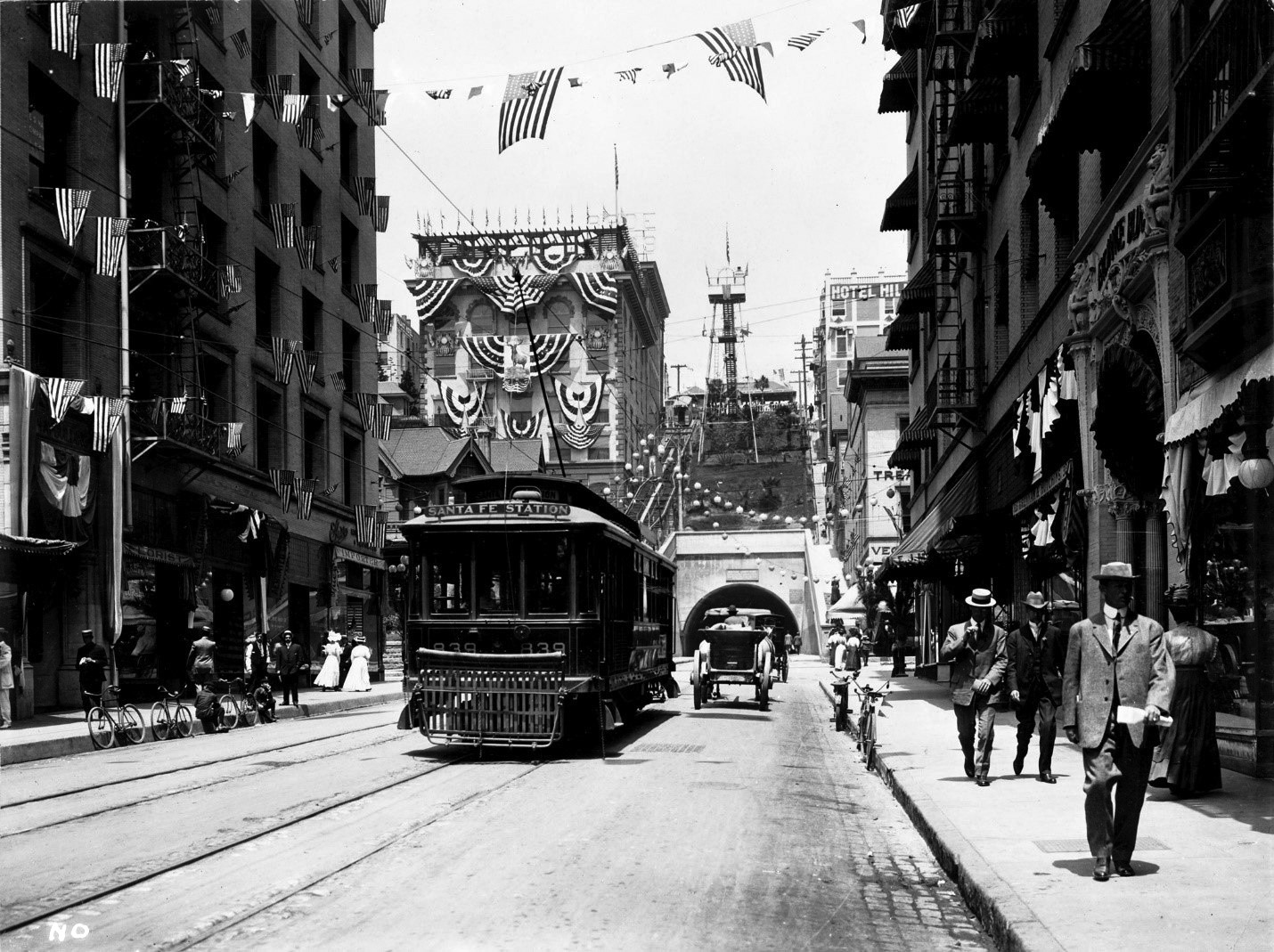
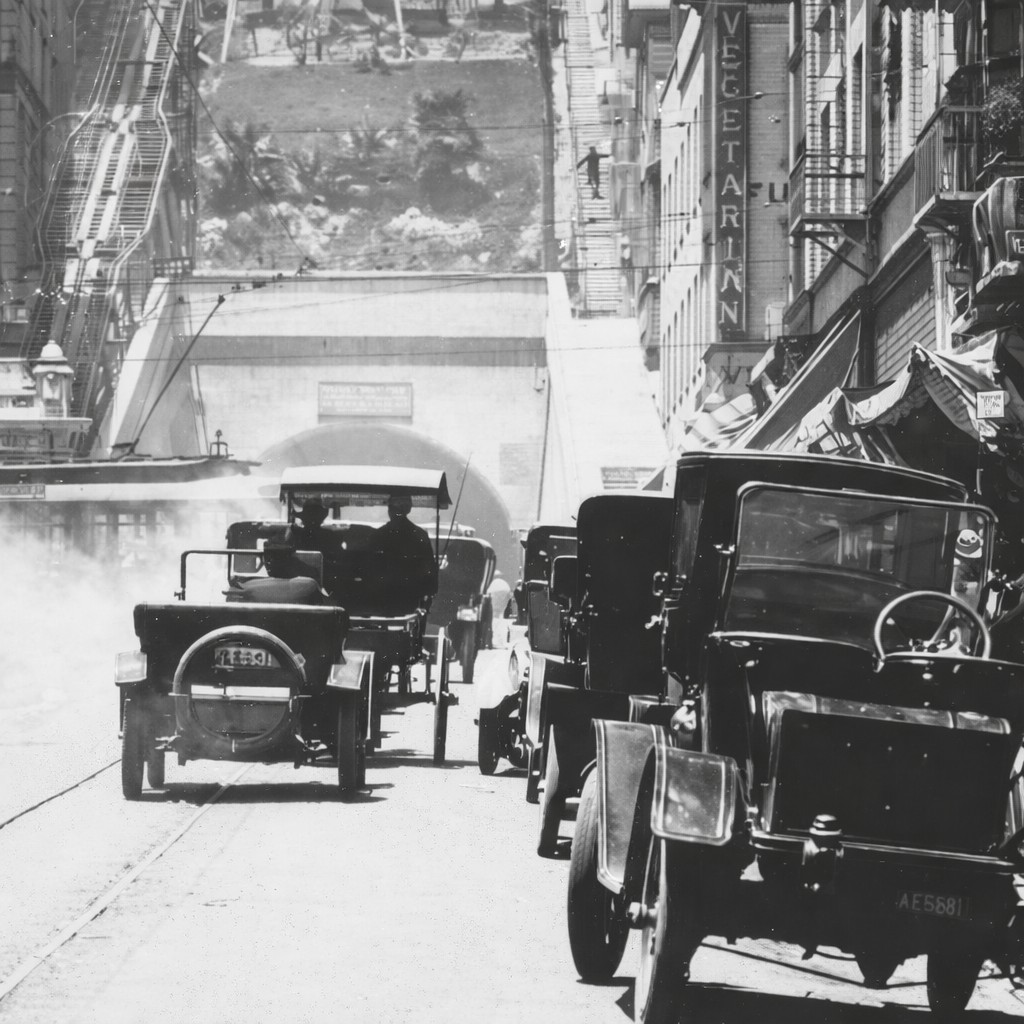
| (1910)* - View looking west toward the Third Street Tunnel and Angels Flight with streetcars, wagons, and early automobiles. Photo Martin Behrman |
| Historical Notes
Flags and banners suggest a civic celebration. The image captures downtown at a moment when multiple transportation modes shared the street. The tunnel and incline form the visual center of the scene, underscoring the importance of this intersection. |
 |
|
| (ca. 1910)* - Autos and a horse drawn carriage approach the Third Street Tunnel with Angels Flight visible above. |
| Historical Notes
This view reinforces the division of movement. Vehicles pass through the tunnel while pedestrians rely on Angels Flight to reach the hilltop. It reflects how the city adapted to growth within a constrained landscape. |
 |
|
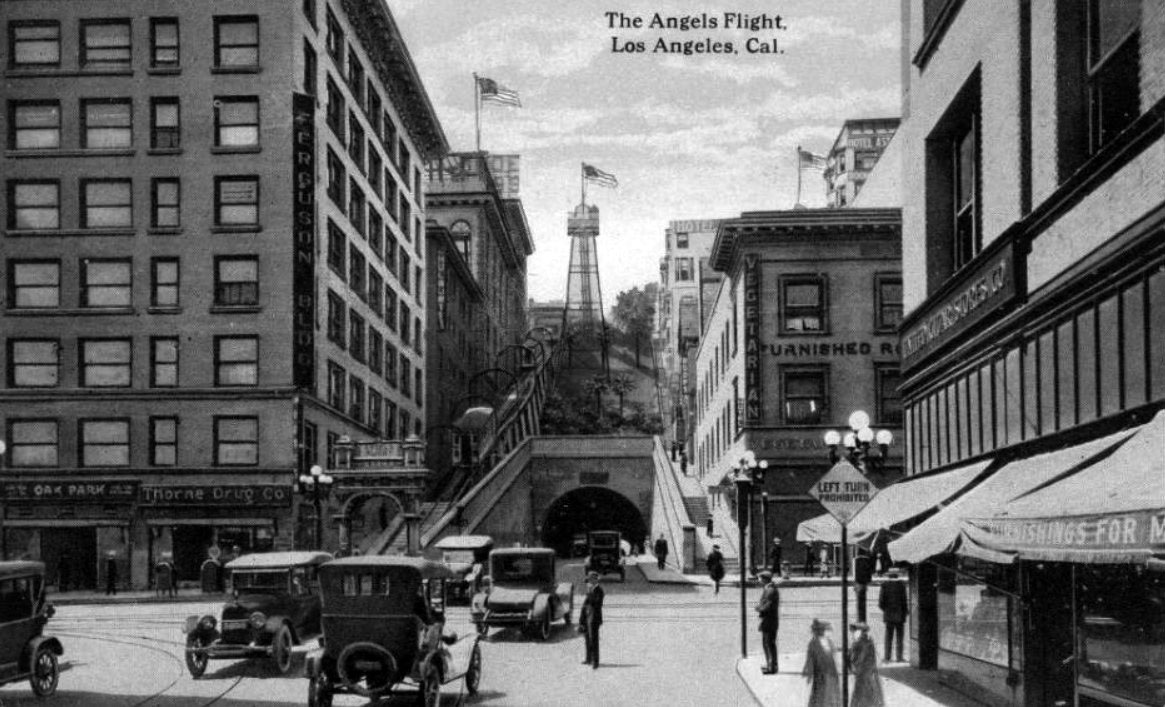
| (ca. 1913)* – Postcard view showing Angels Flight with traffic flowing in and out of the Third Street Tunnel. A sign reads “Left Turn Prohibited.” |
| Historical Notes
Traffic control signs reflect increasing congestion at Hill and Third Streets. Managing movement at this junction became essential as vehicles multiplied. Angels Flight helped reduce pressure by removing foot traffic from the steep climb. |
 |
|
| (ca. 1915)* – View showing a newspaper boy and traffic officer in the middle of the intersection at Third and Hill Streets. |
| Historical Notes
By the mid 1910s, traffic officers were needed to manage busy downtown intersections. Streetcars, wagons, automobiles, and pedestrians all converged here. Angels Flight remained a constant presence in the background of daily street life. |
 |
|
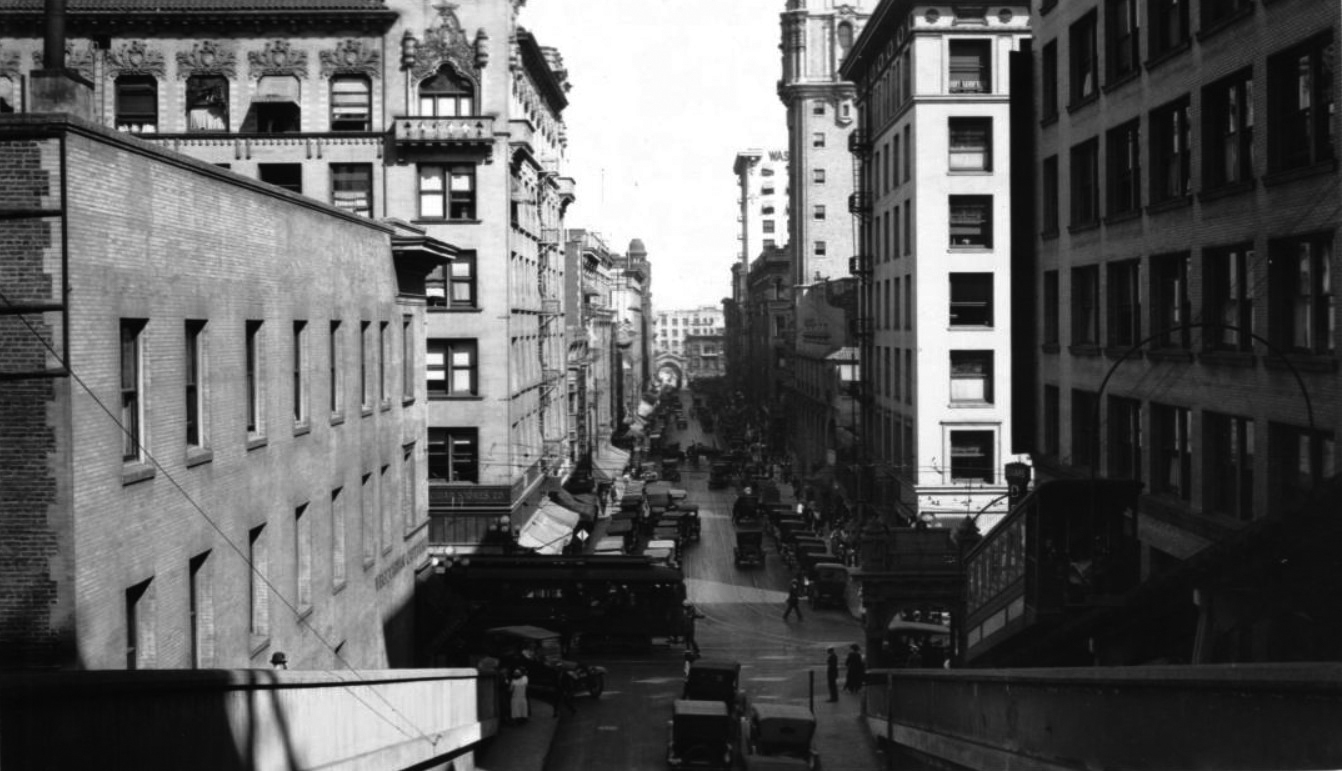
| (1919)* – View looking east toward Third and Hill Streets from near the stairway opposite Angels Flight. |
| Historical Notes
This later view shows the same elements still in place but with heavier traffic and a more developed streetscape. It underscores Angels Flight’s long period of steady service as a simple solution to a persistent topographic challenge. |
 |
|
| (1922)* – View looking east along Third Street from near the west portal of the Third Street Tunnel with Angels Flight on the right. |
| Historical Notes
By the early 1920s, Angels Flight had become a familiar and enduring feature of downtown Los Angeles. Its continued operation made it one of the few physical links between early Bunker Hill and the modern city that followed. Click HERE to see more early views of Angels Flight.Click HERE to see more early views of the Third Street Tunnel. |
* * * * * |
|
Other Sections of Interest |
|
Water and Power in Early LA |
|
Newest Additions |
New Search Index |

A new SEARCH INDEX has been added to help navigate through the thousands of topics and images found in our collection. Try it out for a test run.
Click HERE for Search Index |
* * * * * |
< Back